


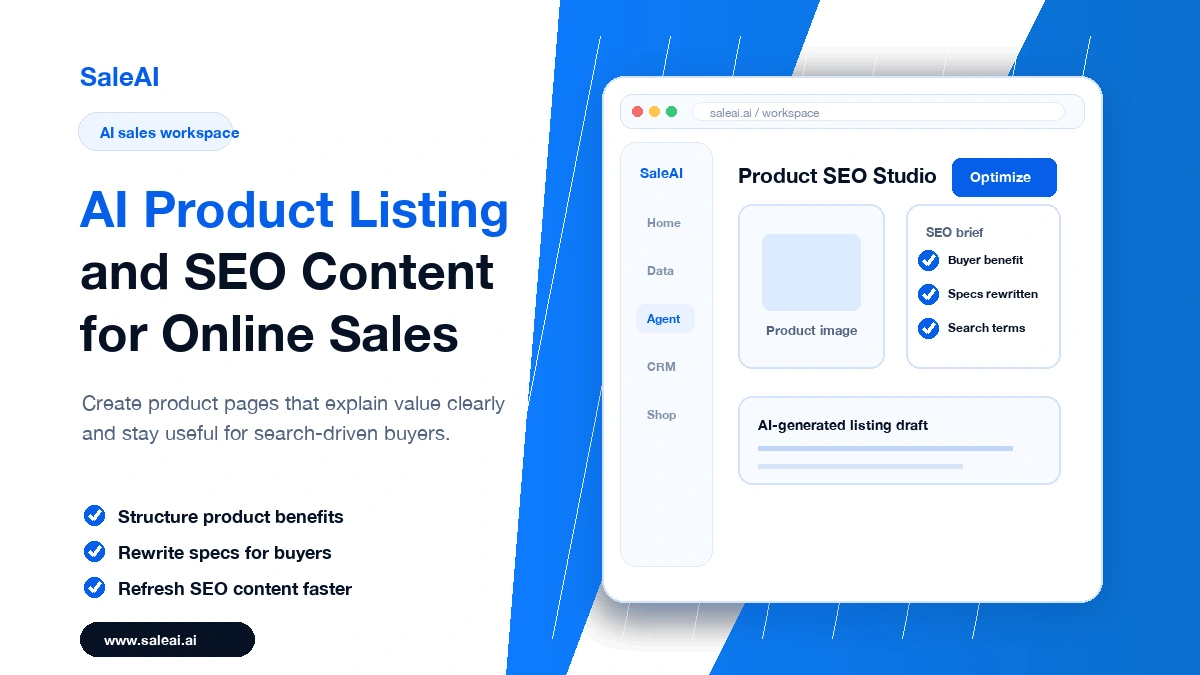
Online sales teams need more than attractive product pages. They need accurate descriptions, useful SEO content, consistent visuals, clear positioning, and a publishing workflow that can scale across many products and markets.
AI product listing and SEO content tools can help, especially when teams manage large catalogs or sell internationally. The key is to use AI for structure, consistency, and speed while keeping human review for accuracy and brand judgment.
SaleAI Shop is designed for this work. It helps generate product descriptions, visuals, SEO pages, and site content, while the broader SaleAI platform connects content with data, browser execution, and CRM follow-up.
Why Product Content Is Hard to Scale
Product content looks simple until a team needs to create hundreds of pages. Each listing needs:
- A clear product title
- Accurate specifications
- Benefit-focused descriptions
- Search-friendly headings
- Images or visual assets
- FAQs and usage information
- Market-specific language
- Consistent brand tone
When teams handle this manually, pages often become inconsistent. Some are too thin. Others repeat manufacturer copy. Many miss the search intent of the buyer.
How AI Helps Product Listing Workflows
AI can help turn raw product information into organized content. It can draft product descriptions, create comparison points, suggest SEO headings, prepare FAQ sections, and adapt copy for different buyer segments.
For online sales teams, this saves time and creates a stronger baseline. Instead of starting each listing from scratch, teams can review and improve an AI-generated draft.
What Makes Good AI Product Content
Good AI product content should be:
- Accurate: Product claims must match real specifications.
- Specific: The copy should explain who the product is for and why it matters.
- Search-friendly: Headings and descriptions should match buyer search intent.
- Easy to scan: Buyers should understand key details quickly.
- Consistent: The tone and structure should match the rest of the site.
- Actionable: The page should help the buyer compare, inquire, or purchase.
AI is most useful when it supports these standards instead of simply producing more text.
SEO Content Beyond Product Descriptions
Product listings are only one part of online sales SEO. Teams may also need:
- Category pages
- Buying guides
- Comparison pages
- Use-case articles
- FAQ content
- Landing pages for campaigns
- Blog posts that explain buyer problems
SaleAI Shop can support these content formats, helping teams create SEO pages and site content that connect product information with search demand.
Connecting Content With Execution
Creating content is only half the workflow. Teams still need to publish it, update pages, move text into CMS fields, and sometimes repeat the process across multiple platforms.
This is where SaleAI Agent adds value. It can help execute web actions such as filling forms, publishing information, or transferring content into online systems. When paired with SaleAI Shop, the workflow moves from content generation to completion.
Using Data to Improve Product Content
AI product content is stronger when it uses real market context. SaleAI Data supports company intelligence, social signals, domain insights, and trends. These inputs can help teams understand how buyers describe needs, what markets are active, and which product angles may deserve more attention.
This creates a better loop: use data to guide content, publish content, track customer interest, and improve future pages.
Example: Launching Products in a New Market
A company wants to introduce a product line to overseas buyers. The team needs English product descriptions, SEO pages, visuals, inquiry-focused copy, and follow-up materials for interested prospects.
With SaleAI, Shop helps generate product and SEO content. Data helps identify market and account signals. Agent helps with browser-based publishing tasks. CRM helps manage inquiries and follow-up.
The result is a more connected online sales workflow, not just a folder of AI-written copy.
Best Practices for AI Product Listing and SEO Content
To use AI effectively, teams should:
- Provide accurate product specifications.
- Review all claims before publishing.
- Keep the buyer's search intent in mind.
- Avoid copying the same wording across many pages.
- Add helpful FAQs and comparison details.
- Use consistent naming conventions and page structure.
- Connect content work with CRM follow-up.
Final Thoughts
AI product listing and SEO content tools can help online sales teams work faster and publish more consistently. The strongest results come when content generation is connected with data, execution, and customer management.
SaleAI supports that connected workflow through Shop, Data, Agent, and CRM, helping teams turn product information into sales-ready content and follow-up actions.
FAQ:
Q: Can AI write product descriptions for online sales? A: Yes. AI can draft product descriptions, headings, FAQs, and SEO content, but teams should review product claims and specifications before publishing.
Q: How does AI help SEO content for product pages? A: AI helps structure content around buyer search intent, create useful headings, expand thin descriptions, and prepare FAQ or comparison sections.
Q: What does SaleAI Shop do? A: SaleAI Shop helps generate product descriptions, visuals, SEO pages, and site content as part of the SaleAI growth platform.
