


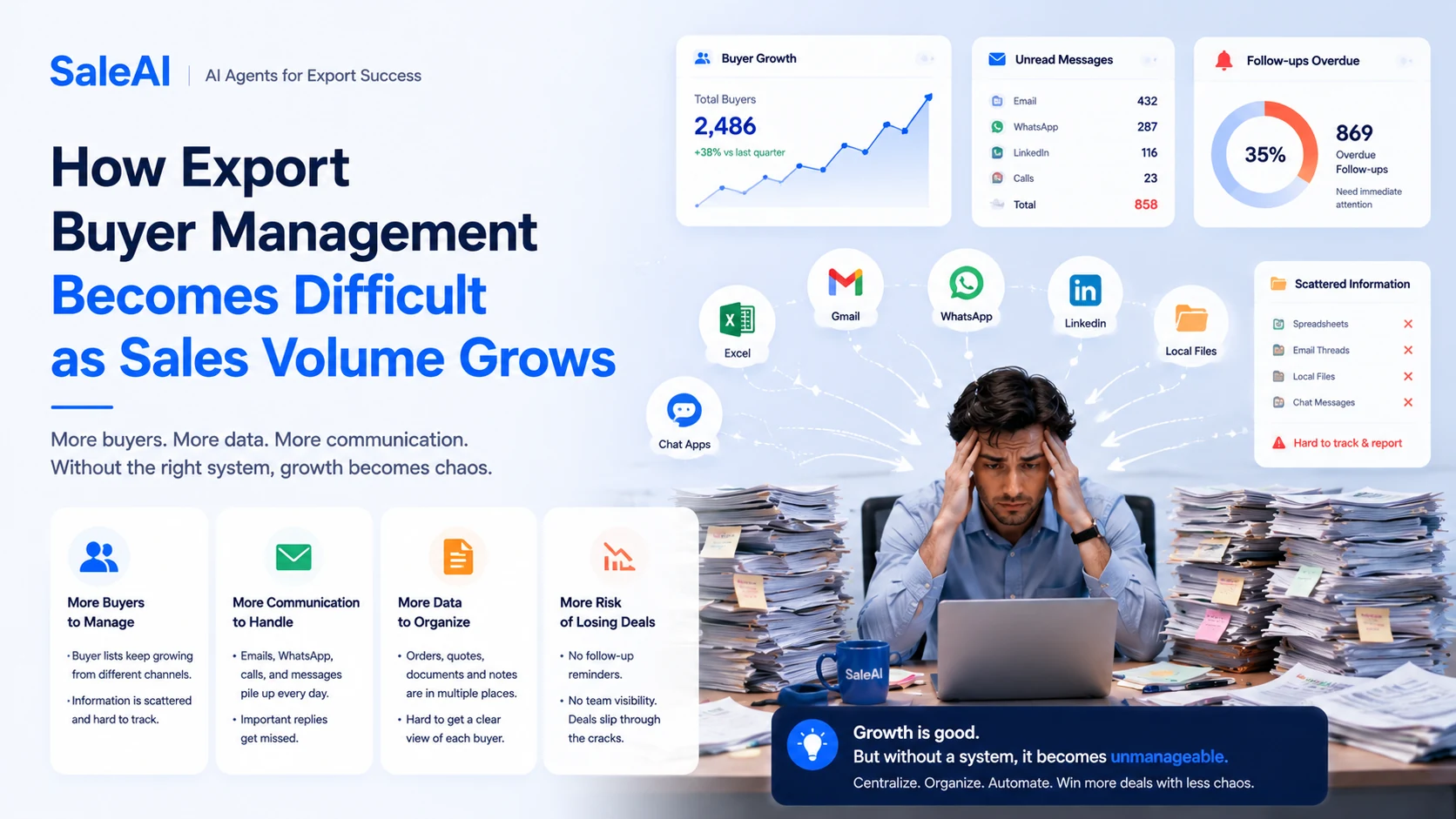
In the beginning, buyer management feels simple.
A few buyers.
A few quotations.
A few email threads.
Then export activity scales.
Suddenly:
- buyers contact multiple salespeople
- quotation versions become inconsistent
- RFQs disappear in inboxes
- nobody remembers the latest follow-up
- WhatsApp conversations replace documentation
This is when companies realize they are no longer managing buyers.
They are managing confusion.
A structured export buyer management workflow becomes necessary long before most teams expect it.
Why Buyer Management Is Different in Export Sales
Export sales involve more moving parts than many standard B2B workflows.
A single buyer relationship may include:
- RFQs
- revised quotations
- sample coordination
- payment discussions
- shipping terms
- certification requests
- multi-language communication
And unlike local sales, export cycles often last weeks or months.
Without visibility, buyer history becomes fragmented quickly.
The Hidden Problems Export Teams Usually Ignore
Most buyer management issues are not obvious at first.
They appear slowly.
| Problem | What Happens Later |
|---|---|
| Scattered communication | Buyer history becomes unclear |
| Duplicate outreach | Teams look unprofessional |
| Missing RFQ tracking | Opportunities disappear |
| Weak follow-up timing | Buyer interest drops |
| Multiple quote versions | Pricing confusion grows |
Many exporters think they need more leads.
Often, they first need better workflow control.
A Real Export Scenario
A distributor from Turkey asks for customized packaging.
The process begins normally:
- First quotation sent
- MOQ adjusted
- Sample requested
- Shipping discussion started
Then problems appear.
The buyer later asks:
“Can you resend the revised quotation?”
Nobody knows which version was last sent.
One salesperson checks email.
Another checks WhatsApp.
Someone else searches an old PDF folder.
Ten minutes become two hours.
This is not a sales problem.
It is a buyer management problem.
What Strong Buyer Management Actually Tracks
Good export buyer management should organize:
Buyer Identity
- company details
- region
- product category
- buyer role
RFQ Activity
- inquiry history
- requested products
- quotation stages
Communication Timeline
- email history
- WhatsApp discussions
- follow-up timing
Commercial Progress
- pricing revisions
- sample status
- negotiation stage
Without these layers connected together, workflows become dependent on memory.
Why Follow-Up Is Usually the Weakest Area
Many export teams follow up inconsistently because:
- reminders are manual
- RFQs are not centralized
- buyers exist across multiple channels
- nobody owns the timeline clearly
This creates communication gaps that quietly reduce conversion rates.
A strong workflow keeps:
- timing visible
- ownership clear
- buyer status updated
How AI Changes Buyer Management
AI systems help exporters:
- summarize buyer conversations
- track quotation stages
- identify inactive opportunities
- organize follow-up sequences
- prioritize active buyers
Instead of manually rebuilding buyer context each time, teams maintain continuity across longer export cycles.
The value of AI is not only automation.
It is operational clarity.
How SaleAI Supports Buyer Management
SaleAI connects:
- buyer profiles
- RFQs
- quotations
- follow-ups
- outreach workflows
inside one export-focused system.
Teams can quickly understand:
- where each buyer stands
- which quotations are active
- which conversations require follow-up
- which opportunities deserve priority
A scalable export buyer management system is not just about storing contacts.
It is about maintaining visibility across the full export relationship lifecycle.
One Simple Test
If a buyer replies today and your team cannot answer these questions immediately:
❌ What did we quote last time?
❌ Who followed up recently?
❌ What stage is the RFQ in?
❌ Did we already revise pricing?
❌ Is the sample already shipped?
…then the issue is probably not sales performance.
It is workflow visibility.
