


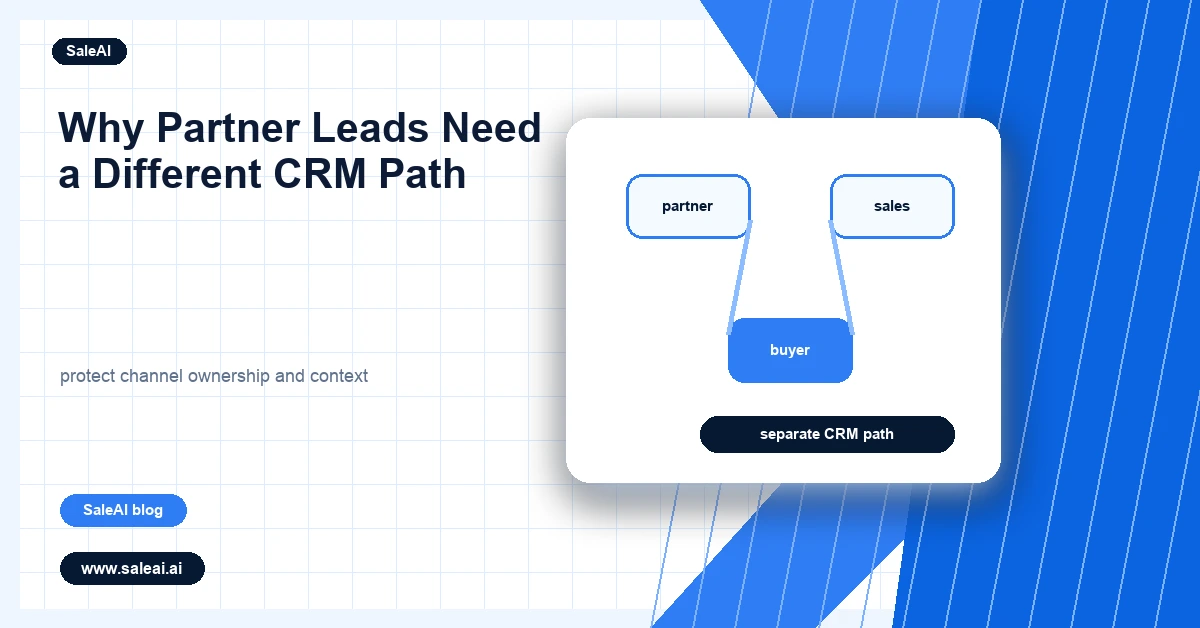
For many B2B teams, partner lead management becomes important only after the easy fixes stop working. A good partner lead management review turns unclear movement into a practical owner decision. The important question is whether the partner conversation is moving a real opportunity or only creating another channel handoff.
Teams often rely on scattered messages and personal memory, which creates slow follow-up and channel conflict. A small partner process is enough at first: classify the inquiry, confirm ownership, and track whether the next action happened.
Where partner context changes the answer for partner lead management
Partner conversations move across markets, languages, price expectations, territory rules, and shared account ownership. That is why partner lead management should be treated as an operating habit, not a one-time campaign idea.
The important question is whether the partner conversation is moving a real opportunity or only creating another channel handoff. The risk is promising too much before checking channel overlap, existing account history, or product fit.
For SaleAI users, outside research is most useful when it sharpens the operating decision behind partner lead management. External research is useful for partner lead management because the buyer rarely moves from first interest to decision in one clean step. B2B buying research reinforces why partner lead management needs context preserved across several touches.
Which partner records deserve attention: partner lead management
This topic fits channel managers, export sales leaders, and distributor teams. The partner lead management review should reduce noise before it reaches the sales calendar.
Use SaleAI to connect the partner lead management signal with the account record, owner, and next action. When partner lead management creates motion without judgment, tighten the criteria before adding more automation.
- Use partner lead management when the team needs clearer priority, not just more activity.
- SaleAI supports partner lead management by making scattered account information easier to use during follow-up.
- Scale partner lead management after reps can show how the process changed timing, routing, or message quality.
How to keep the channel conversation clean for partner lead management
A practical process starts with the record that triggers attention. A small partner process is enough at first: classify the inquiry, confirm ownership, and track whether the next action happened.
For partner lead management, the first pass should stay simple. When partner lead management creates activity but not stronger replies, reduce the use case and revisit who owns the next step.
| partner lead management field | Question to answer | Sales decision |
|---|---|---|
| Partner fit | Is this signal specific enough to act on? | Review partner lead management route |
| Territory | Does the partner lead management record show fit, timing, and enough buyer context? | Prioritize partner lead management |
| Product interest | Which owner is best placed to handle this partner lead management follow-up? | Assign partner lead management owner |
| Last conversation | Which offer, question, or proof point fits the partner lead management situation? | Send content, ask a question, or prepare a quote |
What to check before responding for partner lead management
A distributor asks for exclusivity while another partner is already active in the same region. The team needs account history before promising anything. This is where review discipline matters. A review is useful only when partner lead management priorities become clearer after the team reads the record.
| partner lead management review area | What it means | How the team should use it |
|---|---|---|
| Buyer context | partner conversations move across markets, languages, price expectations, territory rules, and shared account ownership | Use it to decide whether the account deserves action now. |
| partner lead management signal | A distributor asks for exclusivity while another partner is already active in the same region. The team needs account history before promising anything. | Separate useful movement from background noise. |
| Channel owner | A partner-related record should show who owns the partner, the end account, and the next commitment. | Reduces duplicated promises and channel confusion. |
| Outcome | Reply, meeting, quote movement, disqualification, or nurture. | Shows whether the process improved real sales work. |
The workflow should guide judgment, not replace it. If no one can name the partner lead management signal that changed action, the workflow needs sharper criteria.
Where SaleAI helps partner teams for partner lead management
SaleAI is most helpful when the team needs buyer data, CRM context, AI support, and sales content to work together. Use SaleAI to connect what the partner lead management buyer did with what the sales team should do next.
For partner lead management, that means the platform should support practical work: identify the signal, connect it to the right account, suggest the next step, preserve notes, and make the manager review easier. The goal is not to replace judgment. SaleAI can help preserve the partner lead management account story while the team tests the workflow.
External research is useful for partner lead management because the buyer rarely moves from first interest to decision in one clean step. partner lead management matters because digital signals, remote conversations, and human follow-up often appear at different moments in the same buying journey. Research on B2B buying supports the need to connect partner lead management signals across channels.
Channel risks to avoid: partner lead management
The biggest risk is treating partner lead management as a label instead of a decision process. When partner lead management creates motion without judgment, tighten the criteria before adding more automation.
Automated tasks are valuable when they preserve context. If partner lead management output feels generic, adjust the qualification rule before adding more automation.
- Do not promise territory terms before checking partner overlap.
- Avoid giving different answers to partners in the same market.
- Keep end-account context attached to the partner conversation.
- Escalate conflicts before the next commercial promise is made.
How to judge partner pipeline quality for partner lead management
Partner quality should show up in faster handoffs, fewer territory conflicts, clearer distributor actions, and stronger partner-sourced opportunities.
| partner lead management approach | Use it when | Watch out for |
|---|---|---|
| Manual review | Small volume, simple account list, one sales owner | Slow once channels, regions, or product lines multiply |
| Basic CRM fields | Teams that need ownership and task control | Fields become stale when buyer signals are not connected |
| SaleAI-supported workflow | Teams that need data, CRM, AI assistance, and content context together | Requires clear rules so automation supports judgment |
Active partner opportunities should be reviewed weekly; broader channel coverage can be checked monthly. Use partner lead management to make priority visible instead of relying on whoever speaks first in a meeting.
If partner lead management does not improve buyer conversations, reduce the fields and tighten the trigger before expanding it.
What the first pilot should prove for partner lead management
Start with one region or partner tier so the team can refine ownership rules before scaling. Use SaleAI to connect the partner lead management signal with the account record, owner, and next action.
Once the team has enough examples, compare the workflow output with real sales outcomes. Roll out partner lead management more widely once reps can use it without turning it into a generic task list.
What to confirm before scaling for partner lead management
One useful way to test the partner process is to review a recent distributor conversation and ask what the internal team knew before replying. The team should also check whether the partner needs a sales enablement asset, a pricing answer, or a channel decision. Those are different actions and should not be handled with the same message.
If several partners touch similar accounts, add a short conflict note before outreach. This prevents duplicated promises and gives managers a clearer view of channel risk. For partner lead management, review whether the partner record includes territory, account stage, product interest, and the last agreed action. If any of those are missing, the next reply may create confusion even when the team moves quickly.
How to avoid adding process without progress for partner lead management
One useful way to test the partner process is to review a recent distributor conversation and ask what the internal team knew before replying. The team should also check whether the partner needs a sales enablement asset, a pricing answer, or a channel decision. Those are different actions and should not be handled with the same message.
If several partners touch similar accounts, add a short conflict note before outreach. This prevents duplicated promises and gives managers a clearer view of channel risk. For partner lead management, review whether the partner record includes territory, account stage, product interest, and the last agreed action. If any of those are missing, the next reply may create confusion even when the team moves quickly.
FAQ
What is partner lead management?
partner lead management is a sales workflow topic that helps B2B teams connect buyer context with a clearer next action.
Who should care about partner lead management?
It is most useful for channel managers, export sales leaders, and distributor teams, especially when partner conversations move across markets, languages, price expectations, territory rules, and shared account ownership.
What problem does it solve?
It helps the team manage partner context, channel ownership, and account movement without relying on private memory.
How does SaleAI help?
SaleAI helps connect partner records, account signals, CRM notes, and follow-up tasks so channel work stays visible.
What data should be captured first?
Start with Partner fit, Territory, Product interest, Last conversation, then add owner and outcome fields once the workflow is stable.
How often should managers review it?
Active partner opportunities should be reviewed weekly; broader channel coverage can be checked monthly.
What is a common mistake?
Teams often rely on scattered messages and personal memory, which creates slow follow-up and channel conflict.
How should the first pilot be scoped?
Start with one region or partner tier so the team can refine ownership rules before scaling.
What should success look like?
Success should look like a cleaner partner pipeline, clearer ownership, and fewer duplicated conversations, not just more activity in the CRM.
When should the workflow be changed?
Change partner lead management when the fields stop helping reps decide what to do.
