


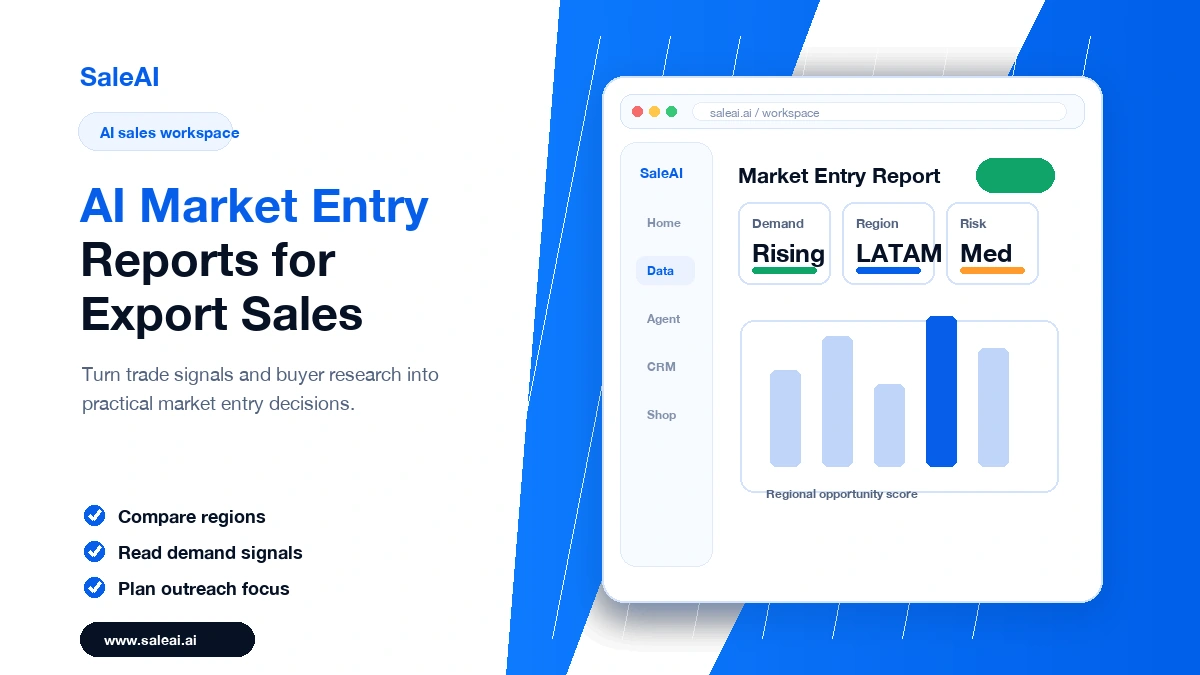
AI market entry reports should help a sales team make a decision. Too many market reports collect information without changing the next campaign. Export teams need something more practical: which region looks worth testing, which buyer segment is reachable, and what first message should be used.
SaleAI Data can help organize market and company signals, but the report still needs a sales point of view. A market that looks attractive in theory may be difficult to enter if contact paths are weak or buyer expectations are unclear.
Begin with the decision, not the data
Before building AI market entry reports, write the decisions the report must support. Should the team test Europe or Latin America first? Should it focus on distributors or manufacturers? Is the product angle price, reliability, customization, or speed?
This prevents the report from becoming a collection of interesting but unused facts.
What the report should include
- Region and buyer segment summary
- Visible demand signals
- Account accessibility
- Product positioning notes
- Risks and unanswered questions
- First outreach test
Each section should end with an implication. If demand is rising, what should the team do? If access is weak, what research step comes next?
Use AI to compare signals
AI can group buyer accounts, summarize public information, and compare regions. It can also help identify patterns that a rep might miss during manual research. But AI market entry reports still need validation from sales conversations and local market feedback.
Turn the report into a campaign
A report becomes valuable when it creates action. Build the account list, prepare the outreach angle, assign owners, and record follow-up rules in SaleAI CRM. If research requires repeated website checks, SaleAI Agent can support the browser work.
The first campaign should feed the second report. Replies, objections, product questions, and silence all teach the team something. That learning loop is what makes AI market entry reports more useful than a static research document.
Use a 90-day test instead of a final verdict
AI market entry reports should not pretend to remove all uncertainty. Export sales always includes unknowns: buyer behavior, local expectations, pricing pressure, channel structure, and response timing. A better report recommends a 90-day test rather than a permanent decision.
The test should define the target segment, the account list, the outreach angle, the product focus, and the review metric. For example, a team may test distributors in one region with a message focused on customization and lead time. The goal is to learn quickly without overcommitting resources.
What to review after the test
After the campaign, review reply quality, objections, common product questions, contact accuracy, and follow-up completion. A market with fewer replies but stronger buyer fit may be more promising than a market with many low-quality responses.
This feedback should update the next report. If buyers ask about certification, add it to the next content plan. If they respond to delivery reliability, adjust the message angle. If contact paths are weak, improve research before the next campaign.
In this sense, AI market entry reports are not static documents. They are part of a sales learning cycle that connects research, outreach, and CRM outcomes.
How to turn a report into a sales decision
A market report has little value if it stops at broad statements such as demand is growing. Export teams need sharper answers: which buyer groups are active, what price level appears realistic, which channels create trust, what certifications are expected, and which competitors are already visible in the market.
SaleAI supports AI market entry reports by combining research signals with practical sales workflows. Instead of treating the report as a static document, teams can use it to shape account lists, outreach angles, product-page updates, and CRM priorities for the first ninety days of market testing.
A useful first ninety days
- Choose one narrow buyer segment instead of chasing the whole market.
- Build a short list of target accounts and compare their sourcing signals.
- Prepare localized proof points before launching outreach.
- Review replies weekly and adjust the market hypothesis quickly.
