


A factory sends 3,000 cold emails.
Only six buyers reply.
Two ask for pricing.
One disappears after the quotation.
This is the reality many exporters face.
The issue is usually not email volume.
It is lead quality and workflow structure.
Strong export lead generation is not about collecting the biggest contact list.
It is about identifying buyers that are actually worth contacting.
Why Most Export Lead Generation Fails
Many exporters still use:
- outdated buyer databases
- scraped email lists
- generic outreach templates
- mass email blasts
This creates three major problems:
| Problem | Result |
|---|---|
| Poor buyer targeting | Low reply rates |
| Weak personalization | Buyers ignore emails |
| No follow-up workflow | Lost opportunities |
More leads do not automatically create more export sales.
What a Good Export Lead Actually Looks Like
A useful export lead usually shows several signals together.
For example:
- imports relevant product categories
- operates in your target market
- has active procurement behavior
- matches your MOQ range
- fits your pricing level
- has reachable contacts
Without qualification, large lead lists become expensive distractions.
The 4-Step Lead Generation Workflow Used by Better Exporters
Step 1 — Find Active Buyers
Good exporters search for:
- recent importers
- distributors
- wholesalers
- sourcing companies
instead of random business directories.
Trade data and Google research are usually more useful than generic databases.
Step 2 — Qualify Before Outreach
Before sending emails, they check:
- company website
- product match
- market focus
- certifications
- sourcing activity
This prevents irrelevant outreach.
Step 3 — Send Focused Outreach
Instead of introducing the entire factory, they focus on:
- one product category
- one buyer problem
- one relevant advantage
This creates clearer positioning.
Step 4 — Follow Up Consistently
Most export deals happen after:
- second contact
- revised quotation
- sample discussion
- shipping clarification
A lead generation system without follow-up is incomplete.
Why AI Is Changing Export Prospecting
As buyer databases become larger, manual prospecting becomes harder to manage.
AI tools help exporters:
- filter buyer relevance
- organize importer data
- detect sourcing signals
- generate outreach drafts
- prioritize follow-up timing
The goal of modern export lead generation is not automation alone.
It is smarter qualification.
What Exporters Often Get Wrong About Leads
Many suppliers focus only on:
- quantity
- open rates
- contact volume
But experienced exporters know:
- 50 qualified buyers outperform 5,000 random contacts
- timing matters more than list size
- follow-up matters more than the first email
The workflow behind the lead is often more important than the lead itself.
How SaleAI Supports Lead Generation Workflows
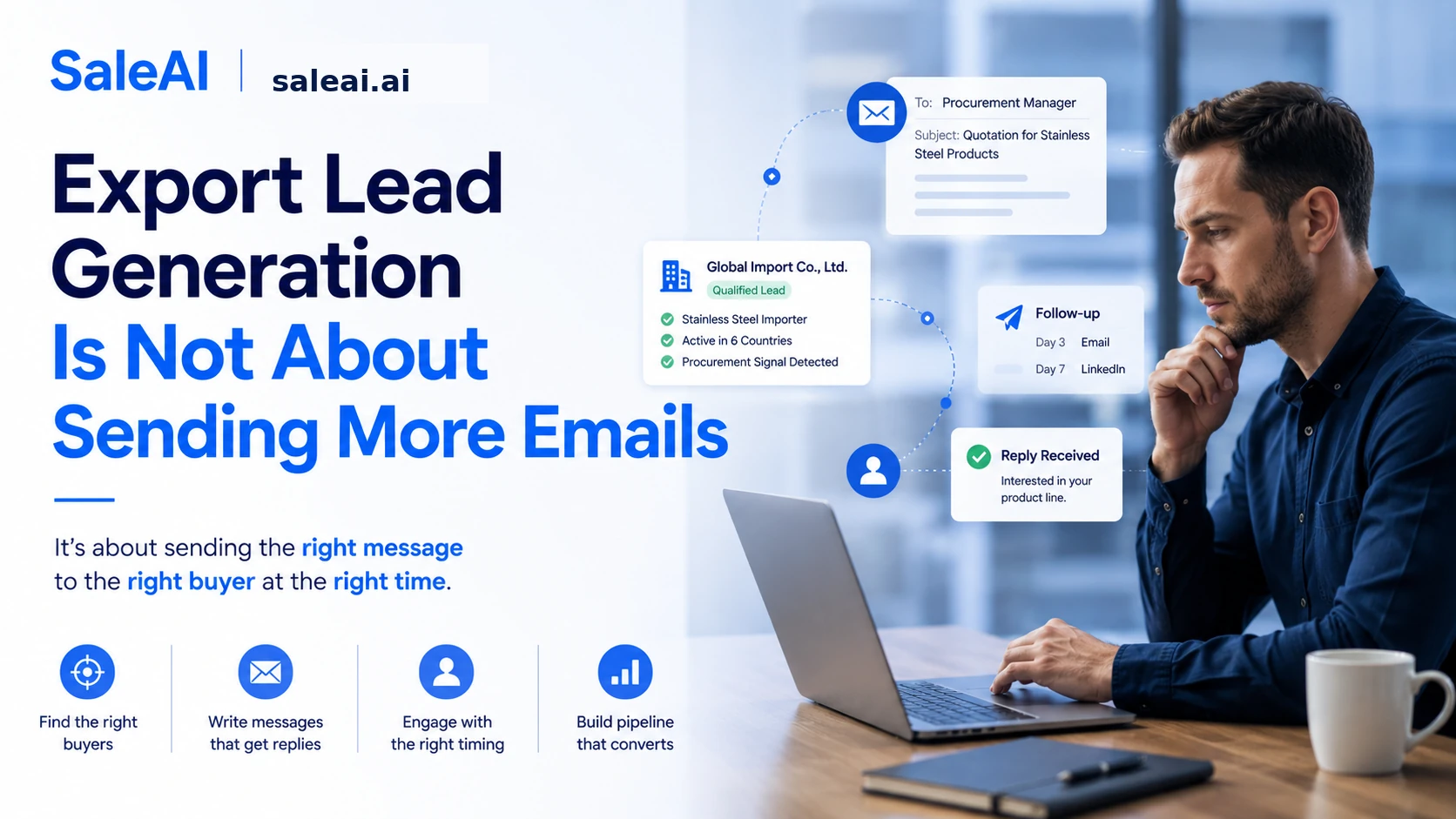
SaleAI helps exporters organize buyer discovery, outreach, RFQ management, and follow-up tracking inside one workflow.
Teams can:
- identify active buyers
- structure outreach
- manage quotation stages
- monitor buyer engagement
instead of handling export prospecting across disconnected spreadsheets and inboxes.
A scalable export lead generation system depends on consistency, qualification, and workflow visibility.
Quick Lead Qualification Checklist
Before contacting a buyer, check:
✅ Product relevance
✅ Active import behavior
✅ Reachable email/contact
✅ Matching market
✅ MOQ compatibility
✅ Website activity
✅ Procurement signals
This simple filtering step alone can improve outreach efficiency significantly.
