


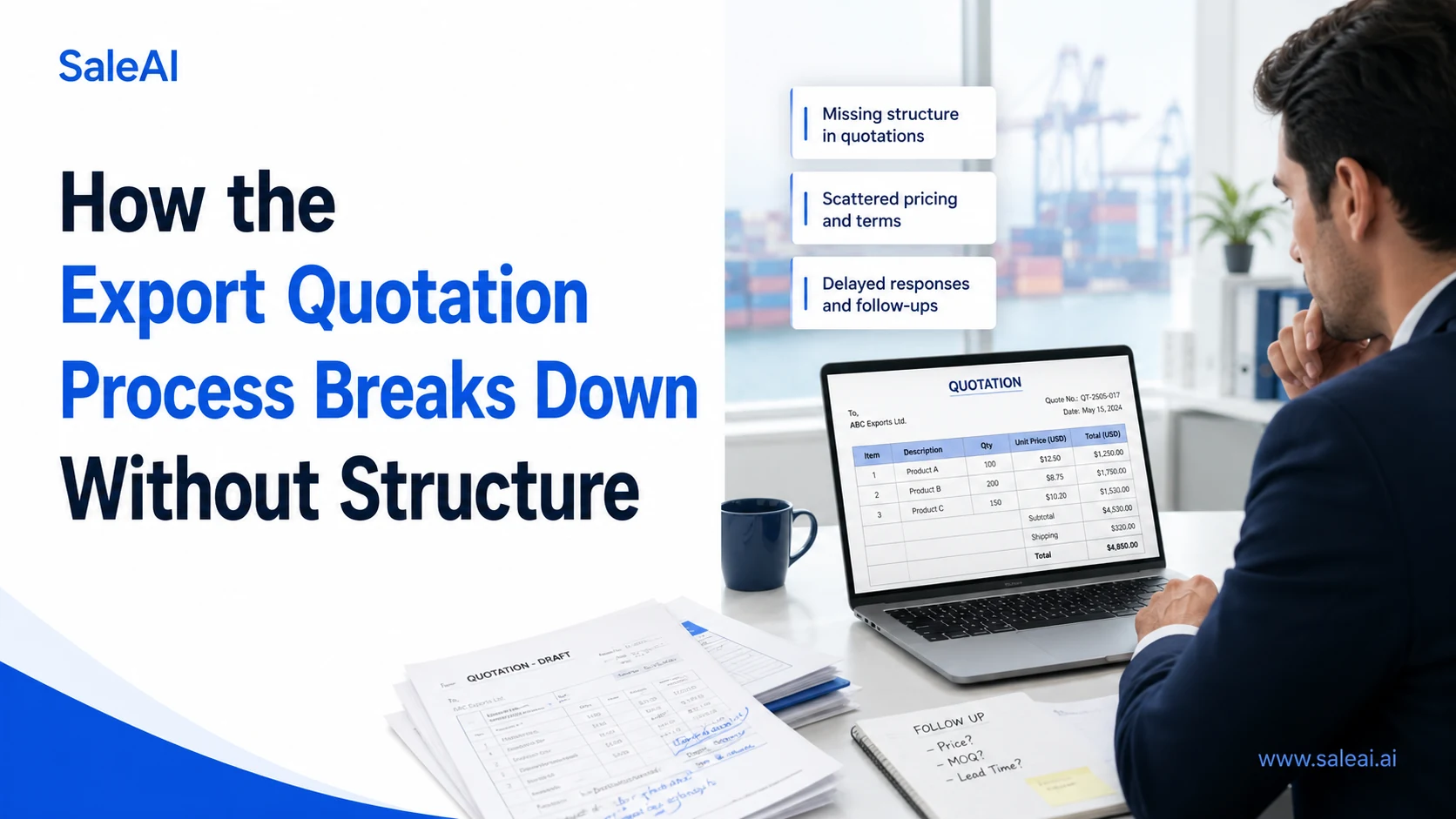
Most exporters think quotations are simple.
A buyer asks for pricing.
The supplier sends a PDF.
The conversation moves forward.
But real export quotation workflows are rarely that clean.
Behind one quotation usually sits:
- RFQ clarification
- MOQ negotiation
- shipping discussions
- product revisions
- payment terms
- follow-up timing
This is why the export quotation process becomes increasingly difficult once inquiry volume grows.
What Actually Happens Before a Quote Is Sent
A quotation does not begin with pricing.
It begins with incomplete information.
Most buyers initially provide:
- rough quantity
- target product
- delivery destination
Then the sales team still needs to confirm:
- specifications
- packaging
- shipping terms
- production timeline
- customization requirements
Without structure, this stage alone creates delays and repeated communication.
The Hidden Complexity Inside Export Quotations
One quotation often creates multiple versions.
For example:
| Revision Stage | What Changes |
|---|---|
| Initial RFQ | Basic pricing |
| MOQ adjustment | Unit price changes |
| Packaging revision | Shipping cost changes |
| Delivery update | Lead time changes |
| Final negotiation | Payment or Incoterm updates |
As revisions increase, quotation management becomes harder than the pricing itself.
Why Many Export Teams Lose Track
Most workflow problems begin quietly.
At first:
- quotations are stored manually
- follow-ups rely on memory
- PDFs are renamed individually
Then sales activity grows.
Soon teams experience:
- duplicate quotation versions
- missing revisions
- inconsistent pricing
- forgotten follow-ups
- unclear buyer status
The issue is no longer quoting.
It is workflow coordination.
What Buyers Actually Notice
Buyers compare more than numbers.
They notice:
- response speed
- quotation clarity
- communication consistency
- professionalism
- revision accuracy
A slow or confusing quotation creates uncertainty even when pricing is competitive.
This is why the export quotation process affects buyer trust directly.
A Real Export Workflow Example
A buyer from Saudi Arabia requests customized furniture pricing.
The process may include:
- Product clarification
- Material discussion
- First quotation
- MOQ revision
- Packaging adjustment
- Shipping recalculation
- Final PDF quotation
- Follow-up negotiation
Now multiply this across:
- 60 active RFQs
- multiple salespeople
- several product categories
Without centralized workflows, visibility disappears quickly.
Why AI Helps Quotation Workflows
AI systems help exporters:
- organize quotation stages
- standardize templates
- generate quote drafts
- manage revision history
- connect quotations with follow-ups
The biggest value is not “automation.”
It is reducing operational friction inside repetitive quotation tasks.
What Better Export Teams Usually Standardize
Stronger export teams usually standardize:
✅ quotation templates
✅ pricing structures
✅ follow-up timing
✅ RFQ intake fields
✅ buyer communication stages
This improves consistency before scaling outreach volume further.
How SaleAI Supports Export Quotation Workflows
SaleAI helps teams manage:
- RFQs
- quotation generation
- PDF exports
- buyer follow-ups
- quotation revisions
inside one export-focused workflow.
Teams can track:
- which quote version is active
- which RFQs require action
- which buyers need follow-up
- which quotations are stalled
A scalable export quotation process is not just about sending documents faster.
It is about maintaining operational clarity across growing export activity.
One Operational Question Worth Asking
If a buyer asks today:
“Can you resend the revised quotation from last week?”
…how long would your team take to find the correct version?
If the answer is:
- “We need to check”
- “Let me search the folders”
- “I’m not sure which PDF was final”
then the workflow—not pricing—is probably becoming the real bottleneck.
