


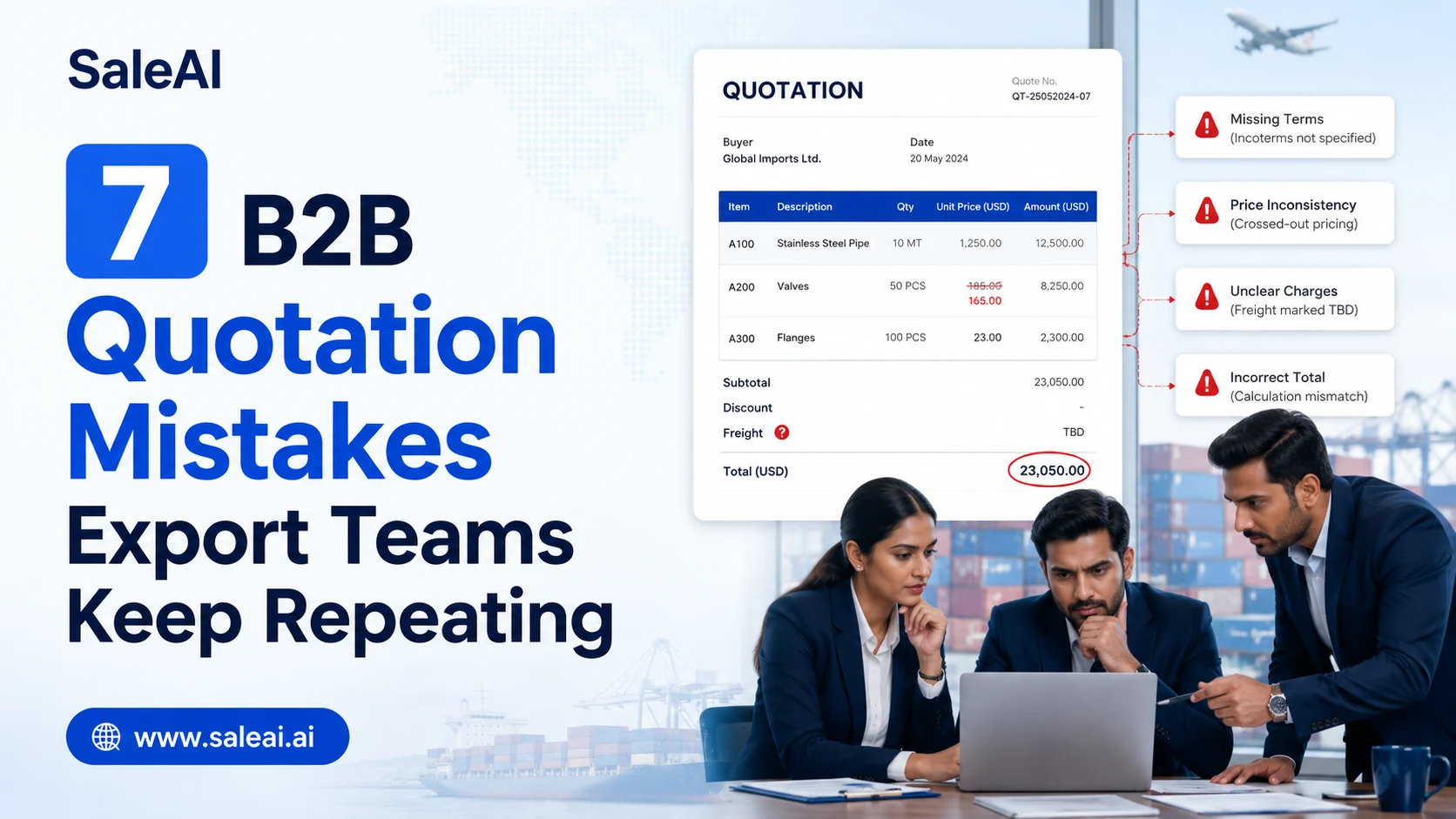
Most export teams think they lose deals because:
- pricing is too high
- delivery is too slow
- competitors are cheaper
Sometimes that’s true.
But many export deals quietly disappear because of small quotation mistakes nobody notices internally.
The buyer notices them immediately.
Below are some of the most common B2B quotation mistakes that reduce buyer confidence before negotiations even begin.
1. Sending Quotations Too Late
A buyer sends an RFQ to:
- five suppliers
- on the same afternoon
Three suppliers reply within hours.
One supplier replies two days later with:
“Sorry for the delay.”
At that point, the buyer conversation may already be moving elsewhere.
In export sales, quotation timing often signals operational capability.
Slow quoting creates doubt.
2. Making the PDF Hard to Understand
Some quotations contain:
- crowded tables
- unclear product names
- inconsistent currencies
- missing Incoterms
- long paragraphs nobody reads
Buyers should understand:
- pricing
- MOQ
- lead time
- shipping terms
within seconds.
A quotation is not a brochure.
It is a decision tool.
3. Forgetting What Buyers Actually Compare
Exporters often think buyers compare only:
- unit price
- shipping cost
In reality, buyers also compare:
| Buyer Concern | What They Evaluate |
|---|---|
| Professionalism | Layout clarity |
| Reliability | Response speed |
| Risk | Communication quality |
| Flexibility | MOQ & revisions |
| Confidence | Consistency |
Weak quotation structure increases perceived risk—even if pricing is competitive.
4. Sending the Same Format to Every Buyer
A distributor and an OEM procurement manager do not read quotations the same way.
Distributors
Usually focus more on:
- margins
- delivery speed
- mixed-container flexibility
OEM Buyers
Usually focus more on:
- specifications
- compliance
- packaging
- production capability
One rigid quotation format rarely fits every scenario.
This is one of the most overlooked B2B quotation mistakes in export workflows.
5. Losing Control of Quote Versions
This happens constantly in export teams.
Buyer asks:
“Can you resend the revised version?”
Now the sales team searches:
- inboxes
- shared folders
- old PDFs
- WhatsApp files
Nobody knows:
- which file is latest
- which MOQ was approved
- whether shipping terms changed
The issue is no longer quoting.
It is operational visibility.
6. Sending Quotations Without Follow-Up Plans
Some exporters treat quotations as the end of the workflow.
In reality, the quotation is usually the beginning of:
- negotiations
- revisions
- procurement discussions
- internal buyer approvals
A quotation without structured follow-up often disappears quietly.
Good export teams already know:
- when to remind
- what to clarify
- what information buyers may need next
before the PDF is even sent.
7. Treating Quotations Like Admin Work
This may be the biggest mistake of all.
A quotation is not only:
- a document
- a price list
- a PDF attachment
It is often the buyer’s first real impression of:
- your operational quality
- your communication standards
- your reliability as a supplier
Strong quotations reduce uncertainty.
Weak quotations create hesitation.
How AI Helps Reduce Quotation Errors
AI-supported workflows help export teams:
- standardize quotation formats
- organize RFQ stages
- track quotation revisions
- generate follow-up drafts
- reduce missing information
The value is not just speed.
It is consistency across growing sales activity.
How SaleAI Supports Quotation Workflows
SaleAI helps export teams:
- generate structured quotations
- manage RFQ workflows
- organize quotation history
- track follow-up timing
- connect outreach with buyer stages
inside one export-focused workflow.
Reducing B2B quotation mistakes is not about making prettier PDFs.
It is about creating smoother buyer decision processes.
Final Thought
If buyers regularly stop replying after quotations, ask yourself:
“Was the problem really the price—or was the workflow creating friction before the negotiation even started?”
That question usually reveals more than another discount ever will.
