


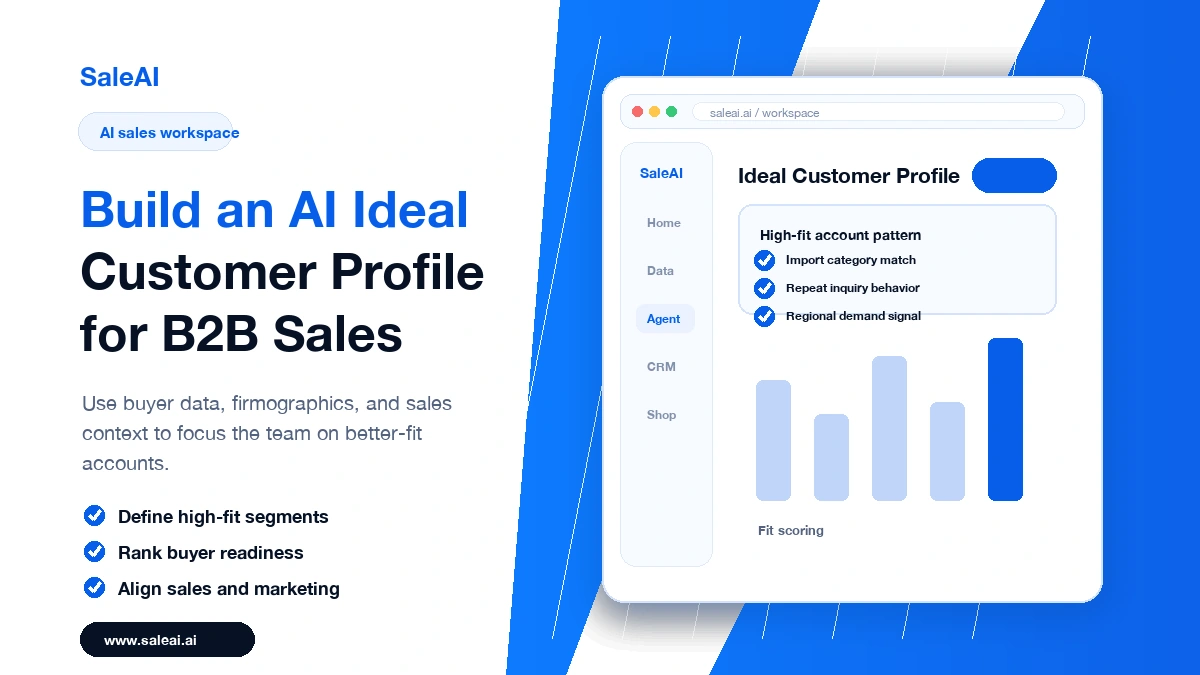
A useful ideal customer profile is not a static description of a “good buyer.” It should help a sales team decide which accounts deserve attention today, which ones can wait, and what kind of message is worth sending. For B2B teams selling across regions, that is hard to do with one spreadsheet and a few broad filters.
AI changes the job by connecting buyer signals, company context, and workflow history. Instead of asking reps to remember every pattern, an AI ideal customer profile can turn scattered clues into a practical account selection system.
What an AI Ideal Customer Profile Should Actually Do
An ideal customer profile, or ICP, should answer a simple question: which companies are most likely to understand the offer, have a real need, and move forward with a sales conversation?
For export teams and B2B suppliers, the answer often depends on more than company size. A good ICP may include:
- Product category fit
- Region and import behavior
- Buyer role and department
- Recent sourcing activity
- Website or social signals
- Existing customer similarities
- Response history from previous outreach
The value is not in collecting more fields. The value is in making those fields useful when a sales rep is choosing who to contact next.
Why Traditional ICPs Become Too Broad
Many sales teams start with a clean ICP, then slowly dilute it. A target account list might begin with “mid-sized distributors in Europe,” but after a few weeks it includes retailers, agents, unrelated importers, and companies with no clear need.
This usually happens for three reasons.
First, teams need volume. When lead targets are aggressive, broad lists feel safer than narrow ones.
Second, data is fragmented. A buyer’s website, trade activity, inquiry history, and email engagement may live in different places.
Third, ICP rules are rarely updated. The market changes, but the team keeps using last quarter’s assumptions.
SaleAI helps by combining company intelligence, buyer context, and CRM activity so teams can keep the ICP alive instead of treating it as a one-time planning document.
Inputs That Make an AI ICP More Accurate
An AI ICP is only useful if the inputs reflect real buying behavior. Start with the data points that salespeople already trust.
Company Fit
Company fit includes industry, size, location, business model, and product relevance. For a global B2B team, this may also include whether the company imports, distributes, manufactures, or resells related products.
Buyer Signals
Signals are clues that a company may be active now. Examples include new product pages, hiring changes, recent sourcing behavior, social posts, or website updates. SaleAI Data can help surface company and market signals that are easy to miss during manual research.
Conversation History
Past conversations matter. If similar accounts respond to certain messages, ask similar questions, or move faster after certain follow-ups, those patterns should influence the ICP.
Negative Fit
A strong ICP also defines who not to pursue. Excluding low-fit accounts protects the team from busywork and improves the quality of sales activity.
A Practical ICP Scoring Model
You do not need a complex scoring system to get started. A simple model can work well if the criteria are specific.
Use four groups:
- Fit: Does the company match the target market?
- Need: Is there evidence of demand or a relevant product category?
- Timing: Is there a current signal that suggests activity?
- Access: Can the team identify a useful contact or channel?
Give each group a simple rating such as strong, moderate, weak, or unknown. The goal is not perfect prediction. The goal is to help reps spend more time on accounts with a clear reason to engage.
How SaleAI Supports ICP-Based Selling
SaleAI supports ICP work across several parts of the sales process.
SaleAI Data helps teams gather company intelligence and market context. SaleAI Agent can assist with repeatable web research tasks, such as checking company pages or extracting public information. SaleAI CRM helps keep profiles, follow-ups, and customer notes connected so the ICP improves over time.
This matters because the ICP should not sit in a document. It should influence daily actions: who to research, what to write, when to follow up, and what to ignore.
Common Mistakes to Avoid
One common mistake is using AI to create a long list of generic buyer traits. That may look complete, but it will not guide real sales work.
Another mistake is relying only on firmographic data. A company can match the right industry and size but still have no active need.
A third mistake is not reviewing outcomes. If the team never checks which ICP assumptions led to replies, meetings, or orders, the model will drift.
A Better Way to Use the ICP Every Week
Set a weekly review rhythm. Look at new replies, missed opportunities, promising accounts, and low-quality leads. Ask what they have in common. Then update the ICP rules.
The best ICPs are not written once. They are maintained like a sales operating system.
FAQ
Q: What is an AI ideal customer profile? A: An AI ideal customer profile uses company data, buyer signals, and sales activity to help teams identify the accounts most likely to become qualified opportunities.
Q: How is an AI ICP different from a normal ICP? A: A normal ICP is often a static description. An AI ICP can update with new signals, account behavior, and sales outcomes.
Q: Can SaleAI help build an ICP for export sales? A: Yes. SaleAI can support company research, buyer signal analysis, workflow automation, and CRM follow-up around ICP-based selling.
