


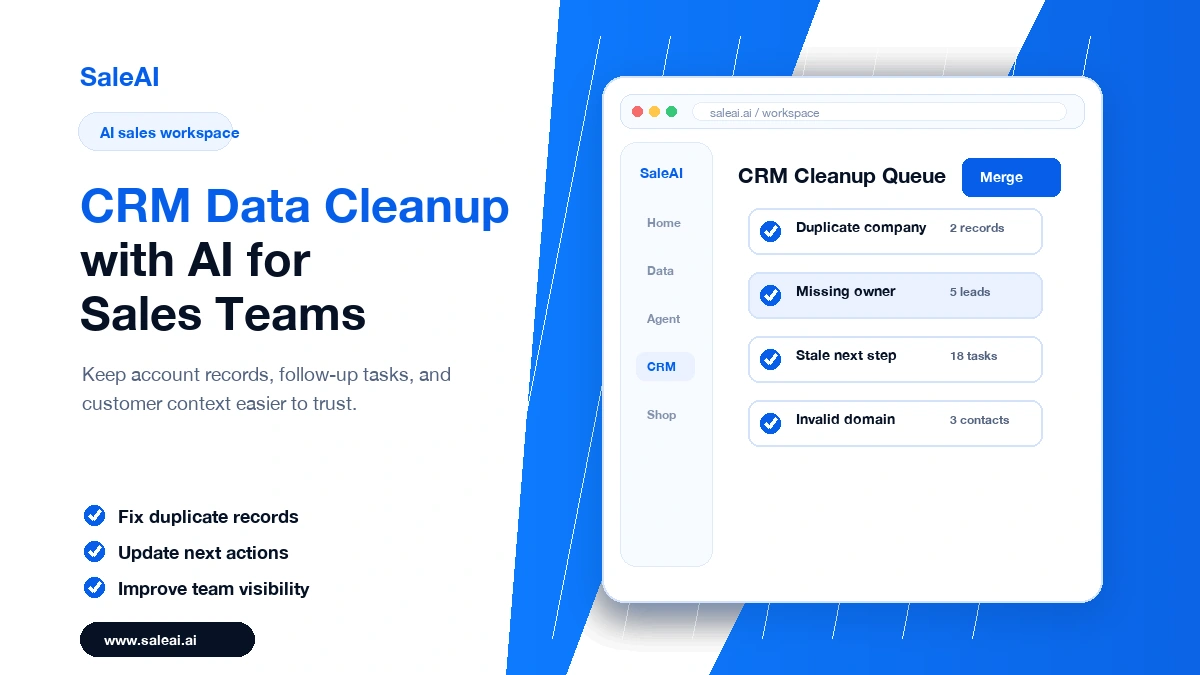
CRM data cleanup matters because trust in the CRM is fragile. Once reps believe the records are outdated or duplicated, they start keeping their own spreadsheets. Then managers lose visibility, follow-up becomes inconsistent, and campaign learning becomes scattered.
SaleAI CRM is useful when cleanup is tied to daily sales work rather than treated as a quarterly admin project. Data quality should improve while reps work, not only after someone complains about a report.
Why CRM data becomes unreliable
Messy data is usually not caused by laziness. It comes from lead imports, rushed campaigns, duplicate company names, unclear ownership, and follow-up notes written under pressure. Over time, those small gaps make the CRM harder to trust.
Strong CRM data cleanup focuses on the fields that affect sales behavior: owner, next action, company identity, contact path, and recent conversation context.
What AI can flag
- Likely duplicate companies or contacts
- Accounts with no owner
- Follow-up tasks that are overdue or vague
- Invalid domains or incomplete contact details
- Records with missing lead source information
AI should suggest changes, not silently rewrite important records. Merging companies or changing ownership may need human review. Flagging a missing next action can be more automatic.
Make cleanup part of the workflow
The best time to clean a record is when the work happens. After a rep sends a follow-up, the CRM should prompt for the next step. After an import, the system should check for duplicates. After a campaign, managers should review accounts with no action.
Clean CRM data also supports other workflows. Account signals from SaleAI Data and browser actions from SaleAI Agent become more valuable when the result is stored clearly.
Measure whether the team trusts it
Track duplicate rate, overdue tasks, owner coverage, and percentage of accounts with a next action. But also ask a practical question: do reps use the CRM without needing a private backup file?
That is the real goal of CRM data cleanup. A clean system lets the team follow up with confidence and learn from every campaign.
Set ownership rules before cleanup begins
CRM data cleanup becomes difficult when no one owns the decision rules. Who decides whether two company records should merge? Who confirms the correct account owner? When should an old follow-up task be closed instead of reassigned?
Before running cleanup, define ownership rules. Sales operations can manage duplicate logic. Team leads can confirm owner changes. Reps can update next actions. This prevents cleanup from becoming another source of confusion.
Use cleanup to improve sales behavior
Cleanup should not only make reports prettier. It should change behavior. If many accounts have no next action, the team needs a follow-up discipline. If duplicate records keep appearing, the import process needs a check. If lead source is often missing, campaign setup needs better naming rules.
AI can flag the pattern, but managers should decide what process caused it. That is where CRM data cleanup becomes operationally useful. It does not just repair old records; it helps the team stop creating the same problem again.
A clean CRM also makes future automation safer. When account names, owners, and next steps are reliable, AI-assisted follow-up and reporting have a stronger foundation.
Why cleanup should improve selling, not only reporting
Many CRM cleanup projects focus on tidy fields but fail to change how salespeople work. The better question is whether the cleaned data helps a rep choose the next account, understand the buyer's stage, and avoid repeating a message that another teammate already sent.
With SaleAI, CRM data cleanup can support prospecting, follow-up, and account management at the same time. Duplicate records, stale contacts, weak tags, and missing country or product-interest fields become easier to spot, which makes the CRM more useful during real sales conversations.
Fields worth protecting
- Buyer country and region, because sales timing and compliance needs vary.
- Product category interest, because generic follow-up lowers reply quality.
- Last meaningful interaction, because activity volume alone can be misleading.
- Lead source, because teams need to compare channels honestly.
