


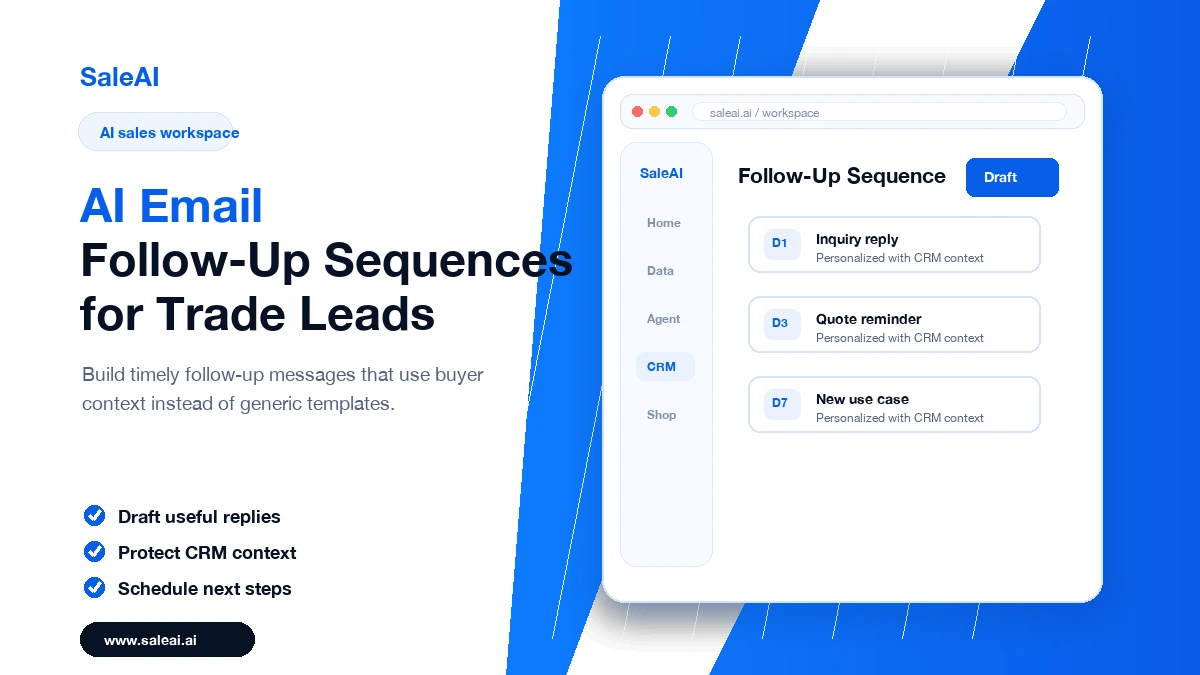
AI email follow-up works only when the message gives the buyer a reason to continue. Many trade sales teams lose momentum after the first quote because the next email says little more than “just checking in.” That is not a follow-up strategy. It is a reminder with no value.
A better sequence uses the buyer’s previous question, product interest, region, and likely concern. SaleAI CRM can help keep that context visible so each follow-up is connected to the actual conversation, not just the calendar.
Think in buying questions
Trade buyers often move through practical questions: Can this supplier meet the requirement? What is the lead time? Is customization possible? Are documents available? How does the quote compare with other options?
AI email follow-up should map to those questions. The first email may confirm the need. The second may answer a likely objection. The third may offer a smaller next step, such as a revised quote, a sample discussion, or a product comparison.
A simple sequence structure
- Message 1: Restate the requirement and confirm the most important detail.
- Message 2: Address one buying concern, such as MOQ, packaging, delivery, or customization.
- Message 3: Offer a next step that is easy to answer.
This structure prevents the sequence from becoming repetitive. Each message has a job.
Where AI helps most
AI is useful for turning CRM notes into a draft, adapting tone for different markets, and preparing variations for different buyer roles. If account context comes from SaleAI Data, the follow-up can refer to the buyer’s business situation instead of relying on a generic sales template.
Still, a human should review product claims, pricing, names, and timing. In trade communication, a small error can damage trust quickly.
Measure more than opens
Open rates do not tell the whole story. Track qualified replies, reopened conversations, quote revisions, and completed next actions. If AI email follow-up increases activity but does not improve conversation quality, the sequence needs a better angle.
The best follow-up feels like the salesperson remembered the buyer’s problem. AI should help preserve that memory, not replace it with polished repetition.
How tone changes across the sequence
The tone of AI email follow-up should change as the buyer relationship develops. Early follow-up should be helpful and low-pressure. Mid-sequence follow-up can become more specific, answering likely concerns about price, delivery, customization, or documentation. Later follow-up should make it easy for the buyer to close the loop, even if the answer is not immediate interest.
This matters because trade buyers often work with internal teams. A buyer may need to confirm technical details, compare samples, or wait for budget approval. A useful follow-up gives them something they can forward or use in that internal discussion.
What to feed into the AI before drafting
The draft quality depends on context. Before generating a message, gather the product interest, quote stage, buyer role, region, previous objection, and desired next action. Without those inputs, AI will produce polished but generic writing.
A good prompt might include: “The buyer asked about MOQ and delivery time for a customized product. We already sent a quote three days ago. Draft a short follow-up that confirms we can discuss packaging options and asks whether they need a revised quantity.” That kind of context produces a better result than asking for “a follow-up email.”
The final review should still belong to the salesperson. AI email follow-up helps prepare the message, but the rep protects accuracy, tone, and commercial judgment.
Where teams usually lose replies
The weakest part of many follow-up systems is not the first email. It is the second and third message, where the wording starts to sound copied and the sales team loses track of why the buyer was contacted in the first place. A better sequence keeps one clear reason for each touch: delivery timing, certification fit, sample policy, price bracket, replacement supplier risk, or upcoming buying season.
In SaleAI, teams can use buyer data, product context, and CRM status together so the next follow-up does not read like a reminder sent by a timer. That is where AI email follow-up becomes useful for export sales: it helps the team keep a commercial thread alive without flattening every buyer into the same generic cadence.
Review points before sending
- Check whether the buyer has shown product-level interest, not only company-level relevance.
- Keep one practical reason for the email and remove extra claims.
- Make the call to action small enough for a busy importer to answer quickly.
