


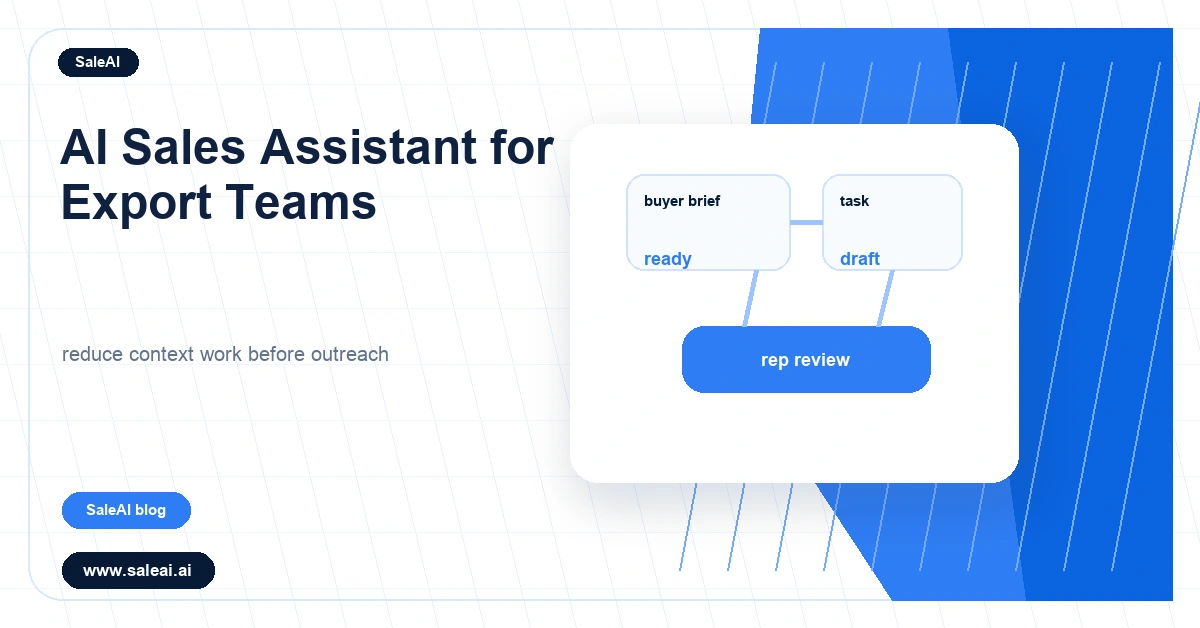
An AI sales assistant becomes useful when export teams have more account context than a rep can review manually before every message. A buyer may have visited product pages, asked for documents, received a quote, spoken with a distributor, or gone silent after a sample request. The sales rep needs that history before choosing what to do next.
The point is not to replace the rep. The point is to prepare the rep. When account history, buyer signals, product interest, and open tasks are organized before outreach, the conversation can become more specific and less repetitive.
The assistant should prepare context, not pretend to own the relationship
Export sales often depends on memory: which buyer asked for a certificate, which distributor owns the territory, which quote version was sent, and which product line was discussed last quarter. A useful assistant turns that scattered memory into a short working brief.
The rep still decides whether to contact the buyer, pause, route the account, or ask for internal support. That human decision matters because export sales includes relationship history, commercial sensitivity, and regional context that should not be handled blindly.
Connect account evidence before writing
A practical SaleAI workflow can connect CRM notes, website behavior, quote status, buyer data, and sales tasks before a rep writes the next message. This is where an AI sales assistant helps most: it brings the account story closer to the action.
For example, the assistant might surface that a dormant customer returned to a product page after six months, that a previous quote mentioned packaging concerns, and that the account owner has no next task. That context changes the follow-up from a vague check-in into a focused question.
Use the assistant where rules are clear
The best first use cases are repeatable: preparing account briefs, finding missing owner fields, summarizing recent buyer activity, drafting a follow-up outline, or flagging accounts without next steps. These tasks are important, but they are not the same as making a commercial promise.
Teams should avoid starting with sensitive decisions such as discount approval, channel conflict, legal language, or technical guarantees. Those areas still need human review and often require company-specific judgment.
Keep the buyer experience natural
A buyer should not feel like they are receiving a machine-generated message based on surveillance. The rep should use context to be more useful, not to announce every tracked action. The message should sound like a person who understands the account, the product area, and the likely question.
For export teams, this matters because trust is often built slowly across distance, language, and time zones. Speed helps only when the response still feels considerate and relevant.
Make the output easy to review
A good assistant output should be short enough for a rep to use quickly. A practical brief might include account fit, latest movement, prior conversation, open question, recommended next action, and risk note. Long summaries can become another thing to ignore.
Managers can review a sample of assistant-prepared briefs each week to check whether they are accurate, useful, and specific enough for sales action.
Measure quality, not only saved time
Time saved is valuable, but it is not the only measure. Teams should also review whether messages became more relevant, whether overdue tasks decreased, whether account handoffs improved, and whether reps found useful signals sooner.
If the assistant creates more tasks without improving conversations, the workflow needs narrower rules. The goal is better sales work, not more activity.
Where an AI sales assistant helps
| Sales moment | Useful support | Human decision |
|---|---|---|
| Before first outreach | Summarize account fit, source, and recent movement | Choose whether outreach is appropriate |
| Before quote follow-up | Find the quote version, open issue, and last buyer action | Decide the message and timing |
| Before handoff | Prepare owner, account note, and next action | Confirm who should own the relationship |
Implementation guardrails
| Guardrail | Why it matters | Example |
|---|---|---|
| Review point | Protects relationship quality | Rep approves important buyer messages |
| Source visibility | Builds trust in the output | Brief shows which CRM notes shaped the recommendation |
| Narrow scope | Prevents weak automation | Start with account briefs before expanding |
How to apply this in a sales workflow
Start with a narrow use case that has visible buyer context and a clear owner. For AI sales assistant, the first version should show the account, the reason for action, the current question, and the next step. Teams can expand after the pilot proves that reps are making better decisions, not only completing more CRM fields.
The review should stay close to real sales work. Ask whether the process helped someone write a better reply, route an account faster, recover a stalled conversation, or remove a weak-fit record. If the answer is unclear, simplify the workflow before adding more automation.
What good execution should look like
Good execution should make the account easier to understand for the next person who opens it. The buyer context should be visible, the owner should be clear, and the next action should be specific enough to review later.
AI Sales Assistant for Export Teams should support faster preparation, clearer account notes, and more relevant follow-up. It should not become another disconnected checklist. Used carefully, it gives sales teams a more practical way to connect data, judgment, and follow-up.
Where export reps lose time before outreach
Export reps often lose time before the actual selling work begins. They check whether the company is already in the CRM, search old email threads, confirm the product category, look for quote notes, review distributor ownership, and try to understand whether the buyer is new, returning, or already assigned. None of these steps is difficult alone, but together they can delay the first useful response.
An AI sales assistant can reduce that preparation burden when the inputs are connected. The assistant should not invent a sales plan. It should bring the right facts closer together so the rep can make a better decision. For a cross-border team, that may mean showing the buyer's region, language needs, product interest, old quote status, recent page activity, and open task owner in one short brief.
What the assistant should not do
The assistant should not hide uncertainty. If account identity is unclear, if two owners appear in the CRM, or if the signal is weak, the output should say so. A confident but unsupported recommendation is worse than a short note that asks for review. Sales teams need to trust the assistant enough to use it, but not so much that they stop thinking.
It should also avoid turning every buyer signal into a task. Export teams already struggle with busy CRM systems. If every page visit, form fill, and old quote creates the same urgent task, reps will stop paying attention. The better approach is to show why the account may deserve action and let the sales owner confirm the next step.
Example workflow for a small pilot
A practical pilot can start with returning accounts that have no clear next action. The assistant prepares a short account brief for each record: latest buyer movement, last meaningful conversation, product area, open question, current owner, and suggested action. The rep then marks the suggestion as useful, not useful, or needs more context.
After two or three weeks, managers can review whether the briefs helped reps write better messages, recover dormant conversations, or close weak records faster. This keeps the pilot grounded in actual sales work. If the output improves judgment, the team can expand the assistant to quote follow-up, distributor handoffs, or product inquiry review.
Signals that show the assistant is working
A working AI sales assistant should reduce preparation time without making the sales process feel mechanical. Reps should be able to explain why an account was prioritized. Managers should see cleaner owner decisions. Buyers should receive messages that reflect their question, product interest, or previous interaction.
The strongest sign is not that the assistant creates more activity. The strongest sign is that the team spends less time searching and more time making useful account decisions.
FAQ
What is an AI sales assistant?
An AI sales assistant helps sales teams prepare context, summarize account activity, organize tasks, and support follow-up decisions.
How is an AI sales assistant different from a chatbot?
A chatbot usually handles a conversation. An AI sales assistant supports internal sales work such as account preparation, task review, and follow-up context.
Should an AI sales assistant write every buyer message?
No. It can prepare a draft or outline, but reps should review important messages, especially for strategic accounts and technical discussions.
Where should export teams start?
Start with a narrow task such as account briefing, quote follow-up preparation, or missing next-action review.
How does SaleAI help?
SaleAI helps connect buyer data, CRM context, website activity, and sales workflow so reps can prepare with less manual searching.
What should managers review?
Managers should review accuracy, usefulness, tone, and whether the assistant output leads to better next actions.
Can AI sales assistant workflows reduce admin work?
Yes, especially when they summarize information and prepare structured tasks that reps would otherwise collect manually.
What is the main risk?
The main risk is automating unclear work too early. Teams should define rules and review points before scaling.
