


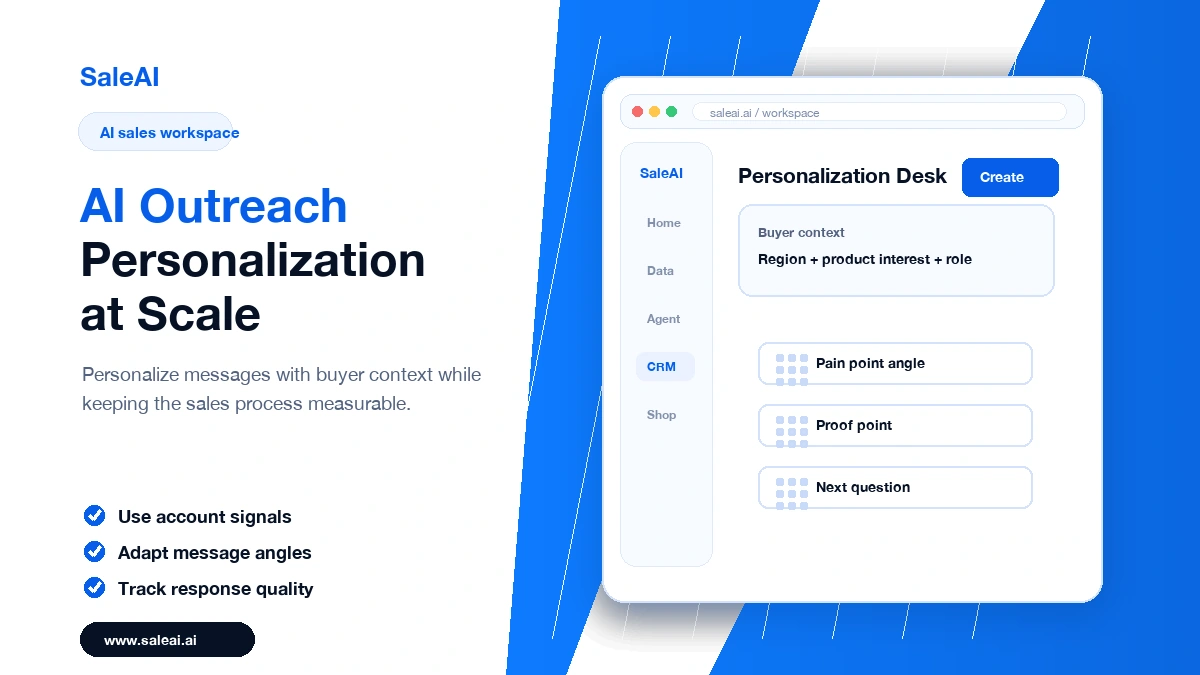
AI outreach personalization is often misunderstood. It is not the same as inserting a company name into a template. Real personalization explains why the message is relevant to this account, at this moment, for this business reason.
The difference matters. Buyers can feel when a message has been lightly decorated. They also notice when a seller has understood their category, market, or likely sourcing problem. SaleAI Data can help provide that account context before the first message is written.
Start with the account reason
Before drafting, define why the account is on the list. Is there a product fit? A public buying signal? A regional opportunity? A previous conversation? AI outreach personalization needs a real account reason, otherwise AI only creates smoother generic copy.
Use message angles
A message angle is the business reason behind the outreach. One account may need reliability. Another may care about customization. A third may be exploring a new product category. The angle should guide the first sentence, proof point, and next question.
- Account signal: what makes the company relevant?
- Buyer problem: what issue could the message address?
- Proof point: what can the seller say accurately?
- Next step: what is easy for the buyer to answer?
Scale with guardrails
AI can create variations quickly, but teams need rules. Approved claims, tone limits, product boundaries, and review points prevent personalization from becoming risky. Connect drafts and outcomes to SaleAI CRM so the team can learn which angles actually produce useful replies.
Measure reply quality
AI outreach personalization should be judged by conversation quality, not just message volume. Track qualified replies, buyer objections, meetings booked, and follow-up completion. If replies are polite but unqualified, the account reason or message angle needs work.
The goal is not to make every email sound different. The goal is to make every email feel justified. That is what separates useful personalization from noisy automation.
Create a personalization library
Teams that scale AI outreach personalization need a library of message angles. This is not a list of finished templates. It is a set of business reasons that can be adapted to different accounts: category expansion, sourcing reliability, product comparison, regional demand, sample process, or operational efficiency.
Each angle should include approved proof points and claims that the team can safely use. This prevents AI from improvising unsupported statements while still allowing messages to feel specific.
Use feedback to improve the angles
After a campaign, review which angles produced useful replies. Did buyers respond to delivery reliability? Did customization questions create better conversations? Did category expansion messages attract the right companies?
That feedback should update the library. Weak angles should be rewritten or removed. Strong angles should be connected to better account criteria. In this way, AI outreach personalization becomes a learning system rather than a one-time writing shortcut.
Personalization at scale works when the message is grounded in real account context. The buyer does not need a long email. They need a clear reason to believe the seller understands their situation.
Personalization should prove relevance
Good personalization is not a compliment about the buyer's website. It gives the buyer a reason to believe the seller understands their sourcing situation. That reason may come from product category fit, market timing, certification requirements, distribution channel, or a recent signal that suggests active demand.
SaleAI helps teams use data and AI together so AI outreach personalization stays grounded in commercial context. The message can be tailored without becoming overly familiar, exaggerated, or difficult for the sales team to review.
A stronger personalization test
Before sending a campaign, remove the buyer's company name from the message and ask whether the email still contains a specific reason for contact. If it could be sent to any importer in any market, it is not personalized enough. If every sentence depends on a fragile assumption, it may be too risky. The best version sits between those extremes: specific, useful, and easy to verify.
