


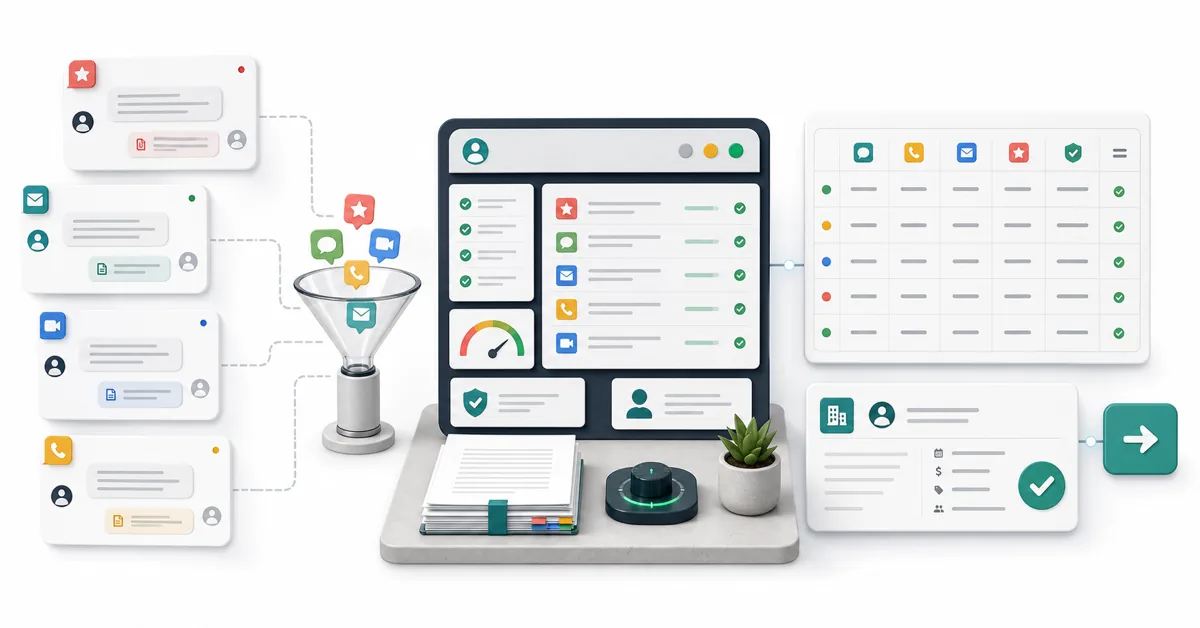
AI sales conversation management is the discipline of keeping each AI-assisted sales chat tied to one business question, clear source evidence, a review decision, and a defined destination. It prevents useful research from disappearing into chat history and stops temporary assumptions from quietly becoming reusable company context.
A read-only inspection of the logged-in SaleAI backend on August 12-14, 2026 showed New Chat, Search Chats, history grouped by Today, Yesterday, Last 7 Days, Last 30 Days, and Earlier, plus Customer Settings, Read Memory, Allow Learning, attachments, and channel shortcuts. The current public SaleAI experience also presents a one-prompt starting point with file attachment and LinkedIn, Facebook, Google, Instagram, Customs Data, and Email Marketing channels. These controls create a practical conversation workspace, but the team still needs operating rules for what a chat is allowed to contain and what should happen when it ends.
The real problem is not too many chats
The problem begins when a conversation cannot answer four questions:
- What decision was this research meant to support?
- Which sources or inputs shaped the answer?
- What did a person verify?
- Where did the approved result go next?
Without those answers, sales chat history becomes difficult to search and risky to reuse. A long conversation about a distributor, for example, may mix stable company facts, one campaign's assumptions, a draft email, an outdated contact, and a speculative buyer signal. Months later, another salesperson may not know which parts remain valid.
The goal of AI conversation governance is not to preserve every sentence. It is to preserve the reason, evidence, decision, owner, and next action that make the work commercially useful.
What the verified SaleAI interface contributes
The inspected controls support different parts of the conversation lifecycle. They should not be treated as interchangeable.
| SaleAI control | Observed purpose | Management question | What it does not prove |
|---|---|---|---|
| New Chat | Start a new target-customer, product, or growth task | Is this a new decision or a continuation? | That a broad request will produce a qualified lead list |
| Search Chats | Find previous conversations | Which distinctive terms will make this task retrievable? | That every old answer is still accurate |
| Grouped history | Organize conversations by time period | When was the evidence collected? | That recent work has been reviewed |
| Customer Settings | Maintain reusable business and outreach context | Which facts are stable enough to become defaults? | That task-specific assumptions belong there |
| Read Memory | Bring saved context into the current conversation | Is approved memory relevant to this task? | That all remembered context is current |
| Allow Learning | Let a conversation contribute to reusable memory | Does this chat contain an approved reusable correction? | That every conclusion should be learned |
| Attachments | Add supporting material to a request | Is the file current, necessary, and appropriate to use? | That every statement in the file is correct |
| Channel shortcuts | Declare LinkedIn, Facebook, Google, Instagram, Customs Data, or Email Marketing context | Which source can answer the present question? | That one source proves buyer readiness |
This division is central to the verified SaleAI backend workflow. Conversation controls help organize reasoning and context; dedicated data, CRM, and email areas handle different operational objects.
Use a five-state AI sales conversation management lifecycle
A useful conversation lifecycle gives every chat a state rather than letting it remain permanently “in progress.” The states below are editorial operating rules, not SaleAI status fields.
| State | Required evidence | Allowed next move | Stop condition |
|---|---|---|---|
| Scoped | One decision, market, product, buyer type, output, and exclusions | Start research | The request still contains several unrelated decisions |
| Researching | Dated sources and visible assumptions | Continue or narrow | Sources conflict or the search boundary keeps expanding |
| Review ready | Findings, confidence, missing facts, and proposed action | Human review | Material claims have no source or date |
| Approved | Named reviewer, decision, and destination | Create a Data Asset, update CRM, or use a draft | The decision exceeds the available evidence |
| Closed | Outcome and reason retained | Reuse the decision record later | No owner, outcome, or retrieval terms were recorded |
This AI sales conversation management model keeps reusable sales research smaller than the full transcript. The transcript can show how the team arrived at an answer; the decision record shows what the business is prepared to use.
Keep one conversation tied to one decision
“Research Germany” is not a decision. “Identify up to 30 German industrial sensor distributors for human review, excluding consumer electronics retailers and logistics providers” is closer to one.
Before opening New Chat, define:
- Decision: what someone will decide after reviewing the output.
- Scope: one product family, market, and commercial role.
- Evidence: the sources and fields needed to support relevance.
- Exclusions: the records that should not qualify.
- Output: list, comparison, company brief, draft, or unanswered-question log.
- Review gate: who checks the result and what prevents activation.
Do not combine market sizing, company discovery, decision-maker research, email drafting, and campaign approval in one undifferentiated thread. Those tasks can inform one another, but each has a different evidence standard and failure mode.
Make a chat findable before it becomes old
Search works best when the conversation contains terms that distinguish it from hundreds of similar requests. In AI sales conversation management, a compact identifier belongs in the opening request and should be repeated in the closing decision record.
Use this pattern:
[Market] - [Product] - [Buyer role] - [Decision] - [YYYY-MM review]
Example:
Germany - industrial temperature sensors - distributors - shortlist review - 2026-08
Add a task owner, source channel, and a short exclusion phrase in the first message. This improves chat context management even if the interface's title-generation or search-matching behavior changes. Search Chats was visible in the inspection, but exact matching logic, filters, bulk labels, saved searches, and conversation ownership were not verified. Teams should test those functions before building a formal service-level agreement around them.
Decide between Customer Settings, memory, and the current chat
The strongest AI sales conversation management practice separates information by lifespan.
| Information type | Example | Best location | Why |
|---|---|---|---|
| Stable business fact | Official company name, core product family, approved website | Customer Settings | Useful across many tasks after review |
| Controlled preference | Priority market, preferred buyer type, email language | Customer Settings with an owner and review date | Reusable, but likely to change |
| Task condition | Germany only, August evidence, exclude retailers | Current conversation | Applies to one research decision |
| External observation | Company page, employee profile, customs record, social page | Research output with source and date | Must remain traceable and refreshable |
| Approved sales record | Owner, stage, reason, next action | CRM Management | Needed for coordinated follow-up |
Use Read Memory when approved saved context is relevant. Keep Allow Learning off during exploration, buyer-specific analysis, speculative segmentation, and temporary campaign work. Turn it on only when the team intends to preserve a reviewed, reusable correction under its own policy.
The SaleAI Customer Settings guide explains these two controls in more detail. The important point here is operational: reading memory and writing reusable memory are separate decisions.
Match the channel to the question, not the habit
The channel shortcuts visible in the composer represent different evidence types. Choosing a familiar channel by default can create false confidence.
| Question | Better starting channel | Useful evidence | Required caution |
|---|---|---|---|
| Does this company operate in the relevant category? | Google Search or company research | Website, product pages, locations, public descriptions | A keyword mention does not prove buyer status |
| Which person may handle the relevant function? | LinkedIn-oriented research | Public role and company context | A title does not prove authority or current interest |
| Does the company show public market activity? | Facebook or Instagram | Public product, event, brand, or location signals | Activity may be incomplete, promotional, or stale |
| Is there relevant historical trade activity? | Customs Data | Product, route, timing, and counterparty patterns | Shipment history does not prove current demand |
| Is a reviewed segment ready for a sending task? | Email Marketing | Recipient, sender, template, timing, and task configuration | Drafting and configuration are not approval or compliance |
Preserve the original question and channel in the closing record. That source discipline supports B2B lead source tracking and makes later review more useful than a generic “found by AI” label.
Promote research into a Data Asset deliberately
The earlier backend inspection showed Data Assets associated with search data created through conversations. Visible fields included title, source, record count, CRM-processed count, available-email count, status, source conversation, and creation time. The interface description indicated that the asset could remain operable even if the source conversation was later deleted.
That makes Data Assets a potential bridge between a temporary chat and a reusable dataset. It does not mean every conversation deserves promotion.
A dataset is ready only when it has:
- a narrow title and original research question;
- source and collection date;
- field definitions and important blanks;
- known exclusions and duplicate rules;
- a reviewer and current status;
- a reason for any record moved into CRM;
- a refresh trigger before later reuse.
Do not treat asset persistence as permission to delete context indiscriminately. Deletion behavior, restore options, permissions, retention periods, and the relationship between every conversation type and Data Assets were not tested during the read-only audit.
Hand off a decision, not a transcript
CRM Management visibly separates contacts, companies, and tags. It also showed fields such as owner, company, email, phone, social media, customer stage, last contact time, and tags. A sales research handoff should translate an approved conversation into the smallest CRM record that another salesperson can understand.
| CRM handoff field | What to record | Weak substitute |
|---|---|---|
| Account reason | Why this company fits the current product and market | “AI lead” |
| Source note | Channel, source, date, and asset or task reference | “Internet” |
| Confidence | Verified, plausible, conflicting, or unknown | One unexplained score |
| Owner | Person accountable for review or follow-up | Shared queue with no decision rule |
| Next action | Specific question, enrichment step, or contact decision | “Follow up later” |
| Hold or rejection reason | Duplicate, wrong role, unsupported market, stale evidence, or other reason | Silent deletion |
This keeps the conversation useful without copying its entire history into CRM. Apply the readiness checks in the B2B lead qualification framework before moving from research to outreach.
Set retention and privacy rules outside the chat
Conversation history may contain public company facts, employee details, attachments, draft messages, assumptions, or internal sales reasoning. Retaining all of it indefinitely is not automatically safer or more valuable.
The NIST Privacy Framework is a voluntary tool for identifying and managing privacy risk. The NIST AI Risk Management Framework and its Playbook similarly emphasize governance, mapping context, measurement, and ongoing management. These sources do not define SaleAI behavior or replace applicable law. They support a practical governance principle: decide what data is appropriate, why it is retained, who can use it, how it is reviewed, and when it should be removed or refreshed.
Before storing a file or person-level detail in a chat, confirm that the use is necessary, authorized, proportionate, and consistent with company policy and applicable rules. The inspected interface did not expose a complete conversation-level permissions matrix, legal-hold function, retention scheduler, memory audit log, or field-level deletion control.
Recognize four conversation failure patterns
The same mistakes repeat across markets and teams.
The endless research thread
The task keeps adding countries, products, and buyer types. Fix it by closing the current decision, recording unanswered questions, and starting a separately scoped chat.
The invisible assumption
A conclusion sounds factual but came from an unverified inference. Fix it by marking the claim as observed, inferred, conflicting, or unknown and linking it to a source date.
The accidental memory candidate
A buyer-specific preference or temporary campaign rule is allowed to influence reusable context. Fix it by keeping Allow Learning off until a reviewer decides the information is stable and appropriate.
The transcript handoff
A salesperson receives a long chat but no decision. Fix it by requiring a six-line closeout: question, sources, finding, confidence, unresolved issue, next action.
Worked example: a distributor search closes cleanly
An exporter needs German distributors for industrial temperature sensors. The team opens a dedicated conversation with one market, one product family, a distributor definition, exclusions for consumer retailers and logistics companies, and a requirement for a working website plus relevant category evidence.
The initial research uses Google-oriented company evidence. LinkedIn-oriented research is reserved for role context after a company passes the fit check. Customs Data may be added for historical trade context, but the team does not treat a shipment as present buying intent.
At review, 24 companies become four groups:
- 9 meet the initial account criteria and move to human contact review;
- 6 need product-role verification;
- 5 are adjacent businesses held for a different campaign;
- 4 are rejected with a recorded reason.
The team saves the reviewed dataset with source and date, moves only approved accounts into CRM, and closes the conversation with the decision record. Allow Learning remains off because the account-specific findings are not company defaults. A later campaign can reuse the approved asset, but B2B data decay rules require revalidation before activation.
Start with a 10-conversation audit
Do not begin sales knowledge management by rewriting every old chat. A practical AI sales conversation management rollout starts with 10 recent conversations that represent common work: company discovery, role research, trade analysis, email drafting, and CRM preparation.
Score each one from 0 to 2 on five questions:
- Is the business decision explicit?
- Are sources and dates visible?
- Are facts separated from assumptions?
- Is a reviewer or owner named?
- Is the next destination or stop reason clear?
A conversation scoring 8–10 is reusable with a light refresh. A score of 5–7 needs a closing record. A score below 5 should not guide consequential action without fresh research.
After the audit, create one opening template, one closing template, and one rule for Customer Settings, Read Memory, and Allow Learning. Then compare retrieval time, repeated research, unsupported claims, CRM handoff quality, and stale-record reuse over 30 days.
Good AI sales conversation management makes SaleAI chats easier to find, safer to reuse, and simpler to hand off. Teams can explore SaleAI, review SaleAI CRM, and request a walkthrough focused on Search Chats, memory controls, Data Assets, conversation retention, permissions, and the exact handoff behavior their process requires.
FAQ
What is AI sales conversation management?
It is the practice of scoping, documenting, reviewing, retrieving, and closing AI-assisted sales conversations so their useful evidence can support later work without preserving every assumption as a reusable fact.
What should one SaleAI conversation contain?
Keep one decision, one defined scope, required evidence, exclusions, a requested output, and a review gate in each conversation. Start another chat when the decision or evidence standard changes materially.
How can users find old SaleAI research?
The inspected interface included Search Chats and history grouped by time period. Use distinctive market, product, buyer-role, decision, and review-date terms in the opening and closing messages.
Is recent chat history automatically trustworthy?
No. Recency shows when a conversation occurred, not whether its sources were accurate, its assumptions were reviewed, or its findings remain current.
When should Read Memory be enabled?
Enable it when approved saved context is relevant to the current task. Compare results with it off when testing whether memory is introducing an outdated or unrelated assumption.
When should Allow Learning stay off?
Keep it off for exploratory work, temporary campaign rules, buyer-specific observations, sensitive tasks, and unreviewed conclusions. Use it only under an approved memory policy.
What should become a SaleAI Data Asset?
A reviewed dataset with a clear question, source, date, field definitions, exclusions, status, reviewer, and refresh rule is a stronger candidate than an unstructured conversation transcript.
Does deleting a conversation delete its Data Asset?
The inspected interface description indicated that search data in Data Assets could remain operable after the source conversation was deleted. Actual deletion, recovery, retention, and permission behavior should be confirmed before relying on it.
What belongs in CRM after a research chat?
Record the approved company or contact, account reason, source and date, confidence, owner, next action, and any hold or rejection reason. Do not paste the full transcript as the handoff.
Which conversation controls remain unverified?
The audit did not verify exact Search Chats matching, bulk labels, saved searches, conversation ownership, full permissions, retention scheduling, legal hold, memory audit history, restore behavior, or field-level deletion.
