


An AI sales tool evaluation should end with evidence, not a longer feature list. For an export team, the fastest useful test is a controlled batch of 30 prospects: ten obvious fits, ten uncertain cases, and ten deliberate mismatches. Give every vendor the same inputs. Then inspect what the tool discovers, what reaches the CRM, what can run unattended, and what still needs a person before outreach.
Thirty is large enough to expose inconsistent results, yet small enough for a manager to read every record. It maps the test to SaleAI functions observed on September 5, 2026.
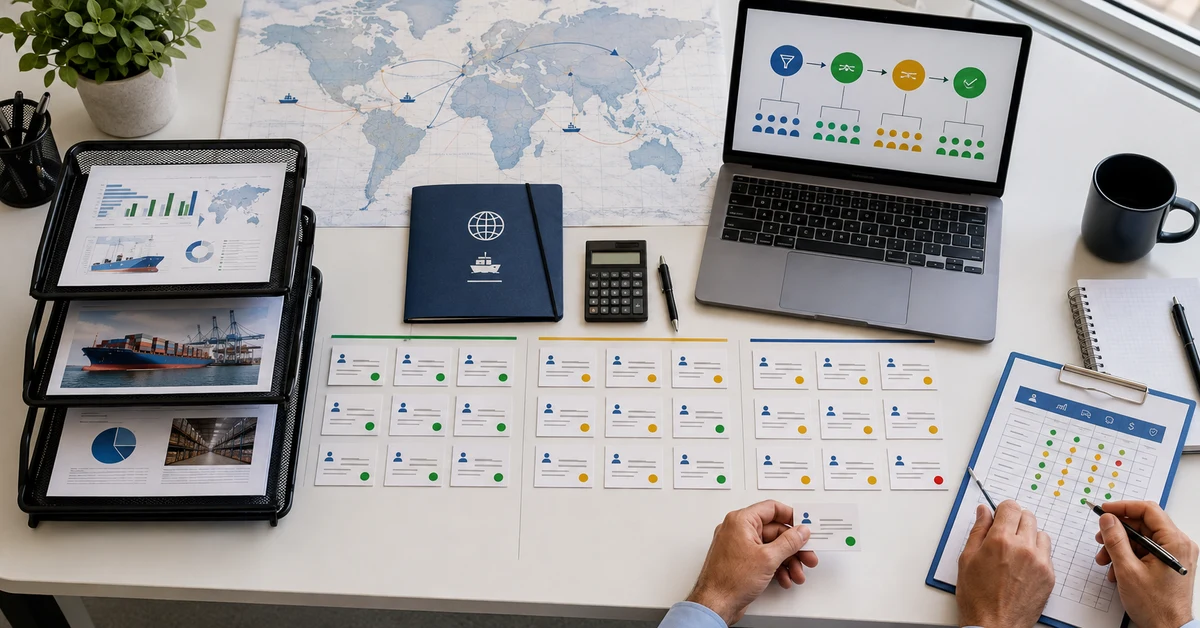
The decision this trial is designed to make
The trial answers a narrow buyer question: Can this platform produce a reviewable path from market research to a sales-ready record for our actual export motion? It does not try to prove that software will create revenue on its own.
Before logging in, write the decision on one line. For example: “Use the platform for distributor research in Germany if at least 70% of suitable records contain enough evidence for a reviewer to accept or reject them in under three minutes.” Your percentage and time limit are internal choices, not SaleAI defaults.
A credible AI sales tool evaluation separates four outcomes:
- discovery usefulness;
- record handoff;
- unattended work;
- outreach readiness.
Name the work before naming the vendor
Teams often begin a sales platform comparison by asking whether a product “has AI.” That question is too loose to score. Name the work instead: finding potential importers, organizing accounts, preparing research, scheduling repeatable tasks, or reviewing campaign results.
Give each job an observable finish line. “Find distributors” becomes “return companies in the chosen country with enough source context to judge fit.” Describe what a reviewer can see, not what a demo implies.
The SaleAI backend workflow article provides a broader product map. This trial is different: it treats the interface as evidence and asks whether a specific operating decision can be made from it.
Build a 30-lead sample that can reveal mistakes
Do not feed the tool 30 near-identical companies. A forgiving sample makes almost any product look accurate. Use three deliberately different groups.
| Sample group | Records | What belongs in it | What the group reveals |
|---|---|---|---|
| Clear fits | 10 | Known target companies matching geography, buyer type, and product use | Whether the tool can recover expected opportunities |
| Borderline cases | 10 | Companies with incomplete sites, mixed business models, or ambiguous relevance | Whether evidence is sufficient for human judgment |
| Negative controls | 10 | Suppliers, competitors, irrelevant industries, wrong markets, or consumer-only businesses | Whether volume is being mistaken for fit |
Keep a hidden answer key and record why each company belongs in its group. Changing the definition after seeing the output invalidates the score.
For an AI lead generation trial, use one product family and one region. The World Customs Organization explains that the Harmonized System uses six-digit product codes in more than 200 countries and economies. A research tool may help explore trade records; it is not the legal authority for classification.
What the current SaleAI workspace can prove
The live review found New Chat, CRM Management, Enterprise Email, Email Marketing, Automation Center, Automated Business Data, Automated Social Data, Customs Data, Linkedin Data, and Search Chats. New Chat also displayed source shortcuts, attachment, memory, learning, customer settings, and model controls.
These observations define the test surface, not universal source coverage, email verification, or plan access.
| Visible workspace area | Evidence a buyer can collect | Boundary to keep in the report |
|---|---|---|
| Automated Business Data | Recent and historical tasks, enterprise/customs source totals, marketable email or phone totals, collection and marketing states | A count does not establish relevance, permission, or current accuracy |
| Automated Social Data | Task history and source splits for Instagram, Facebook Pages, Google Data, and Google Maps | A public profile is not proof of buyer intent |
| SaleAI CRM | Contact and company views, tags, stages, owners, import/export, assignment, filters, and column settings | The reviewer must still define field and ownership rules |
| Automation Center | Started automations, running tasks, enabled schedules, approvals, run health, status distribution, and recent attention items | Visible failure status does not prove automatic diagnosis or repair |
| Email Marketing | Campaign preparation and delivery/opening indicators available for review | Delivery or opening does not prove consent or commercial interest |
Evidence pack A: discovery usefulness
Run the same search brief for all 30 cases. Save the query, market, date, source, and returned evidence. In an AI sales tool evaluation, the useful unit is a lead plus enough context to make a decision.
Ask the reviewer to label each record accept, investigate, or reject and state why. Count a clear fit as recovered only when the record supports the answer key. Count a negative control as correctly handled only when the reviewer can reject it without guessing. For borderline records, score evidence sufficiency rather than forcing a yes.
Maps, social pages, search results, LinkedIn data, and customs records answer different questions. The B2B lead source tracking guide shows how to preserve that context.
Evidence pack B: record handoff
Discovery has value only if the result can enter the team's working system without creating a cleanup project. Choose five accepted records and inspect the route into CRM Management.
Check company identity, contact details, stage, tag, owner, last-contact time, and the research note. Empty, uncertain, and confirmed values must remain distinguishable.
Use SaleAI CRM import preparation for batch handoff and the B2B data revalidation workflow for older details. Full points require a salesperson to understand why the record exists and what happens next.
Evidence pack C: unattended work
Choose one reversible research task for a short sales automation pilot. Automation Center showed creation, started workflows, running tasks, schedules, approvals, 7-day or 30-day Run Health, status, attention items, and view, pause, run-now, and archive controls.
Observe three executions and capture planned time, status, output, attention state, and reviewer decision. Automated Business Data and Automated Social Data separate collection from automated marketing: research can succeed while marketing fails or stays disabled.
Actual task history included both successful and failed marketing states. Treat that as a reason to test failure visibility. Do not infer that the system guarantees a send, retries automatically, or explains every root cause.
Evidence pack D: outreach readiness
For three accepted records, prepare but do not send an outreach draft. Judge whether each message is grounded in the record and ready for a named sender to approve.
Check company reference, product claim, language, sender identity, subject, reply route, and opt-out handling. Email Marketing exposes campaign and performance information; Enterprise Email is separate. Confirm sender setup, recipient rules, and plan access in a walkthrough.
Legal review belongs outside the score generated by the platform. The US FTC CAN-SPAM guide covers accurate headers, non-deceptive subjects, postal-address disclosure, and opt-out requirements, including B2B commercial email. The UK ICO guidance on B2B marketing explains that the rules vary by channel and by whether a contact is a corporate subscriber or an individual. Apply the rules for each market; software settings are not legal advice.
The red-line stop rules
Write stop conditions before the first output. A defensible AI sales tool evaluation puts them in the evidence pack, not in a private judgment added at the end.
Pause the trial if a negative control is repeatedly presented as a strong fit, source context disappears during handoff, personal data cannot be corrected, a task failure is invisible to the operator, or a draft invents a product or customer claim. Also stop external activation when recipient eligibility, sender identity, or suppression handling is unresolved.
The ICO accuracy principle requires reasonable steps to keep personal data accurate and to rectify or erase inaccurate data without delay where appropriate. A field marked “marketable” inside a workspace is an operational status, not a universal legal conclusion.
One scorecard, four reviewers
The person who configured the tool should not be the only judge. Have sales, operations, data/privacy, and management review the same evidence from different angles.
| Dimension | Weight | Sales reviewer asks | Operations or risk reviewer asks |
|---|---|---|---|
| Discovery usefulness | 30% | Would I pursue this company? | Is the decision traceable to a source? |
| Record handoff | 25% | Can I understand and act on the CRM record? | Are identity, owner, and field states controlled? |
| Unattended work | 20% | Did the task save repeatable effort? | Can status, failure, and approval needs be seen? |
| Outreach readiness | 15% | Is the draft specific and factually sound? | Are sender, recipient, and opt-out checks complete? |
| Adoption cost | 10% | Can the team repeat the workflow? | What training, review time, and cleanup remain? |
Use written anchors: 1 means unusable or untraceable; 3 means useful with routine correction; 5 means consistently usable within the trial's boundaries. Record reviewer disagreements instead of averaging them away.
This mirrors the spirit of the voluntary NIST AI Risk Management Framework: govern the use, map the context, measure performance, and manage the observed risks. NIST is a governance reference here, not a certification of SaleAI or any other vendor.
What to record when the tool fails
A failed case can be more informative than a clean demo. Log its record ID, intended job, source, observed and expected output, impact, reviewer, and next decision.
Use plain categories: wrong company, insufficient evidence, stale contact, missing field, duplicate or ownership conflict, task failure, unsupported message claim, or policy concern. Avoid a catch-all label such as “AI error.” It cannot guide configuration or procurement.
Ask whether the cause was the brief, source, platform, handoff rule, or the team's definition. The B2B sales tool scorecard then shows whether a problem is isolated, systematic, or out of scope.
Read the result without fooling yourself
At the end of the trial, reveal the answer key and compare all four evidence packs. Report raw counts alongside percentages: for example, “8 of 10 clear fits recovered” is harder to misread than “80% accuracy.” Do not combine an uncertain record and a wrong record unless your scoring policy said so in advance.
Count reviewer time as well as software time. A fast list of 200 names may lose to a smaller, better-explained set if operators spend hours rejecting noise.
Run the same AI sales tool evaluation with the closest alternative or the current manual process. Keep the input, answer key, reviewers, and stop rules unchanged. The result should support a decision such as proceed, proceed with limits, retest after configuration, or decline. “The demo looked good” is not a fifth outcome.
Where SaleAI fits after the trial
The current SaleAI workspace brings research entry points, automated business and social data tasks, CRM controls, automation oversight, enterprise email, and email marketing into one logged-in environment. That makes it a plausible candidate for export teams that want to test a connected export prospecting workflow rather than buy an isolated writing assistant.
Fit still depends on country, source, volume, governance, and outreach method. A controlled AI sales tool evaluation finds that boundary. Preserve the 30-record evidence and ask SaleAI to demonstrate the exact handoff, schedule, approvals, and sender setup you expect. Teams can review SaleAI pricing and request a walkthrough built around their answer key.
FAQ
How long should an AI sales tool evaluation take?
A focused 30-lead trial can usually be reviewed within several working sessions. Allow time for setup, three unattended task runs, independent scoring, and a final comparison with the current process rather than rushing everything into one demo call.
Why use exactly 30 leads?
Thirty is not a statistical guarantee. It is a practical procurement sample that gives clear fits, borderline cases, and negative controls equal visibility while keeping every record reviewable by a human.
Which AI tools for export business should be compared?
Compare tools that match the job you actually need: market research, customs-data exploration, social or web discovery, CRM management, workflow automation, or outreach. A broad platform and a specialist database should be scored only on overlapping work.
Can SaleAI search customs data?
The reviewed workspace included a Customs Data destination and customs-data entry points. Buyers should test coverage for their products and markets, confirm subscription access, and use qualified customs advice for legal classification decisions.
Does SaleAI verify every email address automatically?
That universal claim was not verified. The workspace showed marketable email and phone totals in automated-data tasks, but teams should test freshness, evidence, correction handling, and suitability for the intended campaign.
Can records be moved into SaleAI CRM?
CRM Management showed contacts, companies, imports, exports, assignment, tags, stages, filters, and column settings. The trial should confirm the exact handoff route and required fields for your workflow.
Can SaleAI run sales tasks on a schedule?
Automation Center displayed enabled scheduled tasks, running and started counts, Run Health views, approvals, and execution statuses. The available trigger, retry, and action options should be confirmed for the specific automation you plan to use.
Should the trial include live email sending?
Begin with drafts unless sender configuration, recipient eligibility, suppression handling, approval ownership, and applicable law have already been reviewed. A procurement test does not need to contact real prospects to assess message quality.
What is a passing score for export sales software?
There is no universal threshold. Set weights and minimums before testing, and make red-line failures override the average. A platform can score well overall and still be unsuitable for a high-risk action.
What should an export team ask in a SaleAI demo?
Ask the presenter to run your own search brief, explain the visible source evidence, show how a record reaches CRM, open run status and failures, and demonstrate the exact approval and email setup you would use. Bring the AI sales tool evaluation answer key so the demo can be scored against known cases.
