


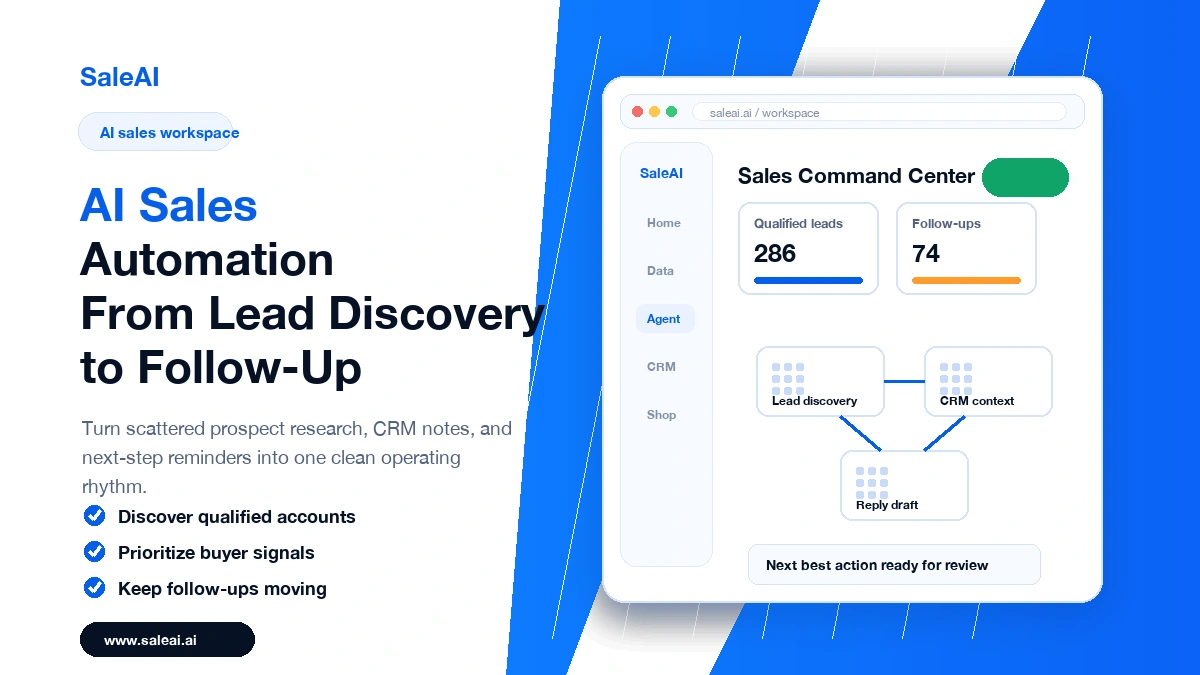
AI sales automation has changed from a simple productivity tool into a full operating system for modern revenue teams. Instead of only helping reps write an email or summarize a call, the new generation of AI tools can help teams find prospects, understand account signals, prepare outreach, execute browser-based tasks, and keep customer records updated.
For B2B companies, this matters because sales work is rarely one clean action. A typical workflow might include researching a company, checking its website, finding decision makers, comparing market signals, drafting a personalized message, sending a quote, updating a CRM record, and scheduling the next follow-up. When each step lives in a different tool, teams lose time and context.
SaleAI is designed for this kind of connected workflow. It combines AI Agents, Data, Shop, and CRM capabilities so teams can move from opportunity discovery to customer management without rebuilding the same process every day.
What AI Sales Automation Actually Means
AI sales automation is the use of artificial intelligence to reduce repetitive sales work while improving the quality and timing of each customer interaction. It can support prospecting, data enrichment, lead qualification, content generation, quote preparation, task execution, and follow-up management.
The goal is not to remove the salesperson from the process. The goal is to give sales teams more time for judgment, negotiation, relationship building, and strategy. AI handles the repeatable work. People handle the decisions that require context and trust.
Why B2B Sales Teams Need a Connected Workflow
B2B sales cycles often involve multiple stakeholders, long research paths, and many small operational steps. A rep may need to verify company information, understand buying signals, write a relevant message, and follow up several times before a conversation starts.
When these actions are disconnected, three problems appear:
- Good leads are missed because research is too slow.
- Outreach becomes generic because there is not enough account context.
- Follow-up is inconsistent because CRM updates depend on manual work.
AI sales automation works best when it connects the whole process instead of optimizing one isolated task.
The Core Stages of AI-Powered B2B Sales
1. Find and Understand Potential Customers
The first stage is finding the right accounts. SaleAI Data supports company intelligence, social signals, domain insights, and trend discovery. This helps teams understand which companies may be relevant before spending time on outreach.
Instead of starting from a blank spreadsheet, sales teams can use AI-assisted data workflows to identify target companies, organize useful signals, and prioritize accounts that match their market.
2. Turn Research Into Useful Outreach
Once a team has account context, the next step is communication. AI can help draft emails, product explanations, quote messages, and follow-up notes based on the prospect's industry, product interest, and likely pain points.
The best AI sales automation tools do not simply generate polished language. They help turn research into a message that feels specific and useful.
3. Execute Web-Based Sales Tasks
Many sales workflows still happen inside browsers: filling forms, publishing information, extracting details from pages, checking supplier or buyer profiles, and moving data between systems. SaleAI Agent is built to execute these kinds of web actions, including clicks, forms, extraction, and publishing tasks.
This is where AI automation becomes more practical. Instead of stopping at a suggestion, an AI agent can help complete the next operational step.
4. Keep Follow-Up Organized in CRM
Follow-up is where many sales opportunities are lost. A lead may be interested, but if the next action is not recorded, assigned, and sent at the right time, momentum disappears.
SaleAI CRM brings customer profiles, suggested actions, and AI-assisted follow-up into the same growth loop. This helps teams keep customer conversations organized and easier to act on.
What to Look for in an AI Sales Automation Platform
When evaluating an AI sales automation platform, B2B teams should look for more than a writing assistant. A practical platform should support:
- Lead and account research
- Data enrichment and market signals
- AI-assisted email and quote writing
- Browser task execution
- Product and SEO content generation
- CRM records, follow-ups, and customer profiles
- Team visibility and repeatable workflows
This broader view is important because sales performance depends on the handoff between tasks. If the data is strong but follow-up is weak, opportunities slow down. If the writing is good but lead selection is poor, campaigns waste time. If the CRM is clean but execution is manual, reps still lose hours.
How SaleAI Fits the Modern Sales Workflow
SaleAI brings four systems together:
- SaleAI Agent executes web actions and workflow instructions.
- SaleAI Data provides company, social, domain, and market intelligence.
- SaleAI Shop generates product descriptions, visuals, SEO pages, and site content.
- SaleAI CRM supports customer profiles, suggested actions, and follow-up messages.
Together, these systems create a loop: discover opportunities, generate content, execute tasks, manage customers, and use the next round of data to optimize the process.
A Practical Example
Imagine a B2B exporter preparing to reach new distributors. The team needs to identify target companies, review their websites, understand product fit, write an introduction, prepare sales materials, and track replies.
With a connected AI sales automation workflow, the team can use data tools to identify prospects, AI writing to prepare outreach, an agent to complete repetitive web actions, and CRM features to organize replies and next steps. The result is not a fully hands-off sales motion. It is a faster, more consistent process where people focus on the accounts that deserve attention.
Final Thoughts
AI sales automation is most valuable when it connects the daily work that B2B teams already do: research, outreach, execution, and follow-up. Tools that only write copy or only store contacts solve part of the problem. Platforms that connect data, agents, content, and CRM can support the full sales workflow.
For teams that want to reduce manual busywork and build a more repeatable growth process, SaleAI offers a practical way to bring AI into B2B sales operations.
FAQ:
Q: What is AI sales automation? A: AI sales automation uses artificial intelligence to support repetitive sales tasks such as prospect research, outreach writing, browser actions, CRM updates, and follow-up planning.
Q: Is AI sales automation only for large companies? A: No. Small and mid-sized B2B teams can benefit because they often have limited sales operations resources and need to make research, outreach, and follow-up more efficient.
Q: How is SaleAI different from a basic AI writing tool? A: SaleAI combines AI Agents, Data, Shop, and CRM features, so it can support research, content generation, task execution, and customer management in one workflow.
