


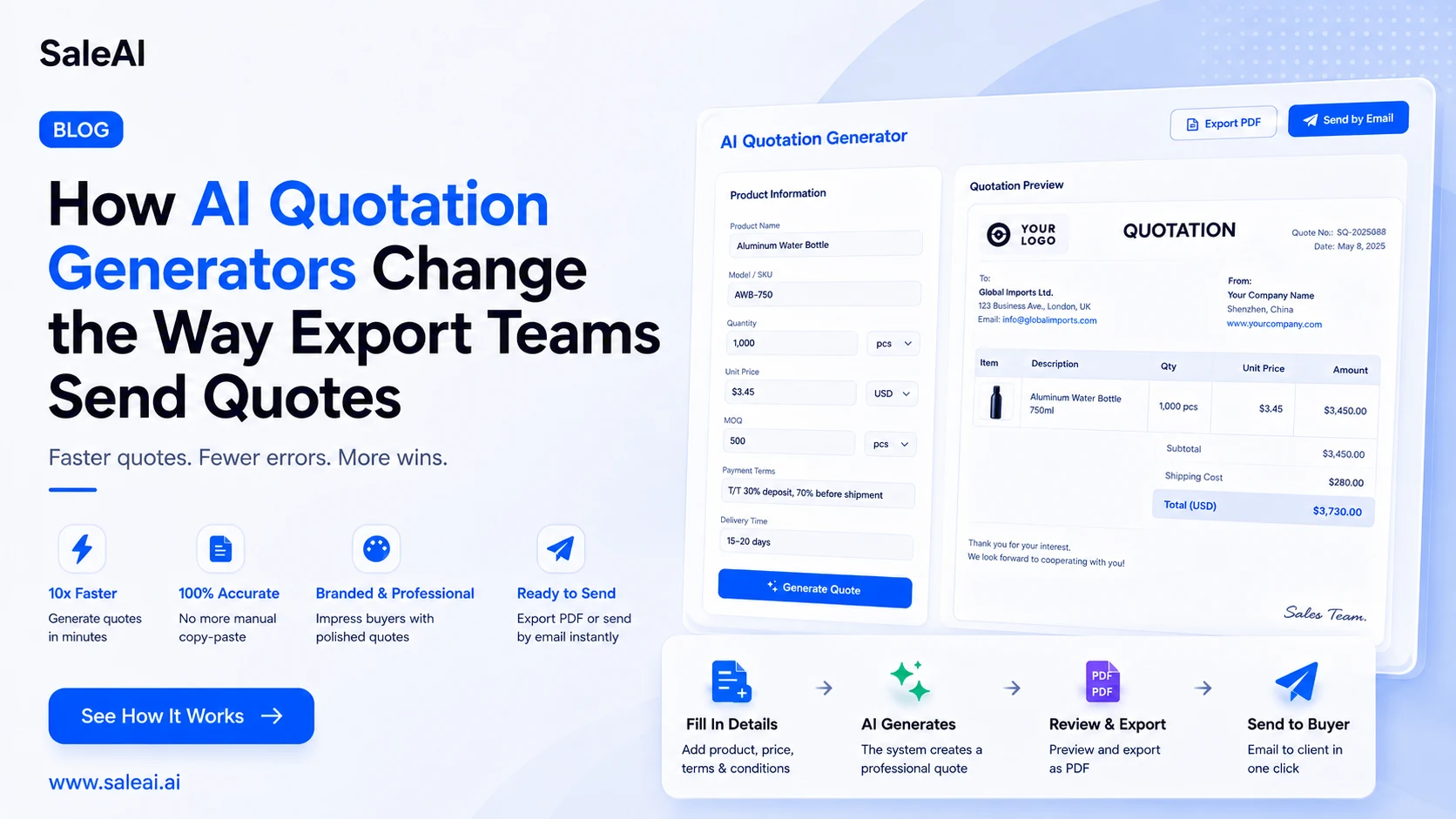
A buyer asks for pricing at 4:50 PM.
The sales team now needs to:
- confirm MOQ
- calculate pricing
- check lead time
- format the quotation
- export PDF
- prepare the email
The problem is not the quotation itself.
The problem is everything surrounding it.
For many exporters, this process still depends on:
- copied Excel files
- old Word templates
- manually edited PDFs
- repeated formatting work
This is why more teams are moving toward structured AI quotation generator workflows instead of rebuilding every quote from scratch.
Buyers Judge More Than Just Price
Most exporters focus heavily on:
- unit cost
- shipping terms
- margins
But buyers also evaluate:
- clarity
- speed
- professionalism
- consistency
A confusing quotation creates friction immediately.
A clean quotation creates confidence before negotiation even starts.
What Makes Quotations Difficult at Scale
One quotation is easy.
Managing:
- 30 RFQs
- multiple currencies
- revised quantities
- different shipping terms
- several salespeople
is where the process breaks down.
Common operational problems include:
| Workflow Problem | Real Impact |
|---|---|
| Old quotation templates | Incorrect information |
| Multiple PDF versions | Buyer confusion |
| Slow formatting work | Delayed replies |
| Missing follow-ups | Lost RFQs |
| Inconsistent layouts | Weak professionalism |
These problems usually appear long before teams realize quotations are becoming a bottleneck.
What an AI Quotation Generator Actually Improves
A good AI quotation generator does not only “create documents.”
It improves workflow continuity.
For example, it can help:
- standardize quotation structure
- organize product fields
- auto-fill recurring terms
- generate export-ready PDFs
- connect quotations with RFQs
- prepare follow-up drafts
The value comes from reducing repetitive operational work.
Why Speed Matters More Than Many Exporters Realize
In export sales, buyers often contact:
- multiple suppliers
- within the same day
- for the same RFQ
The supplier that replies:
- clearly
- professionally
- quickly
usually controls more of the conversation momentum.
A slower quotation workflow quietly reduces reply probability even when pricing is competitive.
A Real Export Quotation Scenario
A distributor from Spain requests:
- customized packaging
- FOB pricing
- revised MOQ options
The sales process includes:
- Product confirmation
- Pricing calculation
- MOQ adjustment
- Delivery estimation
- PDF quotation generation
- Follow-up reminder
Now multiply this by:
- dozens of active buyers
- several product lines
- different markets
Without structured systems, quotation handling becomes operationally chaotic very quickly.
Why Follow-Up Should Be Connected to Quotations
Most exporters separate:
- quotations
- email replies
- follow-ups
into different tools.
This creates visibility problems.
A stronger workflow connects:
- RFQ stage
- quotation version
- buyer engagement
- reminder timing
inside one process.
This is where AI-supported quotation workflows become especially valuable.
How SaleAI Supports Quotation Generation
SaleAI helps export teams:
- generate structured quotations
- organize RFQ workflows
- manage quotation versions
- track buyer engagement
- connect quotations with follow-ups
inside one export-focused workflow.
Instead of rebuilding every quotation manually, teams maintain more consistent communication across growing sales activity.
A scalable AI quotation generator is not just about faster PDFs.
It is about reducing friction across the entire quotation process.
A Simple Internal Test
If your team regularly asks:
❌ “Which quotation version is latest?”
❌ “Did we already revise this MOQ?”
❌ “Who followed up after the PDF?”
❌ “Where is the final quotation file?”
…then the bottleneck may no longer be pricing.
It may be quotation workflow structure itself.
