


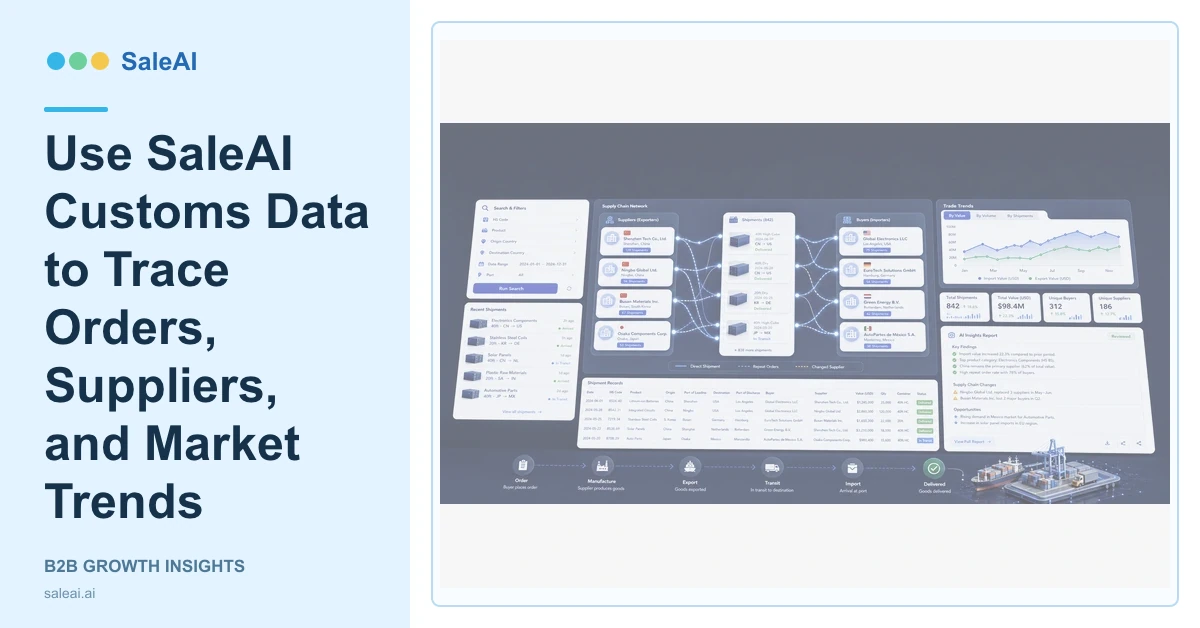
The TradeLink AI Insights page describes access to more than 800 million customs records and transaction details across 56+ countries and regions. SaleAI Customs Data can analyze industry trends, procurement areas, transaction activity, additional orders, buyer-supplier relationships, and AI-generated reports.
Trade records are valuable because they provide traceable commercial evidence. They still need careful scoping. Country coverage, reporting rules, product descriptions, company names, and shipment structures can differ.
Start with a specific trade question
| Question | Records to compare | Possible output |
|---|---|---|
| Is demand changing? | Product and market activity over time | Trend with period and coverage |
| Is this buyer active? | Repeated related transactions | Activity pattern, not guaranteed intent |
| Who supplies this company? | Supplier relationships and shipments | Traceable supplier map |
| Did sourcing change? | Supplier mix across periods | Change hypothesis for review |
| Which market deserves research? | Country and procurement patterns | Market-priority evidence |
A broad search can produce impressive numbers without answering a decision. A specific question gives SaleAI Customs Data a testable output.
Trace additional orders and supply-chain relationships
The product page highlights comprehensive traceability, including additional orders and supply-chain relationships of buyers and suppliers. Repeated transactions can reveal continuity. A changing supplier mix can suggest sourcing movement. A new category may indicate expansion or a classification difference that needs review.
The analysis should keep dates, product descriptions, parties, and the relationship path visible. Similar company names and intermediaries can complicate identity. A buyer record may represent a trading company, logistics party, subsidiary, or operating business.
Enterprise Scope can help research company identity and decision-makers. Automated Business Data can combine trade evidence with domain and corporate intelligence. Data Assets can preserve the reviewed result.
Generate an analytical report without hiding uncertainty
The AI-generated report can summarize trends, key procurement areas, transaction activity, and relationships. It should distinguish observed records from interpretation. If coverage is incomplete or company matching is uncertain, the report should say so.
A qualified importer candidate can move into SaleAI CRM only after the company role, product fit, ownership, and outreach reason are reviewed. Trade activity is evidence for qualification, not permission for aggressive messaging.
Use customs analysis for strategy as well as leads
Not every report needs to produce a contact list. SaleAI Customs Data can support market selection, category-demand review, competitor-supply-chain research, customer expansion analysis, and supplier-risk monitoring. The correct output may be a market conclusion or research priority.
The WTO trade statistics portal and the World Bank trade data topic provide authoritative external context. Comparing account-level customs evidence with broader trade information can expose conclusions that are too narrow.
Preserve the analysis trail
Save the filters, market, time period, record examples, company-matching decisions, and report date. Another reviewer should be able to understand how the conclusion was produced and what would invalidate it.
FAQ
What coverage does SaleAI Customs Data describe?
The product page states more than 800 million customs records across 56+ countries and regions.
Can it trace buyer and supplier relationships?
Yes. The page describes transaction traceability, additional orders, and buyer-supplier supply-chain relationships.
Does repeated importing prove current purchase intent?
No. It indicates historical activity and should be combined with company, timing, and product-fit research.
Can SaleAI generate a customs report?
Yes. The product page describes AI-generated analytical reports based on trade data.
What should move into CRM?
Only reviewed companies with verified identity, commercial fit, ownership, and a responsible outreach reason should become CRM work.
