


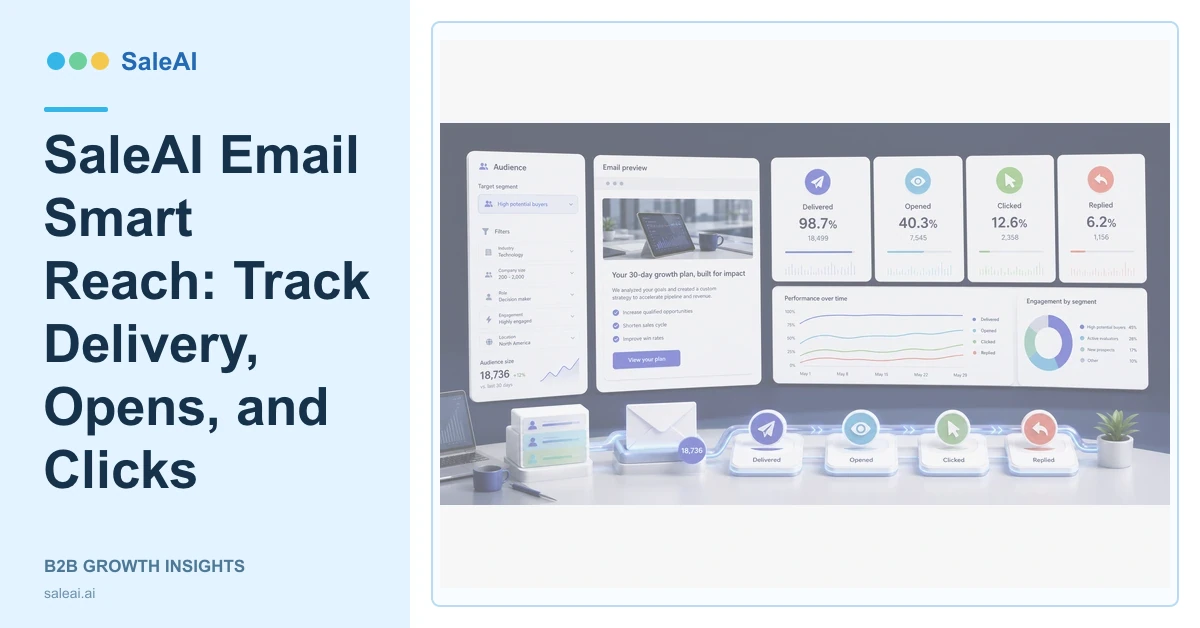
SaleAI Email Smart Reach combines targeted bulk outreach, AI-powered email generation, product-content integration, email management, and real-time performance tracking. The official product page specifically lists delivery, open, and click metrics as feedback teams can use to adjust campaigns.
Those metrics are useful, but they answer different questions. Delivery indicates whether the receiving system accepted the message. Opens provide an imperfect attention signal. Clicks show interaction with a tracked link. None of them proves that the recipient is a qualified buyer.
What each email metric can tell you
| Metric | What it can indicate | What it cannot prove |
|---|---|---|
| Delivery | Technical acceptance by the receiving server | Inbox placement or buyer relevance |
| Open | Possible message viewing | Genuine interest or correct identity |
| Click | Interaction with a linked resource | Purchase intent or decision authority |
| Reply | Direct response from the recipient | Qualification without reading the content |
| Unsubscribe | Audience or frequency rejection | The exact reason for every departure |
Some email clients preload images or protect user privacy, which can affect open tracking. Campaign decisions should therefore combine several signals and actual replies.
Start with a targeted audience
The product page describes filtering target audiences before bulk sending. SaleAI Email Smart Reach performs better when the audience is based on company role, product relevance, geography, source, and CRM history. A large mixed list makes performance numbers harder to interpret because different buyer groups respond for different reasons.
SaleAI CRM can provide account ownership and interaction history. Data Assets can provide research context. Customs Data or Enterprise Scope may support audience research. These sources should improve selection, not be pasted into a message in a way that feels intrusive.
Use AI generation and product integration carefully
SaleAI Email Smart Reach can use AI to draft emails and can incorporate store products into templates. The team should still check that the product is relevant to the segment, claims are approved, links are correct, and the message has one clear next action.
A template is useful for structure, but audience context should decide the opening question, proof, and call to action. An importer segment, a distributor segment, and an existing-customer segment should not receive the same message simply because they share a country.
Interpret campaign performance as a diagnostic
Low delivery may point to list quality, domain reputation, or sending configuration. Reasonable delivery with weak engagement may indicate poor targeting or messaging. Clicks without replies may suggest the page answered the question, the call to action was unclear, or the recipient was researching without an active project.
The result should return to CRM Management and future Data Assets. That creates a feedback loop: the campaign teaches the team which sources, segments, messages, and product links deserve more attention.
RFC 5321 defines the core SMTP transport standard, while the U.S. CAN-SPAM requirements cover commercial-email obligations. Technical delivery and legal communication rules remain important regardless of which platform sends the message.
What to change after the review
Change one major variable at a time: audience, message, product content, call to action, sending configuration, or timing. When several variables change together, the next result cannot explain which adjustment helped.
FAQ
What does SaleAI Email Smart Reach track?
The product page lists delivery, open, and click metrics for real-time campaign review.
Does an open mean the buyer is interested?
No. Open tracking can be affected by privacy features and does not prove qualification or purchase intent.
Can SaleAI create email content?
Yes. The product page describes AI-powered email generation tailored to audience attributes.
Can product information be included in templates?
Yes. SaleAI Email Smart Reach describes integration with store products and personalized email templates.
What should happen after a campaign?
Replies, rejections, engagement, and delivery problems should update CRM records, audience rules, and future campaign decisions.
