


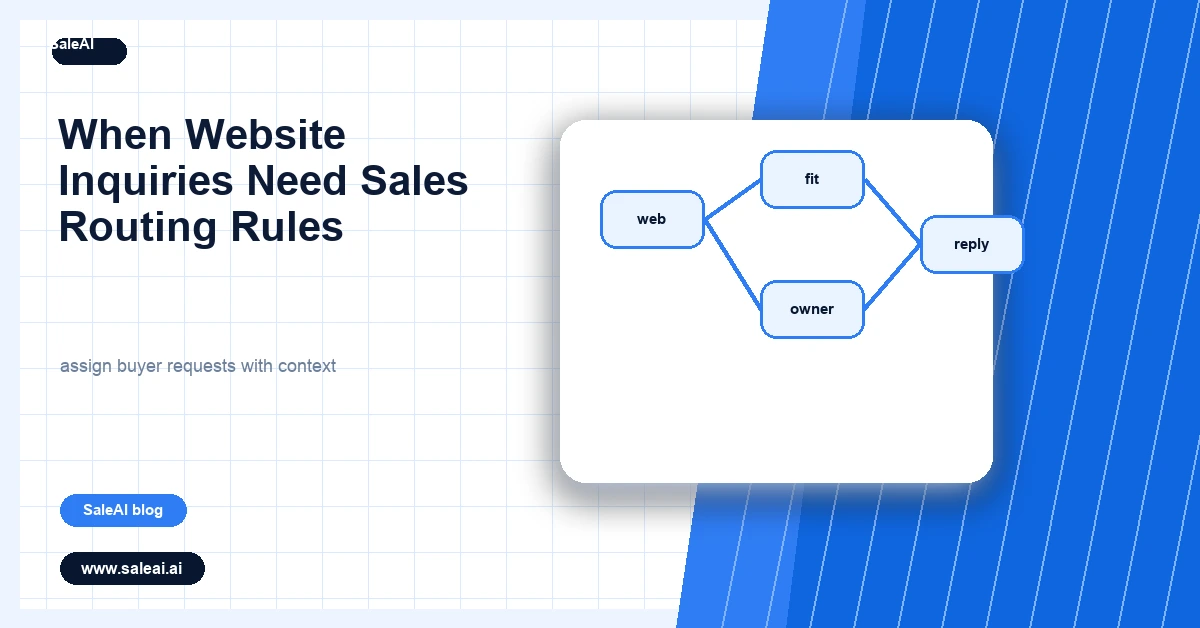
website inquiry routing is useful when the sales team has enough activity to create opportunity, but not enough shared context to decide what should happen next. For content-driven sales, the useful signal is the question behind the page view, download, or product inquiry.
Sales teams repeat the same explanations while useful product content stays disconnected from the CRM. The team should review the buyer action, the product category, the missing proof, and the next resource before contacting the account.
What the buyer is really asking for website inquiry routing
Buyers compare specifications, proof, examples, and supplier credibility before they are ready to talk. That is why website inquiry routing should be treated as an operating habit, not a one-time campaign idea.
For content-driven sales, the useful signal is the question behind the page view, download, or product inquiry. A rep should not mention tracking behavior; the message should simply be more useful because the context is better.
The same idea applies to sales operations. The same standard applies to website inquiry routing: information should help the buyer or the rep make progress. website inquiry routing matters because digital signals, remote conversations, and human follow-up often appear at different moments in the same buying journey.
When content should involve sales for website inquiry routing
This topic fits marketing teams, sales managers, and reps who answer product-fit questions. The team should use the website inquiry routing review to decide what deserves outreach, research, routing, or nurture.
If the team cannot define a qualified action for website inquiry routing, automation will only move the confusion faster. The website inquiry routing process should be agreed before it is scaled.
- Use website inquiry routing when the team needs clearer priority, not just more activity.
- Use website inquiry routing when the buyer trail exists but the next sales action is still hard to choose.
- Keep the first website inquiry routing rollout narrow until fields, owner rules, and review timing are clear.
How teams can connect pages, questions, and accounts for website inquiry routing
A practical process starts with the record that triggers attention. The team should review the buyer action, the product category, the missing proof, and the next resource before contacting the account.
For website inquiry routing, the first pass should stay simple. For website inquiry routing, a small set of reliable fields is better than a long form nobody trusts. Start with what helps the rep act today.
| website inquiry routing field | Question to answer | Sales decision |
|---|---|---|
| Viewed page | Is this signal specific enough to act on? | Review website inquiry routing route |
| Product question | Does this website inquiry routing account match the team's commercial threshold? | Prioritize website inquiry routing |
| Content gap | Who should be responsible for the next website inquiry routing touch? | Assign website inquiry routing owner |
| Account fit | Which website inquiry routing action is most relevant now? | Send content, ask a question, or prepare a quote |
What to review before outreach for website inquiry routing
A technical buyer reads a specification page three times but never submits a form. The sales team needs to know whether the page answered the real question. The purpose of a website inquiry routing review is to make the next message more specific, not to make the record longer.
| website inquiry routing review area | What it means | How the team should use it |
|---|---|---|
| Buyer context | buyers compare specifications, proof, examples, and supplier credibility before they are ready to talk | Use it to decide whether the account deserves action now. |
| website inquiry routing signal | A technical buyer reads a specification page three times but never submits a form. The sales team needs to know whether the page answered the real question. | Separate useful movement from background noise. |
| website inquiry routing response owner | A website inquiry routing content clue should lead to an owner, a response path, or a content fix, not just another note. | Prevents page activity from becoming a vague alert. |
| Outcome | Reply, meeting, quote movement, disqualification, or nurture. | Shows whether the process improved real sales work. |
Human judgment still matters. In website inquiry routing, some signals look strong but are poor fit, while smaller accounts may matter because the relationship or region is strategic.
When SaleAI connects content to CRM for website inquiry routing
SaleAI is most helpful when the team needs buyer data, CRM context, AI support, and sales content to work together. SaleAI reduces the time a rep spends connecting website inquiry routing context across disconnected tools.
For website inquiry routing, that means the platform should support practical work: identify the signal, connect it to the right account, suggest the next step, preserve notes, and make the manager review easier. The best result for website inquiry routing is a rep who understands the account before sending the next message.
Gartner research on B2B buying is useful context for website inquiry routing because buyers often move through several steps before speaking with sales. That matters for website inquiry routing because B2B buying usually develops through research, comparison, internal questions, partner conversations, and delayed follow-up.
Content signal mistakes to avoid: website inquiry routing
The biggest risk is treating website inquiry routing as a label instead of a decision process. For website inquiry routing, a dashboard alone will not change the buyer experience. The website inquiry routing process has to make the next sales move clearer.
Speed helps only when the message is specific. A useful website inquiry routing workflow gives the rep a product reason, timing reason, account reason, or question worth asking.
- For website inquiry routing, keep outreach focused on the buyer need rather than the tracking source.
- Avoid treating every page view as buying intent.
- Do not send website inquiry routing material that simply repeats the page or asset the buyer already reviewed.
- When website inquiry routing questions repeat, improve the page or resource as well as the sales reply.
How teams can measure useful content influence for website inquiry routing
Useful content influence should appear in better product questions, higher-quality replies, fewer repeated explanations, and more relevant follow-up.
| website inquiry routing approach | Use it when | Watch out for |
|---|---|---|
| Manual review | Small volume, simple account list, one sales owner | Slow once channels, regions, or product lines multiply |
| Basic CRM fields | Teams that need ownership and task control | Fields become stale when buyer signals are not connected |
| SaleAI-supported workflow | Teams that need data, CRM, AI assistance, and content context together | Requires clear rules so automation supports judgment |
Sales-worthy website inquiry routing inquiries need quick review, while broader content patterns can be discussed monthly with marketing. The best website inquiry routing review makes prioritization faster, especially for teams handling many similar accounts.
If reps still cannot explain the next website inquiry routing step, the workflow needs fewer fields and clearer rules.
A useful pilot check: website inquiry routing
Begin with one product category or one high-intent page before applying the process across the whole site. SaleAI can keep website inquiry routing data, task, account note, and follow-up context close enough for a rep to act.
Judge website inquiry routing by the quality of the follow-up conversation, not by the number of updated fields. The right time to expand website inquiry routing is after the pilot improves judgment across real accounts.
What to confirm before scaling for website inquiry routing
The content review becomes stronger when marketing and sales compare what the page promised with what buyers asked next. For website inquiry routing, review the buyer question behind the content. A website inquiry routing visitor reading specifications may need proof or comparison, while a reader on a general page may still be researching.
The follow-up should not reveal tracking behavior. The website inquiry routing response should feel relevant because the rep understands the product area and likely concern. If the same website inquiry routing question appears across several accounts, turn it into stronger product content and a reusable sales response. That keeps the workflow useful beyond one lead.
A simple way to keep the process honest: website inquiry routing
The content review becomes stronger when marketing and sales compare what the page promised with what buyers asked next. For website inquiry routing, review the buyer question behind the content. A website inquiry routing visitor reading specifications may need proof or comparison, while a reader on a general page may still be researching.
The follow-up should not reveal tracking behavior. The website inquiry routing response should feel relevant because the rep understands the product area and likely concern. If the same website inquiry routing question appears across several accounts, turn it into stronger product content and a reusable sales response. That keeps the workflow useful beyond one lead.
FAQ
What is website inquiry routing?
website inquiry routing is a sales workflow topic that helps B2B teams connect buyer context with a clearer next action.
Who should care about website inquiry routing?
It is most useful for marketing teams, sales managers, and reps who answer product-fit questions, especially when buyers compare specifications, proof, examples, and supplier credibility before they are ready to talk.
What problem does it solve?
It turns website inquiry routing content behavior into clearer buyer questions and next-step needs.
How does SaleAI help?
For content-led website inquiry routing, SaleAI can help sales see what the buyer explored and what response may fit next.
What data should be captured first?
Start with Viewed page, Product question, Content gap, Account fit, then add owner and outcome fields once the workflow is stable.
How often should managers review it?
Sales-worthy website inquiry routing inquiries need quick review, while broader content patterns can be discussed monthly with marketing.
What is a common mistake?
Sales teams repeat the same explanations while useful product content stays disconnected from the CRM.
Can this work for export sales teams?
Yes. Export teams often need website inquiry routing because markets, languages, distributors, and product requirements create more context than a simple CRM note can hold.
What should success look like?
Success should look like fewer repeated questions, stronger sales conversations, and better use of website behavior, not just more activity in the CRM.
When should the workflow be changed?
Adjust website inquiry routing when managers cannot explain why a record is prioritized.
