


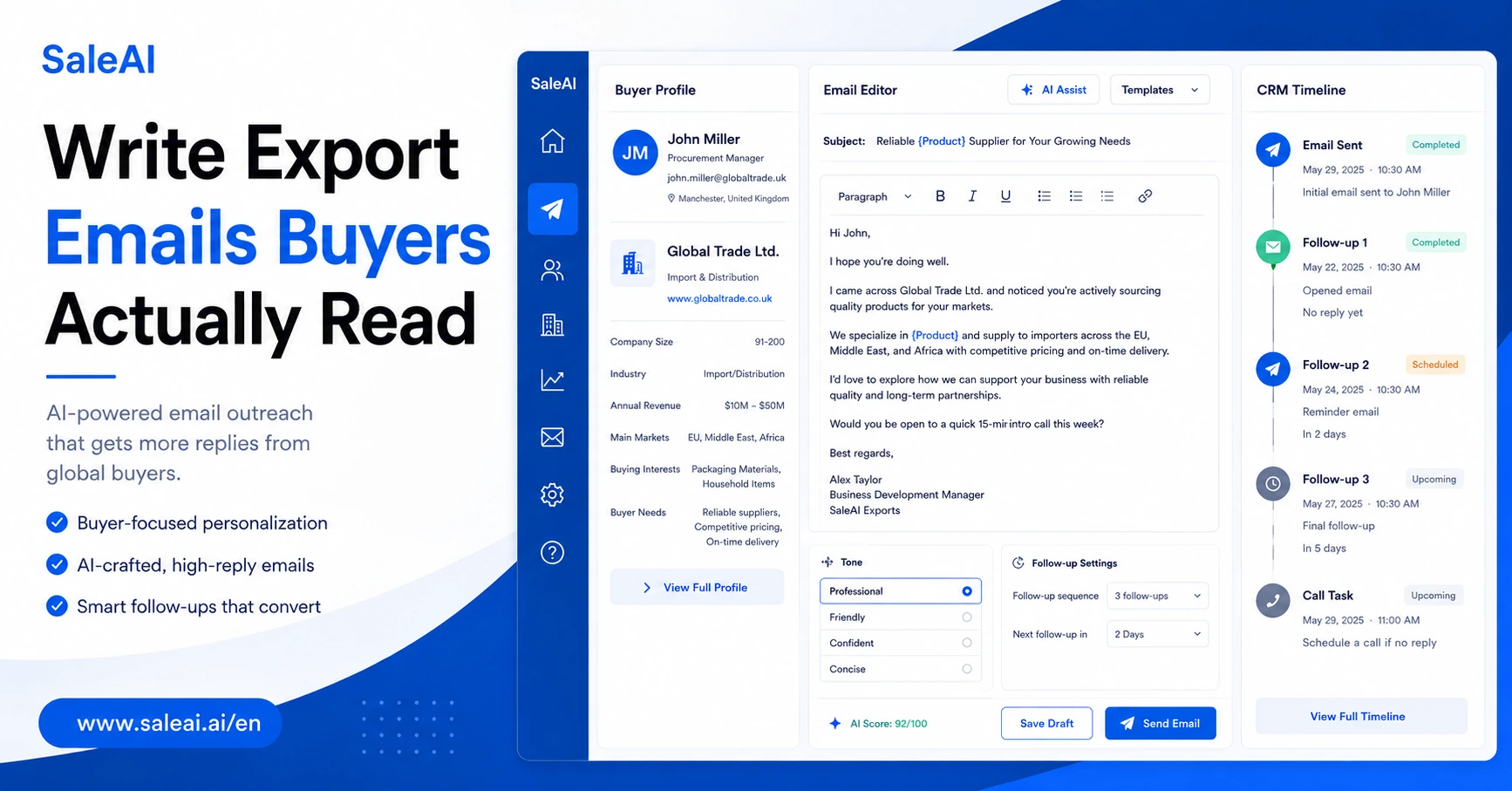
A buyer does not need to read the whole email to know it was sent to hundreds of companies.
Usually, the first two lines are enough.
Dear Sir,
We are a professional manufacturer with high quality and competitive price.
Export sales teams know this sentence too well. Many have used some version of it. It feels safe. It is polite. It says nothing wrong.
But it also says almost nothing useful.
The buyer does not know why you are writing to them.
They do not know why your product fits their market.
They do not know whether you understand their role.
They do not know what they should do next.
This is where AI email outreach for exporters can help — not by making every message longer, but by helping salespeople start from buyer context instead of a blank template.
Still, AI should not be used blindly. Export outreach needs judgment, timing, and a clear reason to contact the buyer.
Why Many Export Emails Get Ignored
Most cold emails are ignored for simple reasons.
They are not specific.
They talk too much about the supplier.
They do not explain why the buyer was selected.
They ask for attention before giving any useful context.
A common export email may include:
- Company history
- Factory size
- Product catalog
- Certification list
- “Best price”
- “High quality”
- “Hope to cooperate”
- A PDF attachment
None of these are always wrong.
The problem is order.
The buyer first wants to know:
| Buyer Question | What the Email Should Answer |
|---|---|
| Why are you contacting me? | Mention buyer role, market, or product relevance |
| What do you supply? | State the category clearly, not the whole catalog |
| Why might this matter to us? | Connect the offer to buyer business type |
| What is the next step? | Ask for a small, realistic action |
| Can I trust this supplier enough to reply? | Show clarity, not exaggerated claims |
If the first email cannot answer these questions quickly, the buyer may never reach the catalog.
The Real Role of AI in Export Email Outreach
AI should not turn a weak lead into a good buyer.
It should not invent facts.
It should not overpromise.
It should not send fully automated messages to high-value buyers without review.
The useful role of AI is narrower and more practical.
It helps salespeople prepare a better first draft.
For export teams, that means:
| Outreach Task | How AI Can Help |
|---|---|
| First email draft | Turn buyer role, product, and goal into a clear message |
| Tone adjustment | Write differently for CEO, buyer, distributor, or project manager |
| Follow-up email | Respond based on buyer silence, hesitation, or quote request |
| Short message version | Convert long email into WhatsApp-style message |
| Language cleanup | Reduce stiff translation tone |
| CTA improvement | Make the next step clearer |
| Email variation | Avoid sending the same message to every lead |
That is valuable because salespeople often do not struggle with knowing their product.
They struggle with turning buyer context into a message quickly.
Generic Email vs Buyer-Aware Email
Here is a simple comparison.
| Generic Export Email | Buyer-Aware Export Email |
|---|---|
| Starts with supplier introduction | Starts with buyer context |
| Lists many products | Mentions the most relevant product category |
| Uses broad claims | Gives one concrete reason to talk |
| Asks for cooperation | Suggests a small next step |
| Sounds like a template | Sounds written for that buyer type |
Example of a weak opening:
We are a professional lighting manufacturer in China. We provide high quality LED products with competitive price.
Example of a stronger opening:
I noticed your company works with commercial lighting projects in the UAE. We supply LED lighting products for distributors and project buyers who need stable delivery, clear quotation support, and project-ready options.
The second version is not perfect. It still needs real company details before sending.
But it gives the buyer a reason to continue reading.
Start With the Buyer, Not the Product
Many sales emails begin with the supplier because that is what the salesperson knows best.
But buyers do not respond because your company exists.
They respond when the message connects with something they are responsible for.
Different buyer roles care about different things:
| Buyer Role | Likely Concern | Email Angle |
|---|---|---|
| CEO / Owner | Margin, reliable supply, long-term value | Business fit and market opportunity |
| Purchasing Manager | MOQ, price, lead time, payment terms | Clear product and commercial details |
| Distributor | Product range, reorder stability, sales support | Category fit and supply consistency |
| Project Manager | Specification, delivery, customization | Project use case and timeline |
| Retail Buyer | Packaging, SKU, reorder, shelf appeal | Product line and retail readiness |
This is one reason the same email should not be sent to every person.
A CEO does not read like a purchasing assistant.
A distributor does not care about the same first line as an end user.
A project buyer may need technical confidence before price.
Good outreach reflects that difference.
Where AI Email Outreach Helps Most
AI email outreach helps most when the salesperson already has useful input.
For example:
- Buyer type
- Product category
- Target country
- Contact role
- Outreach goal
- Previous interaction
- Quote status
- Follow-up timing
- Buyer concern
The better the input, the better the draft.
A poor prompt might be:
Write a cold email for my product.
A better prompt would be:
Write a short export sales email to a purchasing manager at a hotel furniture distributor in Dubai. We supply custom hotel room furniture. The goal is to ask whether they are reviewing new suppliers for upcoming projects. Keep it natural and not too promotional.
AI does not replace sales knowledge. It organizes it into usable language.
What Should Not Be Automated Blindly
Some outreach should always be reviewed by a human.
Especially when:
| Situation | Why Human Review Matters |
|---|---|
| High-value account | A generic message can damage the opportunity |
| Sensitive price discussion | Discounts and terms need commercial judgment |
| Technical product | Wrong claims can create trust issues |
| Compliance-related product | Certification language must be accurate |
| Existing customer | Tone and history matter |
| Complex negotiation | AI may miss relationship context |
| Cultural nuance | Some markets expect different communication styles |
For export teams, the best process is not “AI writes and sends everything.”
A safer process is:
- AI prepares the draft.
- Salesperson reviews buyer context.
- Product and price details are checked.
- Message is adjusted for tone.
- Email is sent or scheduled.
- Follow-up is tracked.
This keeps speed without giving up control.
A Practical Email Workflow for Export Teams
A good export email workflow starts before writing.
Step 1: Check whether the lead deserves an email
Do not write first. Qualify first.
Check:
- Does the buyer match your product category?
- Is the company active?
- Is the country relevant?
- Is there a buyer-facing role?
- Can you explain why you are reaching out?
If you cannot answer these, the email will likely sound generic.
Step 2: Choose the email goal
Not every email should ask for the same action.
Possible goals include:
| Situation | Better Email Goal |
|---|---|
| First contact | Ask if they review suppliers in this category |
| After buyer visits website | Offer product details or catalog |
| After RFQ | Send quotation or clarify missing details |
| After quote sent | Ask whether MOQ, price, or delivery works |
| After silence | Give a simple reason to reopen the conversation |
| After hesitation | Share proof, case, FAQ, or alternative option |
A clear goal keeps the email shorter.
Step 3: Write around one message
One email should not do everything.
It should not introduce the company, list all products, explain all certifications, attach every file, ask for a meeting, and request a reply in the same message.
Pick one angle.
For example:
- Supplier introduction
- Product fit
- Quotation follow-up
- Sample option
- Customization support
- Market-specific offer
- Reorder support
The buyer should know what to do next.
Step 4: Adjust tone by channel
Email and WhatsApp should not sound the same.
| Channel | Better Style |
|---|---|
| Structured, polite, clear CTA | |
| Short, conversational, direct | |
| Light introduction, not too sales-heavy | |
| Follow-up email | Brief reminder plus useful context |
| Quote email | Clear attachment or quote link with key terms |
SaleAI’s Email Writer Agent is useful here because it can help convert the same sales intention into different formats.
The point is not to write more.
The point is to write in the format the buyer is more likely to read.
Example: First Email Draft
Here is a simple export email structure:
Subject: LED lighting supply for commercial projects in UAE
Email:
Hi [Name],
I noticed your company works with commercial lighting and project supply in the UAE.
We manufacture LED lighting products for distributors and project buyers who need stable delivery, clear quotation support, and product options for commercial spaces.
I am not sure whether you are reviewing new suppliers now, but I can send a short product list with MOQ and lead time if useful.
Best regards,
[Name]
This email is not flashy.
That is the point.
It gives context, explains relevance, and asks for a small next step.
Example: Follow-Up After No Reply
A follow-up should not simply say “waiting for your reply.”
Better:
Hi [Name],
Just following up on my last message about LED lighting supply for commercial projects.
If this category is not something you handle, no problem. If you are reviewing suppliers later this year, I can send a short product list with MOQ, lead time, and sample options for reference.
Best regards,
[Name]
This gives the buyer an easy way to respond.
It also reduces pressure.
Example: Follow-Up After Sending a Quote
Hi [Name],
I wanted to check whether the MOQ and delivery time in the quotation work for your current order plan.
If the first order quantity is still uncertain, I can also prepare a smaller trial-order option for comparison.
Best regards,
[Name]
This is better than a generic reminder because it continues the buying discussion.
How SaleAI Supports Email Outreach
SaleAI connects email writing with the rest of the export sales workflow.
A practical workflow may look like this:
- Use Lead Finder Agent to find possible buyers by product and market.
- Use Company Insight Agent to check whether the company looks worth contacting.
- Use Email Writer Agent to generate a first message based on buyer role and goal.
- Use Quote Generator Agent if the buyer requests pricing.
- Use CRM to track reply status, quote status, and follow-up timing.
This matters because outreach is not just writing.
A good email depends on:
- Who the buyer is
- What they may need
- What product fits them
- Whether they asked for a quote
- Whether they replied before
- What the next action should be
When those details are connected, email writing becomes more relevant.
How to Measure Better Email Outreach
Open rate alone is not enough.
Export teams should track:
| Metric | What It Shows |
|---|---|
| Reply rate | Whether the message creates conversation |
| Positive reply rate | Whether replies are commercially useful |
| Quote request rate | Whether buyers move toward pricing |
| Follow-up response | Whether timing and message angle work |
| Meeting or WhatsApp add rate | Whether the buyer wants further discussion |
| Market response by country | Which regions deserve more focus |
| Template variation performance | Which message angles work better |
The goal is not to write beautiful emails.
The goal is to move real buyers to the next step.
Common Mistakes in Export Email Outreach
Mistake 1: Starting with company introduction
Buyers do not need your full company background in the first line. Start with why the message is relevant to them.
Mistake 2: Sending one email to every role
CEO, purchasing manager, distributor, and project buyer should not receive the same message.
Mistake 3: Overloading the first email
Too many products, claims, files, and requests make the email harder to answer.
Mistake 4: Using AI without buyer context
If the input is generic, the output will be generic. AI needs buyer role, product, market, and goal.
Mistake 5: Forgetting follow-up
Many buyers do not reply to the first email. A clear follow-up plan matters as much as the first draft.
FAQ
What is AI email outreach for exporters?
AI email outreach for exporters means using AI to help draft, adjust, and follow up on sales emails for overseas buyers. It can support first contact emails, RFQ replies, quotation follow-ups, and role-based message writing.
Can AI write export sales emails better than templates?
AI can write better than static templates when it uses buyer context, product category, target market, and outreach goal. However, salespeople should still review facts, tone, and commercial details before sending.
What should an export sales email include?
An export sales email should include buyer context, product relevance, a short supplier explanation, one clear reason to continue the conversation, and a simple next step.
How long should a first export email be?
A first export email should usually be short. Around 100–150 words is often enough if the message is specific and easy to answer.
Should exporters use the same email for every buyer?
No. Different buyer roles care about different things. A distributor, purchasing manager, CEO, and project buyer should receive different message angles.
How can SaleAI help with export email outreach?
SaleAI helps by connecting buyer search, company insight, AI email writing, quotation generation, and CRM follow-up, so messages are based on context instead of copied templates.
Final Takeaway
The first email is not hard because writing is hard.
It is hard because the message has to prove relevance quickly.
A buyer does not need another supplier introduction that sounds like every other email. They need to understand why you contacted them, what you offer, and what small next step makes sense.
AI can help export teams get there faster.
But the strongest results come when AI is used with buyer context, not as a blind template machine.
SaleAI helps connect that context — from lead search to company insight, email writing, quotation, and CRM follow-up — so export teams can write messages that sound less copied and more worth answering.
