


A long list of company names can feel like progress.
You export the file. There are hundreds or even thousands of contacts. Some have emails. Some have websites. A few look like importers. The sales team starts sending messages.
Then the usual problems appear.
Some emails bounce.
Some companies are not in the right industry.
Some are too small.
Some stopped importing years ago.
Some never reply because they were never a good match in the first place.
For many export teams, the problem is not that they cannot find data. The problem is that they cannot quickly tell which buyers are worth contacting.
That is why finding overseas buyers should not start with buying the biggest lead list. It should start with a better process.
Why Random Lead Lists Often Fail Export Teams
A random lead list usually gives you names before it gives you context.
That creates a hidden cost. Your team still needs to check whether each company is active, whether it imports your type of product, whether the website is still working, and whether there is a realistic reason to contact them now.
A lead list may look valuable because it contains many rows. But export sales is not won by contacting the most companies. It is won by contacting the right companies with the right message at the right time.
The International Trade Administration recommends using structured resources and services to make the search for foreign buyers and partners more efficient. It also describes pre-qualification as part of identifying the best prospects in a target country.
That matters because qualification changes the way your team works.
Instead of asking:
“How many contacts do we have?”
A better question is:
“Which companies have enough buying signals to deserve our first email?”
What Makes an Overseas Buyer Worth Contacting?
A useful buyer lead should answer more than one question.
At minimum, your team needs to know:
| Question | Why It Matters |
|---|---|
| Is this company in the right industry? | A general company match is not enough. Product category fit matters. |
| Is the company still active? | A working website, updated profile, or recent signal reduces wasted outreach. |
| Does it import, distribute, resell, or source products? | Export teams need buyers, not just any business contact. |
| Is there a relevant person or department to contact? | A generic inbox is weaker than a role-based contact or buyer-facing team. |
| Is the market suitable for your product? | Some countries may have stronger demand, better pricing, or easier entry. |
| Can your offer solve a visible problem? | Better outreach starts from buyer context, not from a product catalog. |
This does not mean every signal must be perfect. In real sales work, that almost never happens.
But a buyer with three or four useful signals is usually more valuable than a company name with only an email address.
Start With Product and Market Fit
Many export teams begin with a broad keyword like “importer” or “distributor.” That creates noisy results.
A better approach is to search with product-specific and market-specific intent.
For example, instead of searching:
importers
Search for:
glass importers in Mexico
LED lighting distributors in UAE
packaging machinery buyers in Brazil
beauty device wholesalers in Germany
furniture importers in Canada
This gives your team a cleaner starting point because the search already contains three useful pieces of information:
- Product category
- Buyer type
- Target country or region
This is also easier to turn into a real outreach message. A sales email to “glass importers in Mexico” can be much more specific than a generic email to “global buyers.”
Use Buyer Signals Before Sending Emails
Before your sales team writes the first message, check whether the company shows signs of being a real opportunity.
Useful buyer signals may include:
| Signal | What It May Suggest |
|---|---|
| Product category match | The company may understand your offer |
| Import or trade activity | The company may already buy similar products |
| Website availability | The company is easier to verify |
| Recent updates | The business may still be active |
| Buyer-facing roles | There may be someone responsible for sourcing |
| Social or channel activity | The company may be reachable outside email |
| Market relevance | The country or region may fit your export plan |
No single signal guarantees a deal. But signals help your team avoid treating every lead the same.
A company with recent activity, clear product relevance, and a working website deserves a different message from a company with only a copied email address.
A Practical Workflow for Finding Overseas Buyers
Here is a simple process export teams can use.
Step 1: Define the buyer profile
Before collecting leads, write down what a good buyer looks like.
For example:
- Product category: LED commercial lighting
- Buyer type: importer, distributor, project supplier
- Target market: UAE, Saudi Arabia, Qatar
- Company size: small to mid-sized distributor
- Contact target: purchasing manager, sales director, sourcing team
- Excluded companies: unrelated retailers, local service companies, inactive websites
This step is important because it prevents your team from chasing every possible company.
Step 2: Search by product, market, and buyer type
Use searches that combine product and commercial intent.
Examples:
- “solar panel distributors in Chile”
- “industrial pump importers in Vietnam”
- “hotel furniture suppliers in Dubai”
- “medical device distributors in South Africa”
- “packaging equipment buyers in Mexico”
The goal is not to collect everything. The goal is to collect companies that have a reasonable chance of matching your offer.
Step 3: Check company fit
Once you find possible buyers, check the basic fit.
Look at:
- Website
- Product categories
- Company description
- Import or sourcing clues
- Market served
- Contact channels
- Active business signals
This is where many teams waste time manually. If your team is checking hundreds of leads, this part needs structure.
Step 4: Prioritize before outreach
Do not send the same email to every lead.
Create a simple priority system:
| Priority | Lead Condition | Suggested Action |
|---|---|---|
| High | Strong product match, active website, clear buyer role | Send personalized outreach |
| Medium | Product match but limited contact or activity signals | Send lighter introduction |
| Low | Weak match or unclear business status | Save for later or skip |
| Not suitable | Wrong industry or inactive company | Remove from list |
This keeps your sales team focused on leads that deserve attention.
Step 5: Write outreach based on buyer context
Once a buyer is qualified, the first email should not sound like it was sent to everyone.
A weak opening looks like this:
We are a professional manufacturer with high quality and competitive price.
A stronger opening gives context:
I noticed your company works with commercial lighting projects in the UAE. We supply LED lighting products for distributors and project buyers who need stable delivery and clear quotation support.
The second version is not longer. It is just more relevant.
Where SaleAI Fits Into This Process
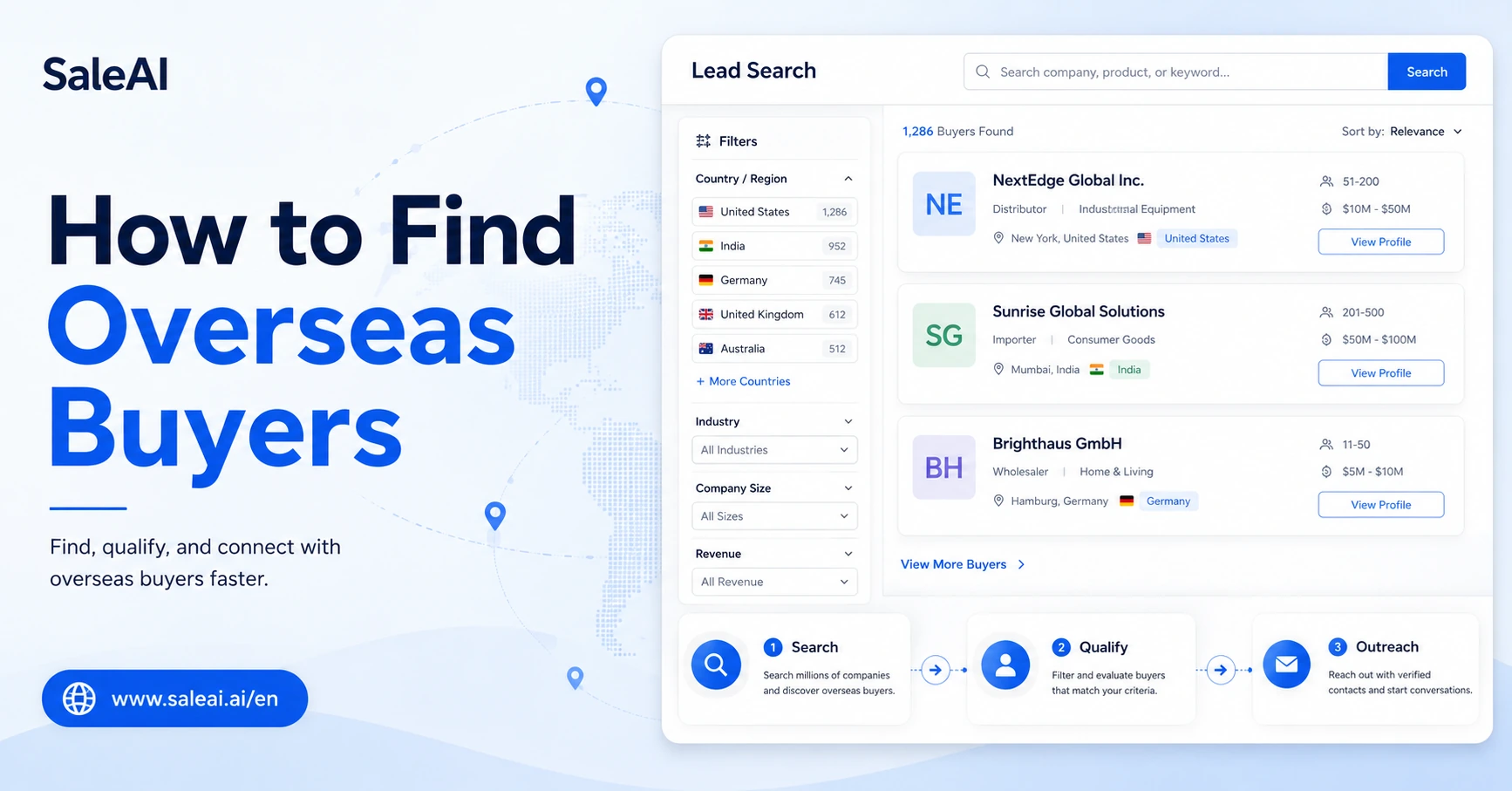
SaleAI is designed around the export sales workflow, not just one isolated task.
Inside SaleAI, a team can move through the buyer search process in a more connected way:
- Use Lead Finder Agent to search for companies by product keyword and region.
- Use Data and company signals to understand whether the buyer looks relevant.
- Use Company Insight Agent to check company activity and qualification signals.
- Use Email Writer Agent to draft a buyer-specific outreach email.
- Use CRM to save the lead, track follow-up status, and avoid losing context.
This workflow matters because export sales usually breaks between tools.
A lead is found in one place.
The company check happens somewhere else.
The email is written in another tab.
The follow-up note is saved in a spreadsheet.
SaleAI helps connect those steps so the team does not need to rebuild the same context again and again.
Buyer Search Is Not Only About Data Volume
Some teams believe they need more data before they can sell better.
Sometimes that is true. But often, they already have enough data. What they lack is a way to filter and act on it.
A list of 5,000 companies is not useful if your team cannot answer:
- Which 50 should we contact first?
- Which companies match our product category?
- Which buyers are still active?
- Which market should we test this month?
- Which leads should go into CRM?
- Which leads should receive a quote or follow-up?
This is why buyer search should be connected to qualification and outreach. Otherwise, the list becomes another file that looks important but does not move the sales process forward.
A Simple Buyer Qualification Checklist
Before your team sends the first email, use this checklist:
| Checkpoint | Yes / No |
|---|---|
| The company matches our product category | |
| The company serves a market we can supply | |
| The website or business profile is active | |
| There is a clear buyer, sourcing, or sales channel | |
| The company has signs of trade, distribution, or resale activity | |
| We can write a relevant first sentence based on what we know | |
| The lead can be saved and tracked in CRM | |
| The next follow-up step is clear |
If your team cannot write a relevant first sentence about the buyer, the lead may not be ready for outreach yet.
That one rule can save a lot of wasted emails.
Common Mistakes When Looking for Overseas Buyers
Mistake 1: Treating every contact as a buyer
Not every company in your target industry is a buyer. Some are competitors. Some are service providers. Some are local installers. Some may never import products.
Check the business role before sending outreach.
Mistake 2: Searching too broadly
A search like “global importers” gives weak results. A search like “commercial lighting distributors in Saudi Arabia” gives your team a clearer path.
Specific searches usually create better leads.
Mistake 3: Sending before checking
If the company is inactive, irrelevant, or too far from your category, a better email will not fix the problem.
Qualification should come before writing.
Mistake 4: Keeping leads outside CRM
If leads stay in spreadsheets, email inboxes, and personal notes, follow-up becomes difficult. A good lead should move into a trackable workflow.
Mistake 5: Buying lists without a follow-up plan
A list is only the starting point. Without qualification, email writing, quotation handling, and follow-up tracking, the list will not produce much value.
FAQ
How can exporters find overseas buyers more efficiently?
Exporters can find overseas buyers more efficiently by combining product-specific searches, target market selection, buyer signal checks, and structured outreach. The goal is to identify companies that match the product category and show signs of real business activity.
Are paid lead lists useful for export sales?
Paid lead lists can be useful if the data is accurate and relevant. However, large lists often create wasted work when contacts are outdated, mismatched, or not qualified. Export teams should verify buyer fit before sending outreach.
What is a verified buyer lead?
A verified buyer lead is a company that has enough information to support outreach, such as product category fit, working website, relevant contact channel, trade activity, or other business signals.
What should I check before emailing an overseas buyer?
Before emailing a buyer, check the company’s industry, product relevance, website status, market location, contact role, and recent activity. If the company does not match your offer, the email is unlikely to perform well.
Can AI help find overseas buyers?
AI can help export teams search, organize, and qualify buyer leads faster. It does not replace sales judgment, but it can reduce manual checking and help teams focus on companies that are more likely to be relevant.
Final Takeaway
Finding overseas buyers is not about collecting the largest file.
It is about building a cleaner path from search to qualification to outreach.
A smaller list of relevant, active, and trackable buyers is more useful than thousands of contacts with no context. Export teams that improve this process can spend less time sorting data and more time starting real conversations.
SaleAI helps export teams connect buyer search, company insight, email writing, and CRM follow-up in one workflow, so the first message starts from better context instead of a random list.
