


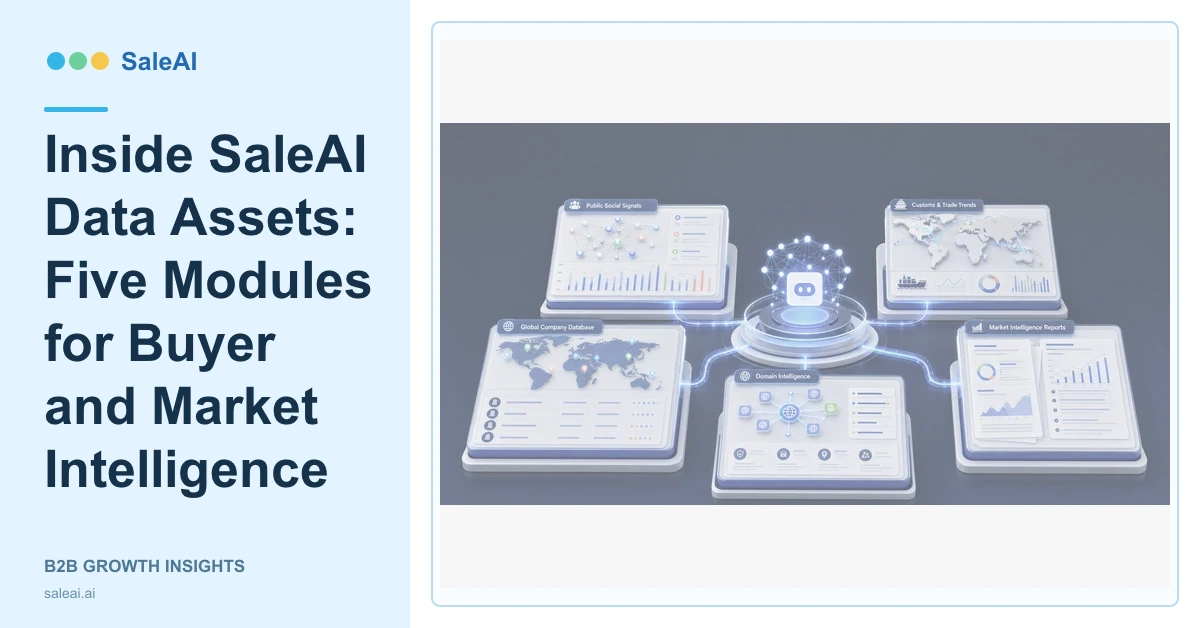
The SaleAI Data product page describes an intelligent data system that combines a global business database with an AI-powered Data Agent. SaleAI Data Assets bring together company records, social signals, trade trends, domain intelligence, and market context so teams can research buyers and markets from more than one evidence type.
The value is not the size of a database by itself. The value is knowing which module answers the current question and preserving the source, date, confidence, and intended use of the result.
What the five data areas contribute
The product page refers to five core modules. The surrounding SaleAI product pages make their roles clearer.
| Data area | Best suited to | Important limitation |
|---|---|---|
| Global business database | Company discovery and basic intelligence | Records still need identity checks |
| Automated business data | Scaled company and market research | Scope determines report quality |
| Automated social data | Public activity and social lead discovery | Activity is not purchase intent |
| Customs and trade data | Transaction, buyer, supplier, and trend analysis | Coverage varies by market and record |
| Domain and professional intelligence | Company background and decision-maker research | Public profiles may be incomplete |
The AI Data Agent helps collect and analyze information, while the user remains responsible for defining the business question.
Use SaleAI Data Assets for buyer discovery
Buyer discovery begins with a target company role. A distributor, importer, manufacturer, retailer, and service partner may all appear relevant to the same product keyword, but they create different commercial routes.
Automated Business Data can combine company, domain, corporate, and trade evidence. Automated Social Data can seek public leads on Facebook and Instagram. Enterprise Scope can research companies and professionals. Customs Data can reveal transaction and supply-chain patterns.
The result should record why the company was selected. A name and email are not enough to create a reliable SaleAI Data Assets record.
Use the same data system for market intelligence
Market research asks different questions. Instead of "is this company worth contacting?" the user may ask which countries show related trade activity, which supplier relationships are changing, which categories are visible in public social channels, or which company types dominate a market.
This work benefits from comparing evidence. Customs trends may show movement while professional data identifies the companies and teams involved. Domain intelligence may clarify what a company sells. Social signals may reveal current campaigns or category focus. Contradictions should remain visible rather than being compressed into a confident but unsupported score.
Keep the data reusable
Data Assets become more valuable when campaign outcomes return to the system. If a researched company is the wrong role, record that reason. If two records represent the same organization, connect them. If a contact has changed jobs, preserve the company history while refreshing the person record.
SaleAI CRM can hold account ownership, customer stage, interaction history, and next actions. The data system supports discovery and analysis; CRM supports the customer relationship and commercial workflow.
The WTO statistics portal and the World Integrated Trade Solution are useful examples of authoritative trade context. Internal SaleAI data should also retain traceable sources and time periods when it supports a business decision.
Choose the smallest relevant module set
Begin with the evidence needed for the decision. Add another module only when it resolves a defined gap, such as company identity, transaction history, stakeholder context, or recent public activity.
FAQ
What are SaleAI Data Assets?
They are the SaleAI data workspace combining global company records, automated data collection, social signals, trade intelligence, domain research, and AI analysis.
Do Data Assets replace CRM?
No. Data Assets support research and reusable evidence, while CRM manages ownership, customer history, stage, and next actions.
Which module is best for importer research?
Customs Data can support transaction-based importer research, while Enterprise Scope and business data can clarify company identity and stakeholders.
Can social activity prove buyer intent?
No. Public social activity can support timing or category context, but it should not be treated as confirmed purchase intent.
How should teams maintain SaleAI Data Assets?
Preserve source, date, company identity, role, fit reason, confidence, duplicates, campaign outcomes, and refresh needs.
