


What does hot mean in your customer list? If the answer depends on who is looking at the record, it isn't much use at handover. A B2B CRM tag taxonomy is the dictionary beside that list: someone reading a tag should be able to find its definition and check why the account qualifies.
For our example, the handover is on Friday. The researcher is away next week, and the person taking over sees hot, priority, Germany, distributor and LinkedIn. There is no explanation beside them. "Shall I send this to the German sales team?" is a reasonable question, but the labels don't answer it.
We'll use that invented account throughout this guide. It isn't a customer success story.
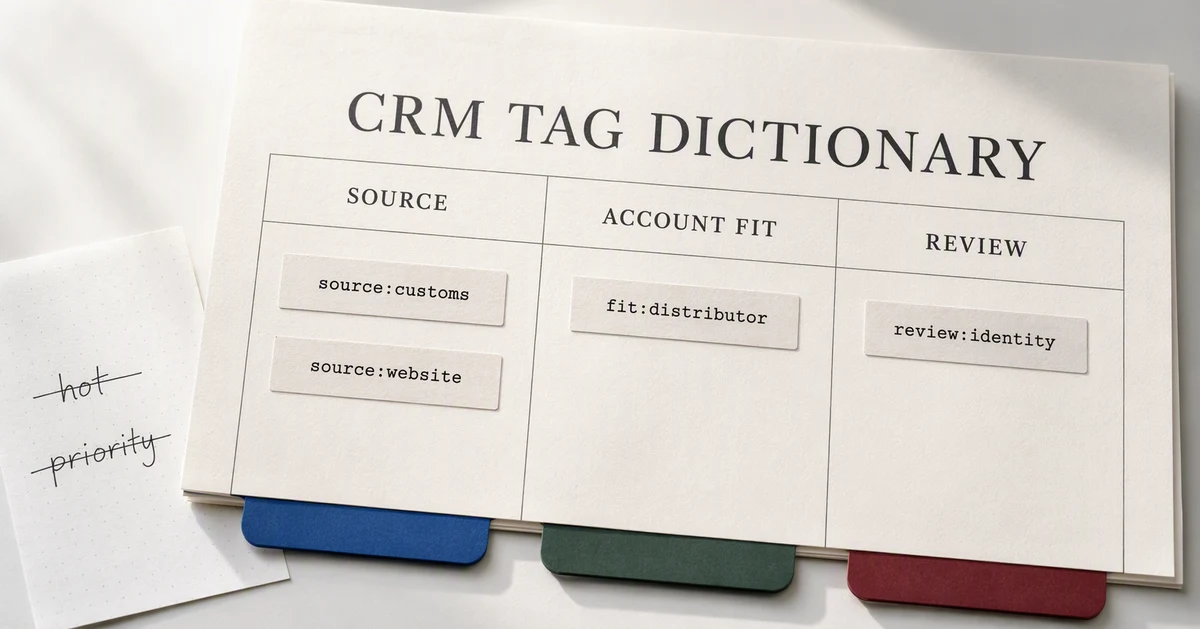
AI-generated editorial illustration of a proposed dictionary, not a SaleAI screenshot.
Start with the fields SaleAI already separates
In the authenticated workspace review on October 17, 2026, CRM Management opened into Contact Management, Company Management and Tag Management. On the tag screen were name, color, creation time and record actions. The contact view separately displayed owner, company, customer stage, tags and last contact time.
For the Friday handover, the owner field is where the receiving salesperson should look for responsibility. Adding Alice-account would give the team two places to update when Alice's accounts move. The same problem appears if negotiating lives both in customer stage and in the tag list.
There were no records in the reviewed company and tag lists, so the review establishes the visible controls, not a successful live tagging exercise. Everything below about prefixes, a dictionary or review ownership is a suggested team procedure. Automatic enforcement wasn't established.
The SaleAI CRM overview covers the wider workspace. Let's stay with the narrower handover problem.
Three questions behind the B2B CRM tag taxonomy
LinkedIn and distributor aren't competing descriptions. One concerns the research trail; the other concerns what the company does. The proposed review labels below have a different purpose again: a colleague seeing review:identity would know to examine the conflicting company references before treating the account as qualified.
| Question | Proposed label | Evidence to retain | Do not infer |
|---|---|---|---|
| Where did research begin? | source:linkedin |
Profile reference and research date | Permission to contact |
| Did a shipment record contribute? | source:customs |
The particular record and its date | A current purchase requirement |
| Does the business resell relevant products? | fit:distributor |
Dated website or catalogue evidence | An exclusive sales territory |
| Is the company relationship uncertain? | review:identity |
The conflicting names or references | That the contact is qualified |
| Is the offer relevant to ours? | review:product-fit |
The product or channel question to resolve | An automatic rejection |
Here, the colon belongs to the proposed spelling. It isn't a SaleAI hierarchy control.
Notice that a source and a business role age differently. In our example, an employee could change employers a month after the research without altering where that research began. If the distributor stopped selling the relevant range during the same month, though, the fit classification would need another look. The two labels wouldn't deserve the same treatment merely because they were added together.
The buyer-research evidence guide goes further into what a source can support. A short tag can point to that research, but the dated reference needs somewhere else to live.
Write the entry for one difficult label
Before filling the dictionary, try one entry: fit:distributor.
Write "good potential customer" as its definition and the Friday handover remains stuck. The new salesperson may read "good" as a sign of active interest; the researcher may only have meant that the product photographs looked relevant.
Our fictional team could agree on this entry instead:
Use this name: fit:distributor. Apply it when: the company's own website explicitly describes relevant wholesale or distribution activity. Keep with the record: the page reference, check date and a brief note identifying the supporting statement. Ask the dictionary owner: when a business buys stock for some products but only represents a brand for others. Revisit it: if the range changes or the company identity becomes uncertain.
Now the website with nothing but product photographs and a contact form has an answer: not enough evidence yet. It goes into product-fit review. Someone can challenge the rule, but they no longer have to guess what the previous researcher intended.
For a B2B CRM tag taxonomy, that's a more useful test than whether the names look organized in a screenshot.
For spelling, a useful distinction appears in the W3C's 2009 SKOS reference, which describes preferred labels alongside alternative ones. Our dictionary can keep fit:distributor as its preferred name and record the team's older spellings next to it. We're borrowing that naming idea, not suggesting that SaleAI implements SKOS.
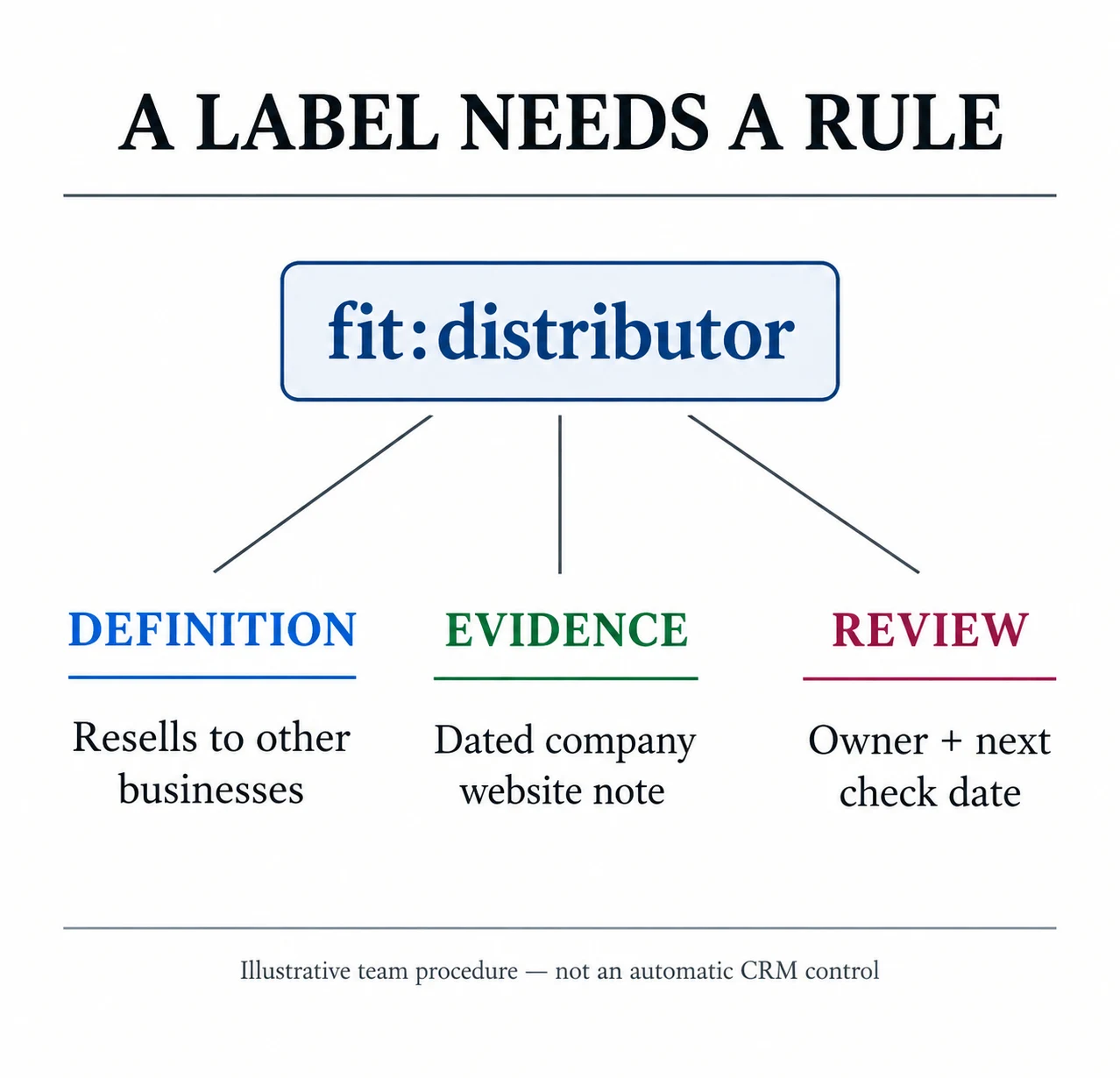
AI-generated method illustration. The team maintains the definition, evidence and review rule.
Put "Germany" aside for a moment
At first glance, Germany looks like the easiest item to clean up. A reviewer could type territory:germany and be finished with it in seconds.
But what if the researcher was recording a warehouse address? Or a shipment destination, while the company itself was based elsewhere? The renamed tag would look more precise than the original and be less defensible.
For now, Germany stays unresolved. When its meaning is recovered, use the appropriate existing field if one is available. This table shows where the other information from the handover belongs.
| Information | Better home | Where a tag may help |
|---|---|---|
| Responsible salesperson | Owner field | A separate research cohort, not duplicate assignment |
| Current sales position | Customer stage | A classification that does not recreate the pipeline |
| Phone, email and company relationship | Relevant contact/company fields | A review flag for an unresolved discrepancy |
| Headquarters or territory | A suitable structured field, if available | A precisely defined temporary research group |
| Reason for distributor status | Dated evidence note or register | The short agreed classification |
| Next review date | Supported task/date field or review register | A flag, but not a substitute for a reminder |
The last row deserves a practical check in your account. Where will the reviewer actually see the date? If there's no suitable task or date field, use a review register with an assigned person. Writing check-later on the account doesn't schedule any work.
Keep that boundary in the B2B CRM tag taxonomy. Otherwise the dictionary gradually turns into a second address book, assignment list and pipeline.
Now repair the five-label record
Let's give the example a research note. It links to a company website explicitly describing wholesale distribution, records the check date and says that a professional profile led there. It says nothing about an enquiry.
Under the definition above, source:linkedin and fit:distributor are defensible replacements. Leave the website reference with the reasoning so the colleague receiving the account can inspect it.
We still can't explain hot. The person who added it might have a quotation request in their inbox, in which case that request belongs in the commercial record and the stage may need updating. If they only meant "looks worth researching," the receiving salesperson needs to hear that before treating this as an active enquiry.
Ask about priority too. Was it a manager's queue for this week, or a lasting account rating? Before retiring either name, look through the saved filters and handoff references with the colleagues who use them.
The awkward part: old names that look equivalent
The next imported file complicates matters: it contains reseller, wholesaler and distributor, with no definitions attached.
Check before merging them. In your team's older files, one might describe a business that buys stock, while another includes representatives paid on commission. If that difference changes the offer or sales conversation, preserve it.
Write a migration map outside the live list, showing the old name, proposed replacement, reason and affected records. Include undecided cases. The original export belongs in a controlled working location; retain it while testing the mapping against a mixed sample that includes a record outside the proposed change.
For batch preparation, work through the CRM import checklist, but keep the tag-behavior questions open for the workspace test. In particular, neither shared-tag merging nor rollback has been established here.
A walkthrough should answer what happens to existing records after a rename, whether saved filters need changing and how earlier associations could be restored. Don't substitute an assumption for a missing answer.
Add the old spellings to the B2B CRM tag taxonomy once their meanings are settled. When a colleague next opens that file, the map should show which names to replace, which to preserve and which still need an answer.
Decide who pays the maintenance cost
What happens when the next researcher asks for very-hot? The request shouldn't have to wait for everyone who has ever used the CRM to agree.
Name the dictionary owner before that request arrives. The role concerns shared definitions, not possession of every tagged account. A salesperson should be able to hand over an account without handing over the right to redefine "distributor" for the whole business.
Maintenance time is easier to discuss with actual disagreements on the table. Bring the company that two researchers classified differently, the tag that duplicates a stage and the campaign label nobody remembers retiring. The meeting can then end with a decision about each, rather than with everyone having heard the list again.
Accuracy, consistency and timeliness are separate dimensions in the UK Government's 2020 Data Quality Framework. For our account, the distributor label could be spelled exactly as agreed and applied consistently, yet no longer fit the company's current range.
Checking that website is revalidation work, covered in the lead revalidation workflow. A rename hasn't done it.
Try the dictionary before rollout by letting two colleagues work through a mixed sample without seeing its original tags. Compare the references they chose as well as the names they applied. Where conflicting answers both satisfy the written definition, send the definition back to its owner. This is a proposed team exercise, not a SaleAI benchmark result.
A research queue is not a sending list
Friday's account now has a defensible business classification and a research trail. The receiving salesperson still has work to do: check the particular recipient, current contact information and the proposed reason for reaching out.
The B2B CRM tag taxonomy doesn't answer those remaining questions, and exclusions deserve particular care. A team may have agreed to mark an account do-not-contact without knowing whether any sending route actually reads that label. Test the real exclusion behavior before relying on it. Tag-based suppression, expiry and mandatory approval weren't established by the product review used here.
The email-identity checks in the sender setup preflight remain a separate job; changing labels on the audience hasn't completed them.
What to take to a SaleAI CRM discussion
For a walkthrough, prepare an anonymized version of the Friday account and the draft dictionary. Include the unresolved geography label; an easy example alone won't show where your procedure leaves gaps.
Ask the demonstrator to trace a shared-name change through to the record the receiving salesperson would open. Who can make the change, and what will that salesperson see? Write down the manual work still required, and confirm availability and plan terms for your account.
The company background is on About SaleAI. To discuss your B2B CRM tag taxonomy, request a CRM workflow walkthrough and bring that sample. The desired outcome is an agreed way to handle it, including the part that still needs a person to decide.
FAQ
What is a B2B CRM tag taxonomy?
The fit:distributor entry above is one piece of it. A B2B CRM tag taxonomy brings entries like that together, letting the next researcher see the agreed application rule and the evidence to retain alongside the account.
How many tag families should we start with?
Try the recurring questions first, then count the families they require. The three in our example suit its research problem. A team with different fields and decisions may need a different arrangement.
Does SaleAI enforce the prefixes in this guide?
The review didn't establish enforcement. You can propose spellings such as source: and fit: as a team convention, but don't describe them as a verified native hierarchy or mandatory rule.
Should contacts inherit every company tag?
In the example, distributor status belongs to the business. Copying it to an employee wouldn't tell the receiving salesperson whether that person handles purchasing. Check the association behavior in your workspace before deciding what to carry across.
Can an email open justify a "hot" label?
An open alone doesn't answer whether the person has a purchase requirement. Keep the event and its date, and agree on the evidence a commercial classification would need before adding one.
Where should old spellings go?
The alias map should explain the old name, its replacement and why they were considered equivalent. Leave an unresolved row open when nobody can recover the old meaning; that is useful information for the next review.
Could a color carry the same meaning?
Export a small sample as plain text and read the names without their colors. If the meaning disappears, revise the name or definition. Color can still help people scan the live list.
The website changed. Should the old evidence disappear?
No. Keep the earlier dated observation in the appropriate history or working note so the change can be explained, then review the current classification. No automatic expiry is assumed here.
Can tags assign account ownership?
Where the dedicated owner field is available, use it for assignment. Otherwise a handover may require two corrections, and the owner field and tag can leave colleagues with conflicting answers.
How do we know the dictionary is ready?
Try a mixed sample with colleagues working independently, then discuss the cases where their reasons differ. Check old-filter dependencies as well. Keep the trial away from live sending until those questions are resolved.
