


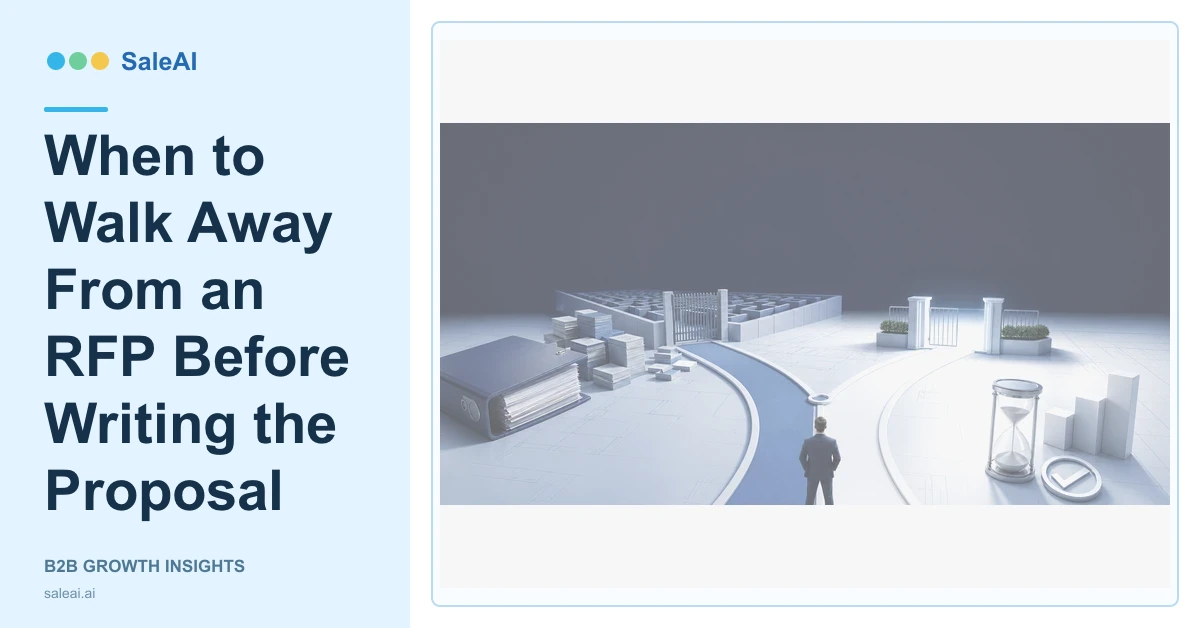
An RFP can look attractive because the buyer has defined a requirement and deadline. It can also consume days of technical, legal, pricing, and management work without a credible path to selection.
Knowing when to walk away from an RFP is a resource-allocation decision, not a lack of ambition. The team should test fit, access, fairness, response cost, and the reason it can win before drafting begins.
The bid or no-bid screen
| Question | Stronger reason to bid | Stronger reason to decline |
|---|---|---|
| Problem fit | Requirement matches proven capability | Major gaps require promises or redesign |
| Decision access | Clarification route and stakeholders are visible | No contact or questions permitted |
| Criteria | Evaluation method is understandable | Criteria are vague or contradictory |
| Timing | Response and delivery dates are feasible | Timeline requires unsupported shortcuts |
| Incumbent position | Open competition with evidence of change | Specification appears written for one supplier |
| Commercial fit | Scope and terms support a viable offer | Price structure or liability is unacceptable |
| Resource cost | Effort matches potential value and learning | Response displaces stronger opportunities |
| Win path | Differentiation matters to stated criteria | No credible advantage can be demonstrated |
No single weak answer requires rejection. The pattern matters.
Look for a real buyer decision
Some RFPs are market tests, budget exercises, incumbent benchmarks, or documentation requirements. Ask what decision follows the process and what has changed since the current approach was chosen.
The RFQ triage guide can support an initial review. The company verification guide helps confirm the account before substantial work begins.
Calculate the response burden
Estimate technical design, compliance documents, samples, testing, translations, legal review, pricing, executive approval, and delivery planning. Include the opportunity cost of delaying other work.
Teams often decide to walk away from an RFP when the response requires unsupported customization, unacceptable terms, or confidential detail without a proportional opportunity.
Decline without damaging the relationship
A no-bid response can explain the specific mismatch and, where useful, offer a narrower alternative. Avoid criticizing the buyer process or pretending capacity is unavailable when the actual issue is fit.
Record the decision in SaleAI
SaleAI CRM can store the RFP source, fit review, response cost, risks, decision, and future conditions. SaleAI Agent can organize requirements and missing questions, while the deal review checklist supports management review.
Country Commercial Guides may add market and procurement context, while WTO trade statistics can inform category context. Neither proves that a specific competition is fair or winnable.
Preserve learning from no-bid decisions
Track which requirements, terms, timelines, and account conditions repeatedly create no-bid outcomes. This can improve product strategy and market selection without turning every rejected RFP into a future lead.
Final takeaway
The right time to walk away from an RFP is before sunk effort becomes the reason to continue. Bid when the requirement fits, the process is credible, and the team can explain why its evidence matters.
Explore SaleAI and SaleAI pricing when building controlled proposal workflows.
FAQ
When should a supplier walk away from an RFP?
When fit, access, terms, timing, response cost, process credibility, or the win path is too weak to justify the work.
Does an incumbent always make the RFP unwinnable?
No. A buyer may have a genuine reason to change. Look for open criteria, access, and evidence that alternatives will be considered.
Should every no-bid decision require management approval?
Approval rules should match opportunity size, strategic importance, and response cost. Routine low-fit requests can use simpler governance.
Can a supplier ask clarification questions?
Yes, when the process permits. Focus on scope, criteria, decision timing, terms, and information required for a responsible offer.
How does SaleAI help with RFP qualification?
SaleAI can organize requirements, account context, missing evidence, risks, ownership, and the recorded bid decision.
