


Most export sales teams have more contacts than they can handle.
There are names from exhibitions.
Old email lists.
LinkedIn searches.
Google results.
Customs data.
WhatsApp contacts.
Website inquiries that were never followed up.
The real problem is not always “we need more leads.”
More often, the problem is this:
The team cannot tell which leads are worth time today.
That is where B2B lead generation for exporters becomes different from general lead generation. Export sales is not only about finding a company name or an email address. It is about finding companies that match your product, your market, your supply capacity, and your sales timing.
A weak lead list gives you data.
A useful lead generation process gives you direction.
Why Export Lead Generation Is Harder Than It Looks
On paper, export lead generation sounds simple.
Find importers.
Send emails.
Wait for replies.
In real work, it gets messy very fast.
A sales rep might search “furniture importers in Canada” and find hundreds of results. Some are wholesalers. Some are retailers. Some are local brands. Some only buy domestically. Some have old websites. Some do not show any sign of importing. Some look relevant but have no clear contact person.
If the team sends the same message to all of them, response rates are usually weak.
Not because the product is bad.
Because the lead selection was too loose.
Good export lead generation needs filtering before outreach. Otherwise, the team spends its energy writing to companies that were never likely to buy.
What “Good B2B Leads” Mean for Exporters
A good B2B lead is not just a company with an email address.
For exporters, a good lead usually has several of these signals:
| Lead Signal | Why It Matters |
|---|---|
| Product category fit | The company sells, imports, distributes, or uses products close to yours |
| Market relevance | The company operates in a country or region you can serve |
| Business activity | Website, social profiles, job posts, or trade signals show it is still active |
| Buyer role visibility | There is a purchasing, sourcing, sales, or business development contact |
| Import or distribution clues | The company may already work with overseas suppliers |
| Clear next step | Your team knows what message or offer should be sent first |
This is why a list of 100 qualified companies can be more useful than 5,000 mixed contacts.
The smaller list gives your team a better chance to write relevant messages, follow up properly, and track progress inside a CRM.
The Wrong Way: Collect First, Think Later
Many export teams still build leads in this order:
- Search broadly
- Export as many contacts as possible
- Send the same message
- Wait for replies
- Start checking company fit only after someone responds
This feels efficient at the beginning, but it creates waste later.
The team may spend hours sending emails to companies that:
- Do not import the product
- Are in the wrong country
- Are too small or too large for the offer
- Have no buyer-facing contact
- Are inactive
- Already work in a completely different category
- Cannot match the supplier’s MOQ or delivery model
The mistake is not using data.
The mistake is treating all data as equal.
The Better Way: Build Leads Around Buyer Fit
A better lead generation workflow starts with buyer fit.
Before searching, define the type of company you actually want.
For example:
| Field | Example |
|---|---|
| Product | Commercial LED lighting |
| Target buyer | Distributor, project supplier, importer |
| Region | UAE, Saudi Arabia, Qatar |
| Exclude | Local electricians, unrelated retailers, consumer-only shops |
| Ideal signal | Imports lighting products or serves commercial projects |
| First offer | Product catalog, project lighting quote, or sample discussion |
This gives the search a clearer direction.
Instead of “find anyone related to lighting,” the team is looking for companies that could realistically buy from an overseas supplier.
That difference matters.
Search Terms Export Teams Should Use
The quality of search terms affects the quality of leads.
Broad searches often produce weak results. Specific searches produce better starting points.
Here are examples:
| Weak Search | Better Search |
|---|---|
| importers | packaging machine importers in Mexico |
| buyers | beauty device distributors in Germany |
| furniture companies | hotel furniture importers in UAE |
| LED companies | commercial LED lighting distributors in Saudi Arabia |
| wholesalers | wholesale kitchenware buyers in Canada |
| medical equipment | medical device distributors in South Africa |
A good search usually combines:
- Product category
- Buyer type
- Country or region
- Business role or use case
This helps the team avoid collecting contacts that look related but do not match the sales goal.
Check Signals Before Sending the First Email
Once you have possible leads, do not send immediately.
Check signals first.
A simple lead check may include:
| Check | What to Look For |
|---|---|
| Website status | Does the website work? Is it recent? |
| Product match | Does the company show related categories? |
| Buyer type | Is it an importer, distributor, wholesaler, retailer, or end user? |
| Market served | Does it sell in the target region? |
| Contact path | Is there an email, form, LinkedIn, WhatsApp, or department contact? |
| Activity signal | Any updates, social activity, hiring, or trade clues? |
| Message angle | Can you write a specific first sentence? |
The last point is useful.
If your team cannot write one specific sentence about why the company is relevant, the lead may not be ready for outreach.
For example:
Weak:
We found your company online and want to introduce our products.
Better:
I noticed your company supplies hotel furniture projects in Dubai. We manufacture custom furniture for hospitality and commercial spaces, and I thought this may be relevant to your sourcing work.
The better message comes from better lead context.
A Practical B2B Lead Generation Workflow for Exporters
Here is a workflow that export teams can actually use.
Step 1: Choose one product and one market
Do not start with everything.
Pick one product category and one region first.
Example:
- Product: packaging machinery
- Market: Mexico
- Buyer type: importers and distributors
This keeps the search focused and easier to measure.
Step 2: Build a buyer profile
Define what a suitable buyer looks like.
Include:
- Industry
- Buyer type
- Country
- Company size
- Product match
- Contact role
- Excluded company types
This prevents the team from wasting time on leads that are not relevant.
Step 3: Search by intent, not just keyword
Use searches that include buying or distribution intent.
Examples:
- “packaging machine importer Mexico”
- “food packaging equipment distributor Mexico”
- “industrial packaging machinery supplier Mexico”
- “packaging automation distributor Latin America”
The goal is not just traffic. The goal is buyer relevance.
Step 4: Score the leads
Use a simple scoring method.
| Score | Meaning | Action |
|---|---|---|
| 5 | Strong product fit, active company, clear contact | Personalized outreach |
| 4 | Good fit, limited contact information | Outreach with light research |
| 3 | Possible fit, unclear buying role | Save for later |
| 2 | Weak fit or inactive signals | Skip or review later |
| 1 | Wrong category | Remove |
This does not need to be complex. Even a simple score helps the team decide who gets attention first.
Step 5: Write outreach based on the lead type
Different buyers need different messages.
A distributor may care about product range, pricing, and supply stability.
A project buyer may care about delivery time, customization, and past cases.
A retailer may care about packaging, MOQ, and reorder support.
A generic email ignores those differences.
A useful email starts from the buyer’s role.
Step 6: Save the lead into a trackable system
A lead that is not saved properly usually disappears.
The team should track:
- Company name
- Country
- Source
- Product fit
- Contact person
- First message date
- Reply status
- Follow-up date
- Quote status
- Notes
This is where CRM becomes important. Export lead generation does not end when the lead is found. It ends when the lead is either converted, rejected, or clearly marked for future timing.
What SaleAI Adds to This Workflow
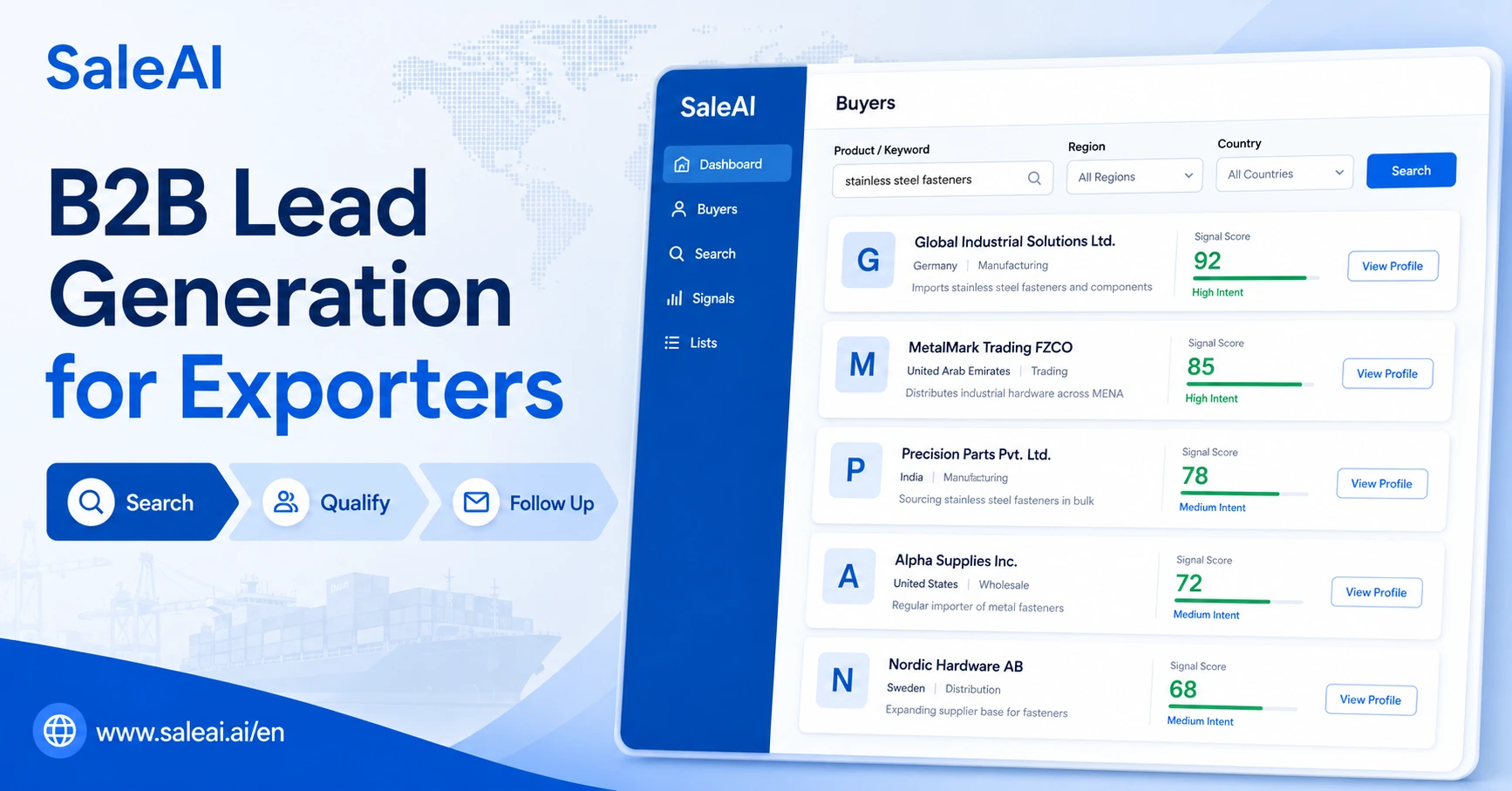
SaleAI is built for export teams that need to connect lead search with the next sales action.
A typical SaleAI workflow can look like this:
- Use Lead Finder Agent to search for potential buyers by product and market.
- Use Data to check company information and business signals.
- Use Company Insight Agent to judge whether the lead is worth outreach.
- Use Email Writer Agent to generate a message based on buyer role and context.
- Use CRM to save the lead, assign follow-up, and track progress.
This is different from only downloading a lead list.
The lead is connected to qualification, email writing, follow-up, and CRM tracking.
That connection matters because export sales often fails in the gaps between tools. One person finds the lead, another writes the email, someone else prepares the quotation, and follow-up gets lost in a spreadsheet.
SaleAI helps reduce that gap by keeping the lead workflow connected.
Why More Leads Can Make Sales Worse
More leads can help if the team has a system.
But without structure, more leads can make work harder.
The team may start asking:
- Which lead should I contact first?
- Did we already email this company?
- Who replied last month?
- Which buyer asked for a quote?
- Which leads are still waiting for follow-up?
- Which market is producing real replies?
When those answers are spread across inboxes, spreadsheets, and chat records, the team slows down.
This is why exporters should not judge lead generation only by the number of contacts collected.
Better metrics include:
| Metric | Why It Matters |
|---|---|
| Qualified lead rate | Shows whether search quality is improving |
| First email relevance | Shows whether the message matches the buyer |
| Reply rate by market | Helps decide where to focus next |
| Quote request rate | Shows whether buyers are commercially interested |
| Follow-up completion | Prevents warm leads from going cold |
| CRM conversion status | Connects lead generation to actual sales progress |
A lead generation system should help the sales team make decisions, not just add more rows to a file.
Common Mistakes in B2B Lead Generation for Exporters
Mistake 1: Searching too broadly
Broad keywords create noisy leads.
Instead of “importers,” search by product, country, and buyer type.
Mistake 2: Ignoring buyer role
A company may be in the right industry but still not be a buyer. It could be a service provider, manufacturer, installer, media site, or competitor.
Check the role before outreach.
Mistake 3: Sending the same email to every lead
If every lead receives the same message, the team is not using the information it collected.
Even small changes based on buyer type can improve relevance.
Mistake 4: Not tracking follow-up
Finding leads is only the first step. If follow-up is not tracked, good leads can go cold.
Mistake 5: Measuring only list size
A large list looks good in a report. But sales results come from qualified conversations, not raw contact volume.
A Simple Lead Generation Checklist
Before adding a lead to your outreach list, check:
| Question | Yes / No |
|---|---|
| Does this company match our product category? | |
| Is it in a market we can serve? | |
| Does it look active? | |
| Is there a buyer, distributor, or sourcing-related role? | |
| Can we explain why our offer is relevant? | |
| Do we know the first message angle? | |
| Is there a clear next action? | |
| Can we track this lead in CRM? |
If the answer is “no” to most of these, the lead should not be treated as a priority.
FAQ
What is B2B lead generation for exporters?
B2B lead generation for exporters is the process of finding and qualifying overseas companies that may import, distribute, resell, or use a supplier’s products. It includes buyer search, company checking, outreach planning, and follow-up tracking.
What makes export lead generation different from local sales lead generation?
Export lead generation usually involves more uncertainty. The team needs to check market fit, import behavior, language, logistics, buyer type, and company activity before sending outreach.
Should exporters buy lead lists?
Lead lists can be a starting point, but they should not be trusted without qualification. Exporters should check whether the companies are active, relevant, and reachable before using time on outreach.
How many leads should an export team contact per day?
There is no fixed number. A smaller number of qualified leads with personalized outreach is often better than a large number of weak leads with the same message. The right volume depends on team size, product complexity, and follow-up capacity.
Can AI help with B2B lead generation for exporters?
AI can help exporters search for leads, organize company data, check buyer signals, and prepare outreach drafts. It should support sales judgment rather than replace it.
Why do many export leads never reply?
Many leads do not reply because they are not the right fit, the message is too generic, the timing is wrong, or there is no clear reason for the buyer to continue the conversation.
Final Takeaway
B2B lead generation for exporters should not be measured by how many names a team collects.
It should be measured by how many relevant companies move into a real sales workflow.
A good lead has context.
A good process has qualification.
A good system keeps the lead connected to outreach, quotes, follow-up, and CRM.
SaleAI helps export teams move from scattered contact collection to a more structured buyer workflow, so salespeople can spend less time sorting lists and more time starting conversations that have a reason to continue.
