


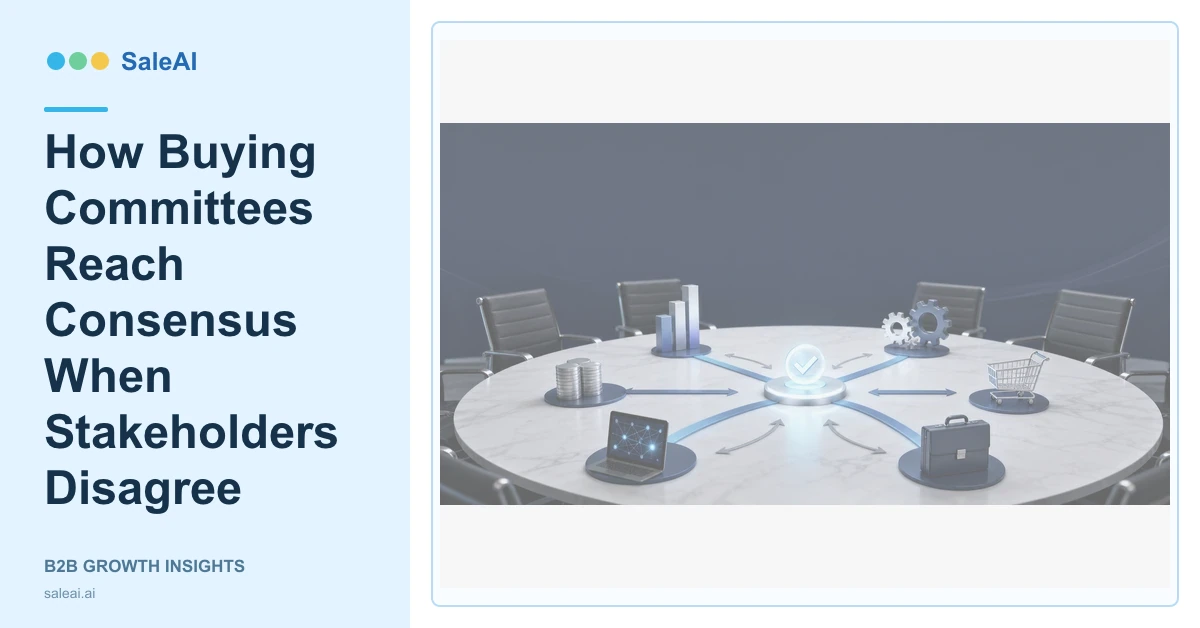
Complex purchases rarely fail because every stakeholder rejects the offer. More often, different functions define success, risk, and urgency in incompatible ways.
Buying committee consensus exists when the relevant stakeholders can support one decision under understood conditions. It does not require equal enthusiasm or the disappearance of every concern.
Map the different outcomes
| Stakeholder | Possible desired outcome | Common concern |
|---|---|---|
| User | Easier or more reliable work | Disruption and usability |
| Technical evaluator | Fit, security, quality, integration | Failure under real conditions |
| Operations | Stable delivery and implementation | Downtime, resources, and ownership |
| Finance | Defensible economic effect | Assumptions and payback |
| Procurement | Comparable scope and acceptable terms | Price, supplier risk, and compliance |
| Executive approver | Strategic or operating result | Priority, exposure, and accountability |
Disagreement is often rational. Each function is protecting a different consequence of the same purchase.
Diagnose the type of disagreement
Ask whether stakeholders disagree about facts, criteria, trade-offs, authority, or timing.
- Facts: They use different baselines or product assumptions.
- Criteria: They evaluate different outcomes.
- Trade-offs: They agree on facts but value them differently.
- Authority: It is unclear who can accept a risk or approve scope.
- Timing: The decision is valid, but not for the same date.
Treating every disagreement as an objection produces shallow responses. Buying committee consensus improves when the unresolved decision is named precisely.
Consensus is not unanimity
One stakeholder may prefer another option and still support the selected path because the decision rule is legitimate and the risk treatment is acceptable.
Sales should not manufacture agreement by excluding difficult voices. A hidden implementation or security concern usually returns later with greater cost.
Use the procurement-first-contact guide to match access with the decision involved. The decision-maker research guide helps separate visible roles from assumed authority.
A consensus-building review
Prepare one page showing the buyer outcome, confirmed facts, stakeholder criteria, unresolved trade-offs, decisions required, and owners. Ask stakeholders to correct it.
SaleAI Enterprise Scope can support account and stakeholder research. SaleAI CRM can preserve objections, evidence, decisions, and changing roles. SaleAI Agent can organize the review brief without deciding which stakeholder should win.
External market context from Country Commercial Guides and WTO statistics may explain local conditions, but internal agreement requires direct buyer evidence.
Watch for false consensus
A sponsor saying "everyone agrees" is not enough when the opportunity depends on technical, operational, financial, or purchasing approval. Look for completed buyer actions and acknowledged conditions.
Buying committee consensus is stronger when the team can explain what each stakeholder accepted, what remains open, and who owns the final trade-off.
Final takeaway
The seller's role is not to make every stakeholder think alike. It is to help the buyer make differences visible, compare evidence, resolve ownership, and reach a decision that can survive implementation.
Explore SaleAI and SaleAI pricing when building multi-stakeholder account workflows.
FAQ
What is buying committee consensus?
It is sufficient stakeholder support for one purchase decision under understood criteria, risks, and conditions.
Does consensus require unanimity?
No. Stakeholders can prefer different options while accepting a legitimate decision and agreed risk treatment.
Who should resolve stakeholder conflict?
The buyer should own internal trade-offs. Sales can clarify evidence and consequences without claiming internal authority.
How can sales detect false consensus?
Check whether relevant stakeholders have completed actions, confirmed criteria, accepted conditions, or approved their part of the decision.
Can SaleAI map a buying committee?
SaleAI can organize public role evidence, CRM history, questions, objections, and gaps. Human owners should validate relationships and authority.
