


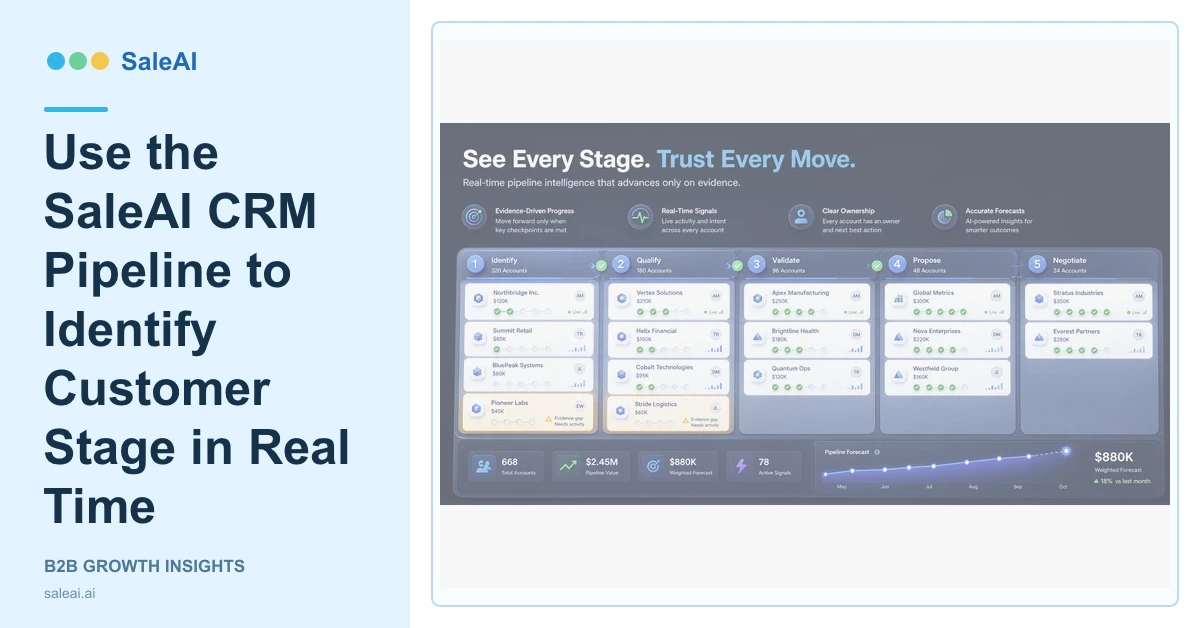
A customer record can contain dozens of messages and still fail to show whether the opportunity is progressing. The SaleAI CRM pipeline provides a visual view of where deals stand, while the surrounding CRM keeps contacts, company details, meeting notes, preferences, ownership, and next actions organized.
The SaleAI CRM page states that visual pipelines help teams see every deal in real time and forecast with more confidence. That promise depends on stage rules. If a salesperson moves a deal after sending a proposal rather than after the buyer begins evaluation, the pipeline displays seller activity as customer progress.
Define stages by customer evidence
Each stage should have an entry condition based on a customer action, decision, or verified situation. Stage names can vary, but the evidence must be visible.
| Pipeline stage | Useful entry evidence | Weak substitute |
|---|---|---|
| Qualified | Company, need, fit, and owner reviewed | Contact replied once |
| Discovery | Customer problem and stakeholders discussed | Introductory call booked |
| Evaluation | Buyer is testing or comparing an agreed scope | Proposal sent |
| Commercial review | Terms are under active buyer review | Discount requested internally |
| Decision | Approval path and timing are confirmed | Seller expects an order |
This evidence model keeps the SaleAI CRM pipeline useful for salespeople and managers. It also gives AI recommendations a better foundation because the current stage is tied to an observable event.
Organize the information behind the visual pipeline
The CRM page highlights centralized customer information, including contact details, notes, and preferences. The pipeline should link to that context rather than become a separate status board. A reviewer should be able to open the record and understand why the opportunity entered its stage.
Company and contact research from Enterprise Scope can clarify stakeholder roles. Data Assets can preserve the source and research context. Email Smart Reach can contribute campaign outcomes. A SaleAI Agent can support repeatable website and data tasks. CRM remains the place where customer ownership and the next commercial action stay visible.
Identify stalled customers without inventing progress
Real-time visibility is valuable when the pipeline also shows inactivity and missing evidence. A deal may remain commercially important while waiting for a test, budget cycle, or stakeholder. That should be recorded as a condition with an owner and review date.
A record becomes stale when the buyer evidence is old, the next action has no owner, or the stage survives only because nobody wants to close it. The system can recommend a next action, but the account owner should choose whether to advance, hold, nurture, research, or close.
Use the SaleAI CRM pipeline for forecasting
Forecasting should use stage evidence, customer timing, open risks, and confirmed next actions. It should not treat every opportunity in the same stage as equally likely. A buyer conducting an agreed test is different from an account that received a proposal and stopped responding.
Review the SaleAI CRM pipeline at two levels:
- Is the individual customer in the correct stage?
- Are the stage rules producing a trustworthy portfolio view?
The HubSpot lifecycle-stage documentation illustrates why shared stage definitions matter. The NIST data integrity guidance provides a broader reminder that information should remain accurate and consistent. A visually polished pipeline cannot compensate for unclear stage evidence.
A weekly pipeline review
Review opportunities that changed stage, stayed beyond the normal window, lost their next action, or depend on outdated evidence. Correct the record before using the pipeline for management decisions or forecasts.
FAQ
What is the SaleAI CRM pipeline used for?
It visually organizes customer and opportunity stages so teams can see progress, ownership, timing, and next actions.
Should sending a proposal move a deal forward?
Only if the stage definition is based on a buyer action that actually occurred. Seller output alone is weak evidence.
How does the pipeline connect with customer information?
The stage should link to the centralized contact, company, notes, preferences, interaction history, and owner record.
Can SaleAI recommend the next step?
The CRM product page says it can recommend next actions based on context and successful deal patterns.
What makes pipeline forecasting more reliable?
Clear entry evidence, current buyer timing, visible risks, assigned ownership, and reviewable next actions make forecasts more defensible.
