


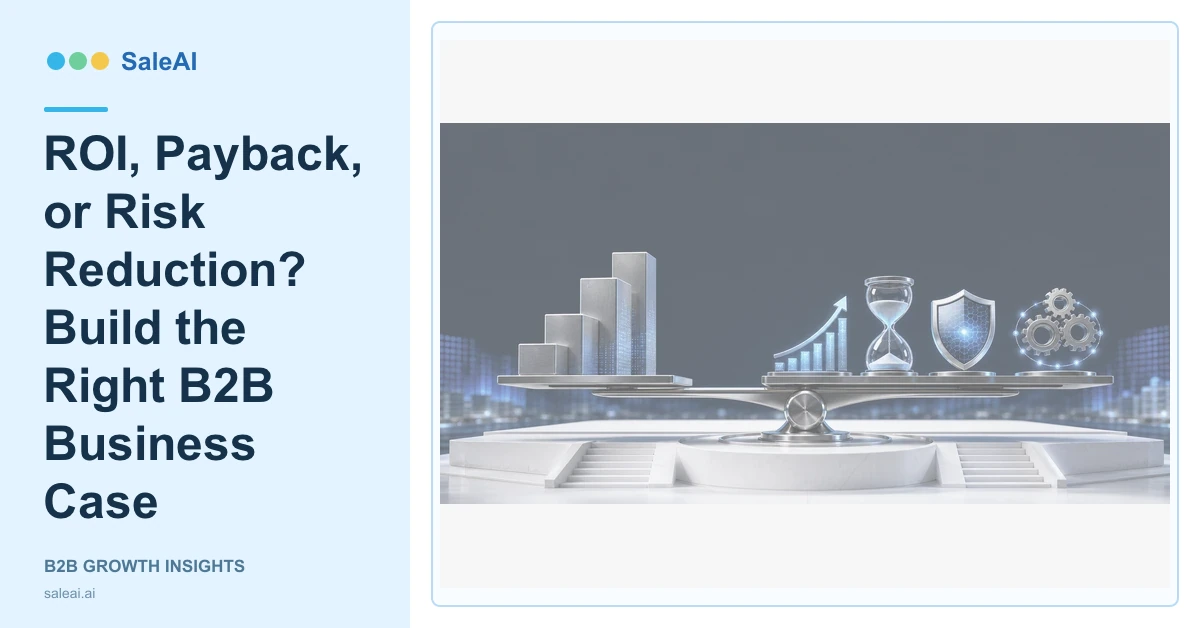
A B2B business case should help a buyer decide whether a change deserves resources and risk. It is not a seller-created spreadsheet that converts optimistic assumptions into a precise return.
The right value method depends on the buyer's decision. ROI may fit a broad investment comparison. Payback may matter when cash recovery is central. Risk reduction may be more relevant when one failure could interrupt production, compliance, or customer service.
Compare the value methods
| Method | Useful question | Main risk |
|---|---|---|
| ROI | How does total benefit compare with total cost? | Benefits and time horizon may be overstated |
| Payback | How quickly is the initial investment recovered? | Value after payback may be ignored |
| Cost avoidance | Which expected future costs can be reduced? | Avoided costs may never have occurred |
| Risk reduction | How does the change reduce likelihood or consequence? | Probability may be invented |
| Capacity value | What additional output or work becomes possible? | Demand and utilization may be assumed |
| Strategic value | Which capability or option becomes available? | Benefits may be too vague to review |
A buyer may use more than one method, but the model should not count the same benefit twice.
Build the baseline before the benefit
| Baseline element | Evidence to request |
|---|---|
| Current labor or process time | Observed workflow, sample period, or buyer estimate |
| Error, defect, or failure level | Operational record with scope and date |
| Current cost | Approved internal cost or defined calculation |
| Exposure | Event, consequence, and current control |
| Volume and frequency | Relevant period and expected change |
| Implementation cost | Product, service, integration, training, and buyer resources |
If the baseline is weak, use a range. A credible B2B business case makes uncertainty visible rather than hiding it inside one number.
Keep assumptions owned
Separate supplier inputs, buyer inputs, external benchmarks, and unknown values. Record who approved each assumption and when it should be refreshed.
The B2B value proposition guide helps connect product capability with a buyer outcome. When value is being tested, the pilot-to-commercial guide keeps technical results separate from commercial readiness.
An example with three valid views
A manufacturer is evaluating automated inspection equipment. Operations values lower defect escape. Finance focuses on payback. Quality leadership cares about recall exposure.
One model can show labor and scrap savings, a payback range, and a separate risk scenario. The buyer chooses which assumptions belong in the approval case. The supplier does not assign a financial value to reputation without buyer evidence.
Use SaleAI to preserve the model
SaleAI CRM can connect baseline data, assumptions, stakeholders, documents, revisions, and approval actions. SaleAI Agent can organize source inputs for review, while Data Assets can keep approved fields reusable.
Country Commercial Guides and WTO statistics may provide market context. They should not be used as substitutes for account-level operating data.
Review the decision, not only the math
Ask what threshold matters, who accepts the assumptions, what risk remains, and what evidence would change the conclusion. A B2B business case becomes buyer-owned when the relevant functions can challenge it and still use it.
Final takeaway
Choose the value method that matches the decision. Build from a visible baseline, show ranges, avoid double counting, and let the buyer own consequential assumptions.
Review SaleAI pricing when standardizing value and approval workflows.
FAQ
What belongs in a B2B business case?
It should include the decision, baseline, value method, costs, assumptions, evidence, ranges, risks, owners, and validation process.
Is ROI always the best method?
No. Payback, cost avoidance, risk reduction, capacity, or strategic value may better match the buyer's decision.
Who should approve the assumptions?
Buyer stakeholders responsible for operations, finance, risk, implementation, or the affected outcome should validate relevant inputs.
How should uncertainty be shown?
Use ranges, scenarios, source labels, confidence notes, and clear statements about missing data.
Can SaleAI calculate the final value?
SaleAI can organize data and formulas. Human owners should approve financial, operating, and risk assumptions.
